


Deep Dive Into "Digital Dollar Money Printer" Circle (CRCL): The Next Visa or an Overvalued Interest Business?



AI Podcast


Circle operates as the issuer of USDC, generating revenue primarily from reserve yields on short-term U.S. Treasuries. While facing headwinds from Federal Reserve rate cuts and rising distribution costs paid to key partners like Coinbase, the company is expanding beyond interest income by commercializing the Circle Payments Network and launching the Arc blockchain network. Regulatory clarity under upcoming legislation supports its compliance-first strategy, though new rivals like OUSD intensify channel competition. Wall Street remains deeply divided on whether Circle can successfully transform into a global digital dollar payment infrastructure or remain an interest-dependent business.
Deep Dive into "Digital Dollar Money Printer" Circle (CRCL): The Next Visa, or an Overvalued Interest Business?
Soaring from its $31 IPO price to nearly $300, only to fall back near $50, Circle has ridden a full capital markets roller coaster in its first year since going public.
As of August 12, 2026, its stock price rebounded to $71.28, still down over 75% from its all-time high, yet still more than double its IPO price.
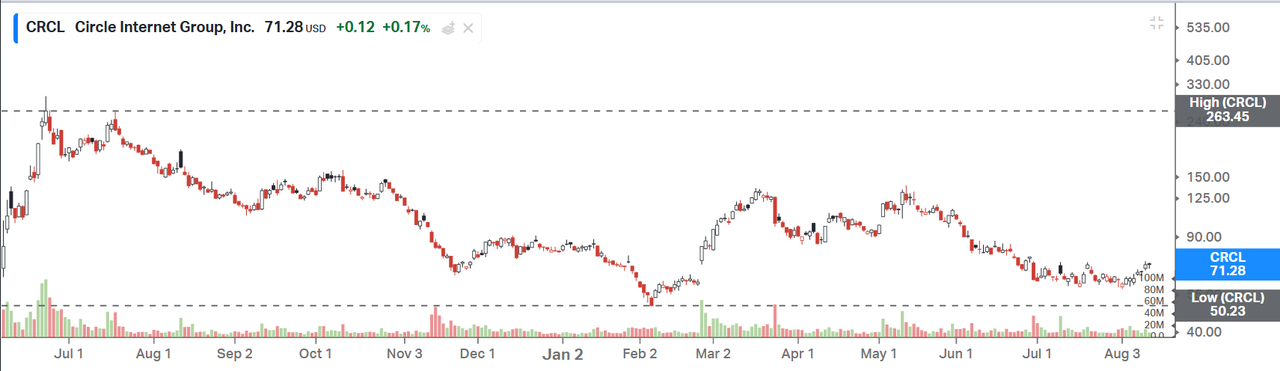
Source: Koyfin
This back-and-forth K-line chart repeatedly asks the exact same question: What kind of business is Circle, really?
Circle is the issuer of USDC, the world's second-largest US dollar stablecoin. USDC is essentially the US dollar moved onto the blockchain: pegged 1:1 to the USD, it allows funds to remain on-chain while avoiding crypto asset price volatility, available 24/7 for digital asset trading, cross-border payments, collateralized lending, or parking cash. The advantage of USDC is that transfers are not restricted by bank operating hours and can flow seamlessly across multiple exchanges, wallets, and blockchains.
For every USDC issued, Circle backs it with one US dollar in cash, short-term US Treasuries, or overnight repurchase agreements (repos), earning returns on these reserve assets.
The model is almost brutally simple: users provide the funds, the reserves generate interest, and Circle shares the revenue with its distribution partners.
However, Circle's ambitions go far beyond this. It is building a payment network that uses stablecoins for cross-border settlement and launching a dedicated blockchain for payments, foreign exchange, and asset trading. Put simply, Circle wants to evolve from an issuer of digital dollars into the operator of the entire digital dollar circulation network.
Yet, just as Circle expands outward, its core business has encountered both Fed rate cuts and a cooling crypto market.
The new round of rate cuts initiated in September 2025 has already dragged down Circle's reserve yields, though short-term pressure has temporarily stabilized. According to CME FedWatch data as of August 11, the market assigns a 51.5% probability that the Fed will maintain the target rate at 3.50%–3.75% in September, a 48.5% probability of a 25-basis-point rate hike, and a near-zero probability of further rate cuts.
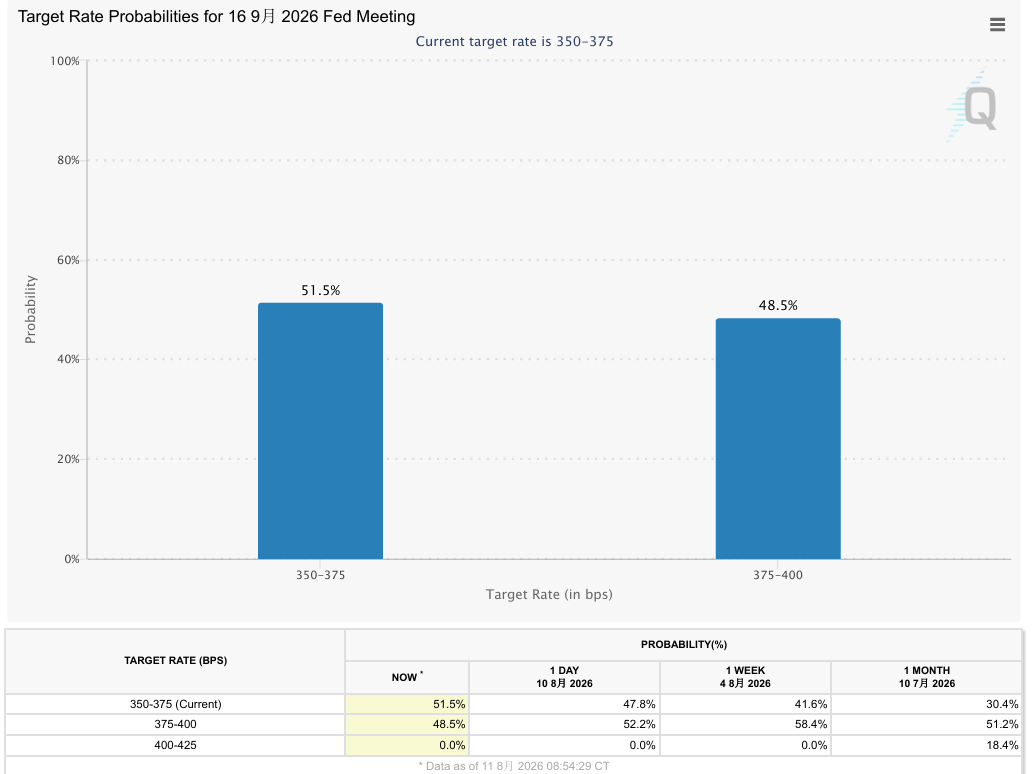
Chart: Market pricing for holding rates steady versus a 25 bps hike in September is nearly a 50/50 split. Source: CME FedWatch, as of August 11, 2026.
On the other hand, while the crypto market continued to decline, stablecoins saw a much smaller drop. In Q1 2026, total crypto market capitalization dropped 20.4%, yet total stablecoin supply grew 0.5%, with USDC growing 2.4%. In Q2 2026, total crypto market capitalization fell 12.6% quarter-over-quarter to $2.1 trillion, while total stablecoin supply dropped only 1.6% to $305.1 billion.
After investors sell volatile assets like Bitcoin, funds may still stay in stablecoins for payments, settlement, or awaiting the next trade. However, USDC shrank 4.8% quarter-over-quarter to $73.5 billion, underperforming the broader stablecoin market; over the same period, USDT remained largely flat, with its market share rising to 60%.
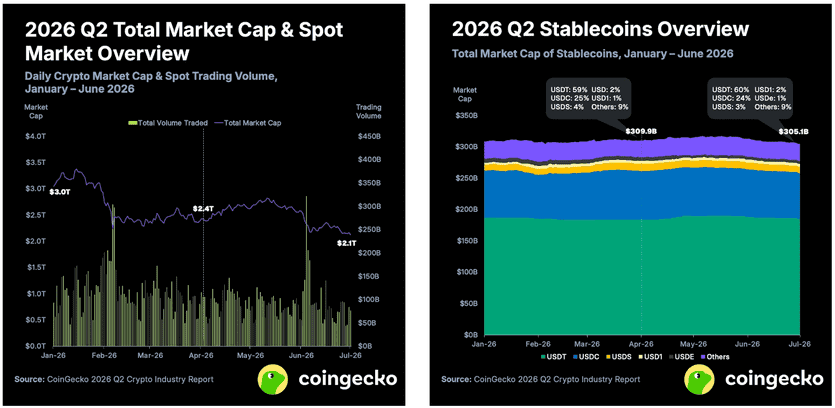
Source: CoinGecko
Will Circle ultimately remain an interest-driven business tied to interest rates, or grow into the payment network of the digital dollar era?
Next, let's dismantle this "digital dollar money printer" to see if its foundation is solid and assess the odds of its "next Visa" narrative succeeding.
I. Dismantling the "Digital Dollar Money Printer"—How Does Circle Actually Make Money?
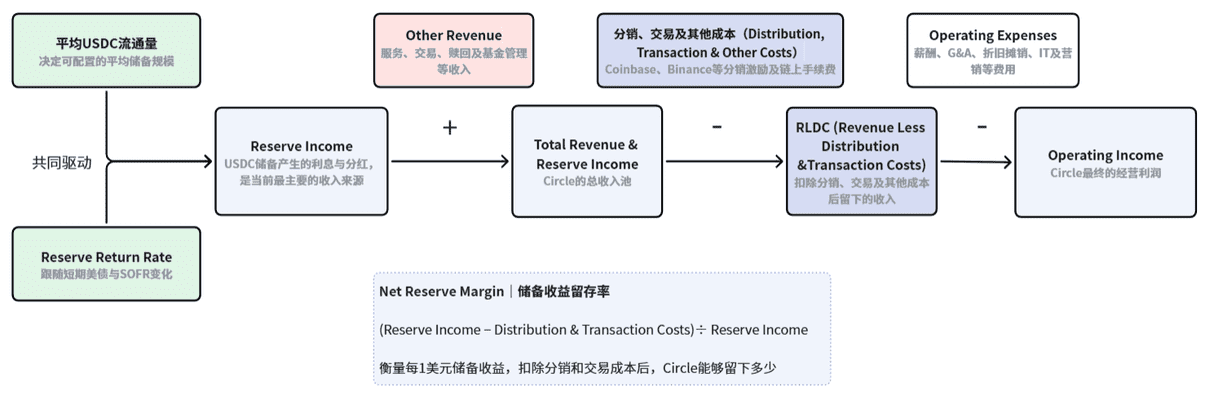
Circle's monetization model can be condensed into four variables:
Average USDC in Circulation, Reserve Return Rate, Net Reserve Margin, and Other Revenue.
The first two determine the size of reserve revenue, the third determines how much Circle keeps, and the last determines whether the company can cultivate a second growth curve.
2Q25 | 3Q25 | 4Q25 | 1Q26 | 2Q26 | |||
Stablecoin Circulation ($ in billions) | 2,190 | 2,543 | 2,688 | 2,752 | 2,714 | ||
QoQ growth rate (%) | 16% | 6% | 2% | -1% | |||
USDC in Circulation ($ in billions) | 613 | 737 | 753 | 770 | 733 | Company Target: 40% USDC CAGR | |
QoQ growth rate (%) | 20% | 2% | 2% | -5% | |||
USDC Market Share | 28% | 29% | 28% | 28% | 27% | ||
Reserve Return Rate | 4.10% | 4.20% | 3.80% | 3.50% | 3.50% | ||
Net Reserve Margin | 36% | 37% | 37% | 38% | 39% | ||
Other Revenue ($ in millions) | 24 | 29 | 37 | 42 | 34 | ||
QoQ growth rate (%) | 20% | 29% | 13% | -19% | |||
Source: Circle
USDC Circulation: Market Size Defines Space, Market Share Determines Winners
Every USDC is backed by one US dollar in reserve assets. The higher the average circulation, the more funds Circle can allocate to short-term US Treasuries, overnight repos, and cash, thereby expanding the principal generating reserve revenue.
USDC circulation depends on total stablecoin market size and USDC market share. Cross-border payments, corporate treasury management, and on-chain settlement dictate how large the industry can grow, while competition between USDC, USDT, bank-issued stablecoins, and other newcomers determines how much of that pie Circle can capture.
Reserve Return Rate: The Fed Directly Controls the Revenue Tap
The Reserve Return Rate is the average yield generated by USDC reserve assets. Since reserves are primarily invested in short-term US Treasuries, overnight Treasury repos, and bank cash, this metric closely tracks changes in short-term Treasury yields and SOFR.
Because reserve maturities are very short, Fed policy rate changes quickly translate into Circle's revenue. When yields fall, USDC circulation must grow faster to fill the gap; analyzing Circle requires both counting the USDC in circulation and monitoring how much interest each dollar earns.
Net Reserve Margin: Earned Revenue Must First Be Shared with Distribution Channels
USDC relies on exchanges, wallets, banks, and payment platforms to reach end users. Partners like Coinbase and Binance provide traffic, fiat gateways, and trading depth, while receiving distribution incentives and revenue sharing from Circle in return.
Net Reserve Margin calculates the final percentage of reserve revenue Circle retains after deducting related distribution costs.
Other Revenue: Is a Second Growth Curve Emerging?
Other Revenue includes subscription and service fees, transaction fees, fund management fees, redemption fees, and infrastructure usage fees. It primarily grows with customer count, payment volume, and product usage, exhibiting lower dependency on US Treasury yields.
While this revenue segment remains small today, it serves as a critical indicator testing whether new businesses like CPN and Arc can monetize independently, ultimately deciding if Circle can evolve into a true financial infrastructure enterprise.
II. Licenses Are Just Admission Tickets: USDC's True Moat Is a Financial Network
The stablecoin table is rapidly crowding. Banks want to issue their own tokens, exchanges back proprietary assets, and payment giants eye digital dollar gateways. With deep-pocketed rivals emerging, why can Circle still sit at the center of the table?
The answer lies in the regulatory compliance footprint and liquidity network that USDC has already built.
1. Regulatory Compliance: Why Do Banks Dare to Use USDC?
Before adopting a stablecoin, banks must ensure that reserves are safe, redeemable at any time, and compliant with anti-money laundering (AML) and local regulatory requirements. Circle holds its reserves primarily in cash, short-term Treasuries, and overnight repos, enlisting traditional financial giants for management and custody: BlackRock manages the Circle Reserve Fund, while BNY serves as the primary custodian.
Circle also holds a New York BitLicense, USDC and EURC comply with the EU's MiCA framework, and in July 2026, Circle received final approval from the OCC to establish a national trust bank operating under the name Circle National Trust. Comprehensive licensing enables USDC to pass risk management reviews by banks and large enterprises more swiftly.
2. Redemption and Liquidity: Why Is USDC So Usable?
Whether a stablecoin is easy to use hinges on three things: whether it can be redeemed for USD at any time, whether it can execute large transactions, and whether it can flow freely across different platforms and blockchains.
Circle Mint (Circle's official USDC minting and redemption channel) offers 1:1 conversion between USDC and USD; exchanges, wallets, and DeFi protocols provide trading depth; and CCTP (Cross-Chain Transfer Protocol) enables USDC to flow across different blockchains. Bank gateways, on-chain liquidity, and cross-chain capabilities are thus linked together.
The more platforms that support USDC, the easier it is for funds to move in and out, making users and applications more willing to adopt it. If competing stablecoin issuers want to grab market share, they must simultaneously match bank accounts, redemption channels, trading depth, multi-chain support, and application coverage.
This liquidity network constitutes a moat for USDC that is far harder to replicate. However, many key gateways remain controlled by third-party platforms, the most influential of which is Coinbase.
III. Coinbase: The Most Vital Ally, and the Most Expensive Partner
Coinbase deserves substantial credit for USDC reaching its current scale.
Coinbase is one of the largest publicly traded crypto asset trading platforms in the US, providing digital asset trading, custody, and USD conversion services to users. It commands a massive user base and crucial fiat gateways.
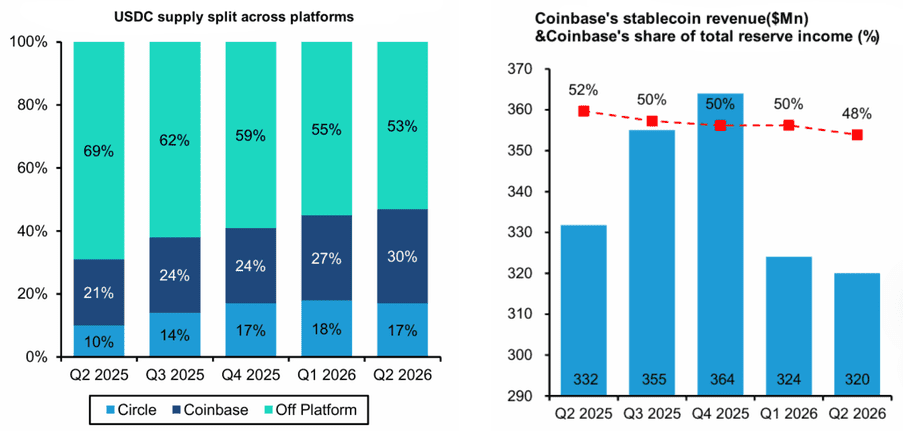
Under their commercial agreement, Coinbase earns income based on USDC balances held on its platform, and the two parties also share a portion of reserve revenue generated from the external ecosystem. The more USDC accumulated on Coinbase, the higher the revenue share Circle typically pays out to Coinbase.
At the end of Q2 2026, approximately 30% of USDC in circulation was held on Coinbase. Coinbase recorded $320 million in stablecoin revenue during the same period, equivalent to 48% of Circle's quarterly reserve revenue, underscoring its immense channel bargaining power.
Data Source: Circle
Facing an increasingly expensive bill from Coinbase, Circle is also building its own institutional gateway: Circle Mint.
Circle Mint can be understood as USDC's direct-to-institutional channel. Eligible corporate clients can link bank accounts to directly mint or redeem USDC at a 1:1 ratio with Circle and manage funds via APIs, bypassing trading exchanges entirely.
As Circle Mint, banking partnerships, and CPN expand, more USDC can enter the market through direct channels, gradually reducing Circle's reliance on any single platform.
IV. Beyond Interest, Circle Wants to Monetize Two More Times
Coinbase highlights the vulnerability in Circle's business model: larger USDC balances lead to higher reserve revenue, but also increase the share of profits taken by distribution channels.
So, can Circle generate additional revenue from the flow of USDC, beyond reserve interest?
That is where CPN and Arc come in.
CPN: Turning Cross-Border Payments into a Network Business
CPN (Circle Payments Network) is a cross-border payment network connecting banks and payment institutions.
Take a US-to-Philippines remittance as an example: the US sender provides USD, which the originating financial institution converts into USDC; the USDC travels via blockchain to the Philippines, where the receiving institution converts it into pesos and deposits it into the recipient's bank account.
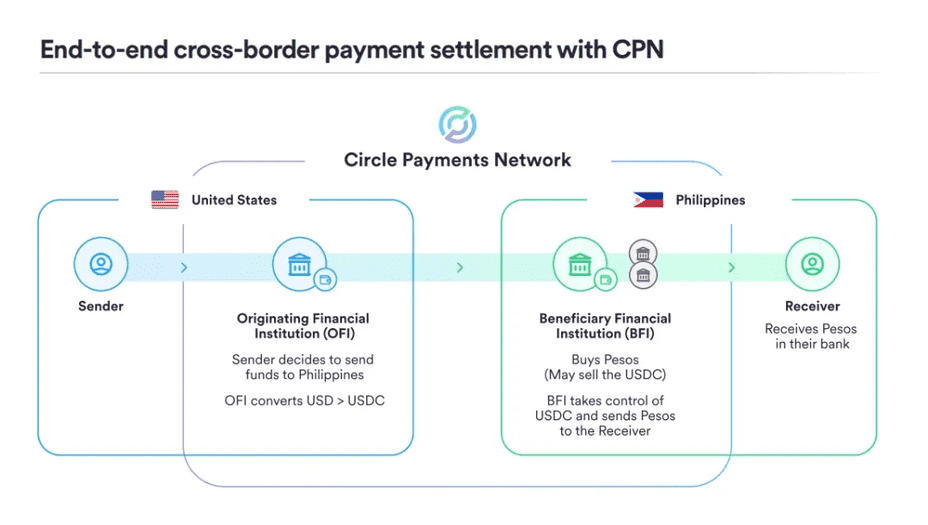
Throughout this process, Circle does not directly touch client funds. It sets network rules, connects institutions on both ends, matches quotes, transmits compliance information, and coordinates settlement.
Traditional cross-border wire transfers often require multiple correspondent banks and are constrained by business hours, batch clearing, and pre-funded foreign accounts. CPN enables 24/7 on-chain settlement with USDC, allowing payment providers to connect to partners across multiple countries via a single system, resulting in faster settlements and lower capital tie-up.
Circle plans to monetize across two layers:
- Charge CPN network fees based on payment volume;
- Increased settlement activity boosts USDC usage and retention, further expanding reserve revenue.
As of the end of Q2 2026, 175 financial institutions have joined CPN, with annualized payment volume reaching $23 billion, a 130% increase from the previous earnings disclosure. Circle plans to begin commercialization in the second half of 2026. Once the fee structure takes effect, CPN's payment volume will begin translating into recurring revenue, adding a revenue stream for Circle with lower correlation to US Treasury yields.
Arc: Settling USDC on Circle's Own Network
While CPN solves how banks and payment institutions connect, every USDC transfer still requires a underlying blockchain to record and confirm transactions.
Currently, CPN can settle using public blockchains like Ethereum and Solana. After CPN commercializes, Circle can collect network fees, but underlying transaction gas fees must be paid to these public blockchains; transaction speed, costs, and privacy features are also determined by external networks.
Consequently, Circle developed its own Layer 1 blockchain, Arc, aiming to process transactions generated by CPN as well as payments, foreign exchange, and asset tokenization. Arc offers sub-second confirmation times, USD-denominated transaction fees, and configurable privacy, catering more closely to the needs of banks and large enterprises.
If more payments and assets move onto Arc, Circle will have the opportunity to capture value from on-chain fee collections and the ARC Token ecosystem, while simultaneously expanding demand for USDC usage.
The real countdown has begun: Arc's public mainnet is scheduled to launch on September 16, 2026.
Prior to the Q2 earnings release, the Arc testnet had processed approximately 500 million transactions across about 3 million wallets; initial validators include BlackRock, DTCC, Visa, and Standard Chartered. Once banks, payment processors, and tokenized assets start running on Arc, Circle will control not just USDC issuance, but also payment connectivity and underlying settlement, extending its business model from stablecoin issuance to a full-stack financial network.
V. Rules Are Finally Clear, and Circle Faces More Rivals
The US is filling in the "operating manual" for the digital asset industry through two key pieces of legislation. The GENIUS Act dictates how US dollar stablecoins should be issued, while the CLARITY Act clarifies regulatory jurisdiction over tokens, trading platforms, and on-chain financial activities.
For Circle, the establishment of clear rules validates the compliance-first strategy it has pursued for years; for banks, payment providers, and tech platforms, entering the stablecoin market finally offers a clear playbook to follow.
- The GENIUS Act governs stablecoin issuance. The bill requires issuers to hold 1:1 liquid reserves, disclose assets monthly, and enforce AML requirements. Signed in July 2025, it will take effect no later than January 18, 2027. Circle's compliance investments over the past decade align closely with these requirements, giving USDC a head start.
- The CLARITY Act governs digital asset markets. It attempts to delineate the regulatory boundaries between the SEC and the CFTC, establishing rules for tokens, trading platforms, and on-chain financial activities. This directly impacts whether Arc can host payments, securities, and other institutional businesses. The bill has passed the House of Representatives and awaits Senate action.
OUSD: Competing for Exchanges and Payment Platforms with Higher Revenue Shares
OUSD is a US dollar stablecoin introduced by the Open Standard initiative. Institutions including Visa, Stripe, BlackRock, BNY, and Coinbase appear on its participant list.
Its biggest distinction from USDC lies in revenue sharing. OUSD plans to deduct a small management fee and return the vast majority of reserve yields to distribution platforms: whoever brings in more users and balances receives a larger share of returns.
This mechanism directly targets Circle's most sensitive channel relationships. While USDC relies on platforms like Coinbase to scale, it must pay hefty revenue shares in return; OUSD uses higher yield incentives to compete for the exact same pool of exchanges, wallets, and payment platforms. Visa's new stablecoin platform will also be among the first to support OUSD, granting it an institutional gateway.
Of course, being on the participant list does not mean exclusive cooperation. Circle noted that approximately 70% of OUSD participants are also part of the USDC ecosystem; moreover, OUSD currently lacks the trading depth, redemption scale, and application coverage that USDC has accumulated.
However, OUSD's impact may materialize before its market share does. If exchanges and payment platforms leverage OUSD's yield model as bargaining power to demand higher payouts from Circle, Circle will face even heavier channel cost pressures.
VI. $37 or $243? Wall Street Is Deeply Divided
How controversial is Circle really?
On August 6, following Circle's Q2 earnings release, Morgan Stanley issued an Underweight rating with a $37 price target, whereas Citi maintained a Buy rating with a $243 price target. For the exact same earnings report, two investment banks offered target prices differing by more than sixfold.
The core debate is clear: Will Circle remain a business dependent on USDC balances and US Treasury yields, or evolve into the payment and settlement network of the digital dollar era?
Bear Thesis: Current Profits Cannot Support a Platform Valuation
Bears' skepticism centers on three main areas:
- The core business is losing momentum. At the end of Q2, USDC in circulation dropped to $73.3 billion, returning to levels near Q3 2025; reserve revenue still accounted for about 95% of Circle's total revenue, and Other Revenue fell short of expectations. Circle previously projected a long-term CAGR of 40% for USDC circulation, but performance over recent quarters has hovered near stagnation.
- Defending market share could become increasingly expensive. Platforms like Coinbase control end users and liquidity, forcing Circle to yield channel revenue share in exchange for USDC volume. The entry of OUSD, which focuses on returning reserve yields to distributors, may further elevate distributors' bargaining power. Even if USDC growth resumes, Circle's retained profit may not grow in tandem.
- Monetization prospects for CPN and Arc remain uncertain. CPN is entering commercialization, but whether payment volume can smoothly translate into revenue remains unproven; Arc must compete with mature networks like Ethereum and Solana for assets and developers. Although $180 million in Arc Token presale revenue is expected to be recognized in 2H 2026, the midpoint of Other Revenue guidance was raised by only about $160 million, implying that after stripping out the Arc Token contribution, revenue expectations for other businesses actually decreased.
Bull Thesis: CPN and Arc Unlock New Revenue Potential
Citi is betting on a transformation in Circle's revenue structure.
USDC commands over $70 billion in circulation, CPN's annualized payment volume has reached $23 billion, and Arc's public mainnet is set to launch on September 16. If CPN begins charging network fees and Arc attracts payment and financial assets, Circle can add payment and underlying network revenue on top of its reserve interest.
Citi's $243 target price rests on an aggressive set of assumptions: USDC maintaining a 40% CAGR over the next five years, and CPN processing $300 billion in payments by 2031 while progressively contributing recurring revenue.
This implies that $243 already bakes in the full best-case scenario of USDC resuming high growth, CPN monetizing smoothly, and Arc launching successfully.
Our Take: Broadly Optimistic Direction, but Execution Is Still Early Stage
Circle already possesses regulatory licenses, global liquidity, banking access, and institutional partnerships—foundations that are difficult to replicate in the short term. USDC also provides the company with cash flow to continue investing in CPN and Arc.
However, around 95% of its revenue still comes from reserves today. Going forward, three outcomes need to materialize:
- USDC resumes growth while defending its market share;
- CPN discloses actual take rates and generates recurring revenue;
- Arc attracts real-world assets, with related earnings flowing onto Circle's income statement.
Until these three outcomes occur, $243 remains a bull-case scenario; what Circle ultimately needs to prove is whether it can transform USDC from a US dollar stablecoin into the core infrastructure for US dollar circulation across the global digital economy.
This content was translated using AI and reviewed for clarity. It is for informational purposes only.
Recommended Articles











Comments (0)
Click the $ button, enter the symbol, and select to link a stock, ETF, or other ticker.