


AMD Earnings Preview: Can AI Chip Revenue and Helios Orders Push Stock Above $600?



AI Podcast


AMD will report fiscal second-quarter 2026 results after the market close on August 4, Eastern Time. Analysts expect revenue of $11.3 billion and adjusted EPS of $1.61. Key focal points include the acceleration of AI chip revenue, specifically MI350 shipments, and quantifiable orders for the new Helios rack-scale systems. Additionally, performance in the high-margin EPYC server CPU segment remains critical to diversifying growth. While the stock has seen a recent pullback, strong earnings guidance and clear data center momentum are essential to drive a valuation re-rating toward $580+ or to mitigate downside risk below $450.

TradingKey - AMD ( AMD) will release its fiscal second-quarter 2026 financial results after the U.S. market close on August 4, Eastern Time. The latest stock price stands at $476.15, having recently pulled back about 12% from its June high, but still up more than 100% year-to-date.
In terms of market expectations, the market currently expects AMD's second-quarter revenue to be approximately $11.3 billion to $11.34 billion, representing year-on-year growth of about 47% to 48%; adjusted earnings per share is expected to be around $1.61, more than tripling from the same period last year. For investors, the company previously provided a second-quarter revenue guidance of $11.2 billion, plus or minus $300 million. Investors need to watch whether the performance can reach the upper limit of the guidance, and whether management can further raise its outlook for the AI and data center businesses in the second half of the year.
Can AI Chip Revenue Accelerate?
The most critical focus of this earnings report is the AI chip business, where attention needs to be paid to whether this segment can enter a more pronounced stage of revenue acceleration.
AMD's first-quarter data center business revenue reached $5.8 billion, up 57% year-over-year, becoming the main driver of the company's revenue and earnings growth. CEO Lisa Su previously stated that demand for AI infrastructure is accelerating, with inference and agentic AI driving customers to increase purchases of high-performance CPUs and AI accelerators. The company expects server business growth to accelerate further following supply expansion.
Investors need to focus closely on the shipments of the MI350 series. In the previous earnings report, AMD had already indicated that the MI350 had entered the volume ramp-up stage; if AI GPU revenue this quarter is significantly higher than expected and management further raises its 2026 AI chip revenue target, the market may perceive that AMD is truly narrowing the gap with Nvidia.
However, simply emphasizing strong demand may no longer be enough to drive the stock price higher. During the same period last year, AMD suffered a post-market decline because its data center revenue only met market expectations and failed to significantly beat estimates. AMD's current stock price has already priced in strong AI growth expectations; therefore, this earnings report needs to deliver clearer AI GPU revenue figures, customer deployment scales, and next-quarter growth guidance.
For the stock price, if data center revenue significantly exceeds market expectations and management confirms that demand for the MI350 and subsequent products continues to accelerate, AMD may see a valuation re-rating; if the data center business only meets expectations, even if overall revenue beats, the stock price may still come under pressure due to concerns that 'AI growth is not fast enough'.
Can Helios Convert Product Story Into Actual Orders?
The second focus of this earnings report is whether AMD's newly launched Helios rack-scale AI system can begin to generate quantifiable orders and revenue.
At the Advancing AI 2026 event held in July, AMD announced that Helios has entered full production and is expected to start shipping by the end of the third quarter. Lisa Su stated that customer demand for Helios is "extremely strong," with OpenAI planning to begin adoption later this year and Microsoft deploying the systems in Azure.
Meanwhile, AMD also announced a strategic partnership with Anthropic to deploy up to 2 gigawatts of MI450 series GPUs; Meta, OpenAI, Microsoft, and other large customers are also expanding their use of AMD's AI platform. These collaborations demonstrate that AMD is transitioning from a single-chip supplier into an AI infrastructure provider capable of offering GPUs, CPUs, networking, software, and complete rack solutions.
For the market, there are three key points to focus on: how many firm orders Helios has already secured; how much revenue can be recognized in the third and fourth quarters; and whether the profit margins of these systems are higher than those of traditional GPU sales.
If AMD can announce clear Helios delivery schedules and order sizes on the conference call, the market may further raise its AI revenue expectations for the second half of 2026 and 2027; conversely, if management only emphasizes customer interest without providing a timeline for revenue realization, the earnings report's boost to the stock price may be limited.
Bank of America believes that AMD has transitioned from a general GPU supplier to a full-stack, rack-scale AI system provider, raising its price target to $620. Jefferies, meanwhile, raised its price target to $640, believing that AMD's recent customer progress in the AI and server markets has improved its future revenue visibility.
Can EPYC Server CPUs Continue to Drive High Profit Growth?
In addition to AI GPUs, the server CPU business is also a key highlight of this earnings report.
AMD saw strong demand for server CPUs in the first quarter. The company raised its 2030 server CPU market size forecast to $120 billion and expects the market's compound annual growth rate to exceed 35% over the next few years.
UBS raised its price target for AMD in a recent report, with the profitability of the server CPU business being one of the core reasons. The firm believes that AMD's server CPU gross margin could be about 10 percentage points higher than the company's overall average, and expects related revenue to continue to grow substantially in 2027 and 2028.
Therefore, in this earnings report, investors need to focus on EPYC revenue growth, orders for the next-generation Venice processors, and whether Microsoft, Meta, and cloud customers continue to expand adoption. If server CPU revenue maintains rapid growth, it will help improve the company's overall product mix and gross margin, and also alleviate market concerns about AMD's over-reliance on AI GPUs.
If the EPYC business beats expectations, AMD's stock price may still receive some support even if AI GPU revenue only meets expectations. However, if both server CPUs and AI GPUs fall short of high expectations, the market may swiftly downgrade AMD's future earnings forecasts.
AMD Stock Price Forecast
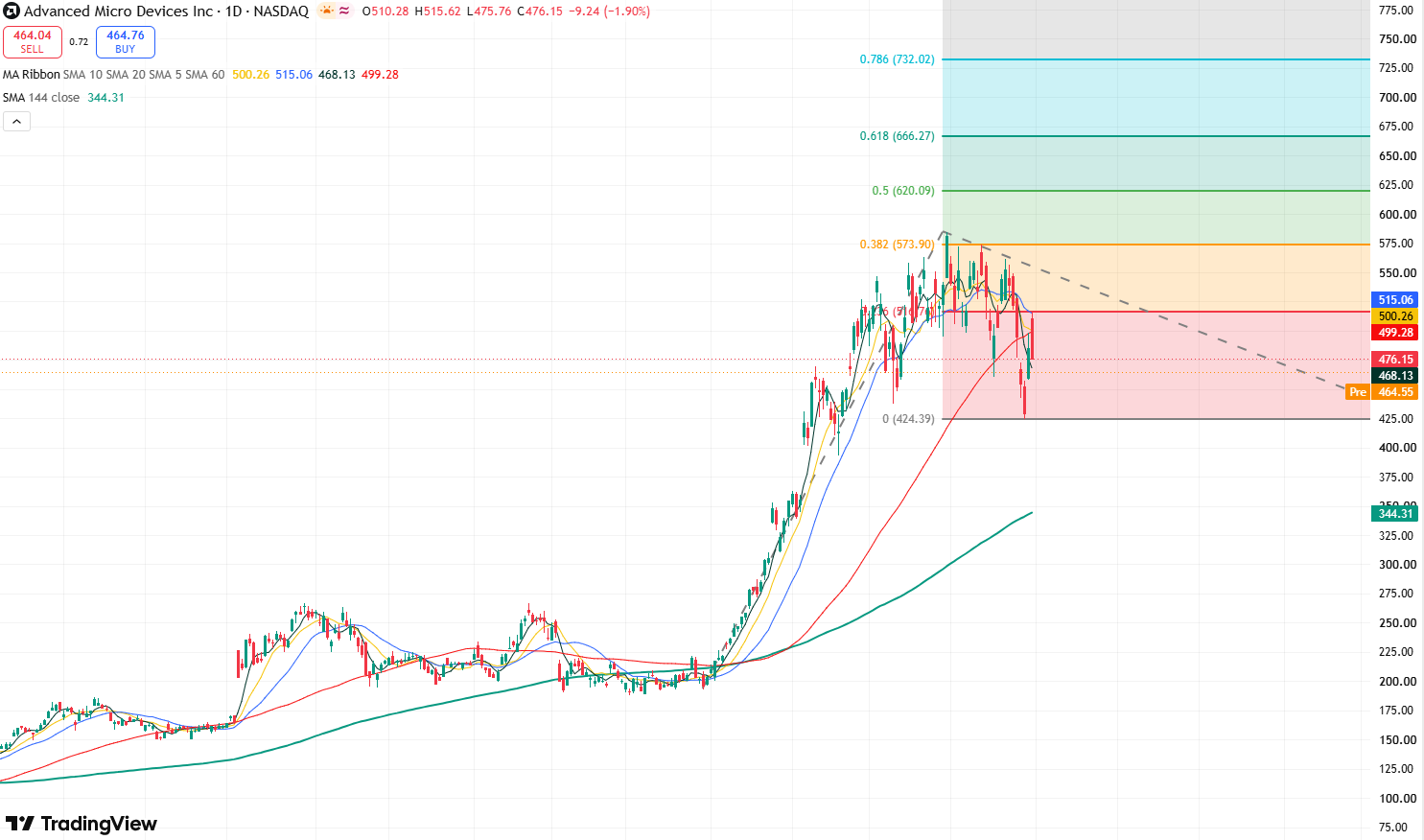
AMD daily stock price chart, source: TradingView
Under an optimistic scenario, if AMD's revenue and EPS both beat expectations, data center revenue accelerates significantly, Helios secures clear large-scale orders, and management raises its second-half AI revenue outlook, the stock price is expected to end its recent correction and rebound toward the $520–$530 range; if strong expectations for 2027 customer deployments are further released, the stock price could retest its all-time high of $584.73, with potential to break above $600.
Under a neutral scenario, if overall revenue meets expectations and data center growth remains rapid, but Helios revenue still needs to wait until the end of the third quarter to materialize, AMD's stock price may fluctuate within the $450–$500 range. The market will continue to wait for actual delivery data in the next quarter.
Under a pessimistic scenario, if data center revenue falls short of expectations, gross margin falls below 56%, or management fails to raise its second-half AI guidance, the stock price could fall below $450, and may even slide further below its recent low of $424.03, moving down to fill the previous gap of $355–$400.
This content was translated using AI and reviewed for clarity. It is for informational purposes only.
Recommended Articles










Comments (0)
Click the $ button, enter the symbol, and select to link a stock, ETF, or other ticker.