


Apple Market Cap Tops $5 Trillion After 25% Rally: Can AI Strategy Support Further Gains?



AI Podcast


Apple reached a $5 trillion market capitalization on July 28 Eastern Time, reclaiming its position as the world's most valuable company. Unlike cloud-heavy peers, Apple’s capital-light AI strategy—prioritizing on-device features and leveraging existing hardware ecosystems—has shielded it from mounting infrastructure costs. While its stable cash flows and services revenue support long-term growth, the current 41x P/E ratio reflects high market expectations. Future performance depends on whether Apple Intelligence and an upgraded Siri can successfully catalyze hardware upgrade cycles and sustain profitability within its 2.5 billion active device base.

TradingKey - Apple ( AAPL) has achieved another capital market milestone.
On Tuesday (July 28) Eastern Time, Apple's stock price hit an intraday high of $342.89, briefly pushing its market capitalization to approximately $5.04 trillion, while its stock has gained 25% year-to-date. Apple has thus become the second publicly listed company globally to surpass a $5 trillion market cap, following Nvidia ( NVDA ). Just a day earlier, Apple's market capitalization had just surpassed Nvidia's, reclaiming its crown as the world's most valuable company.
Unlike Google ( GOOGL ), Microsoft ( MSFT ), Meta ( META) and Amazon ( AMZN ), which have invested heavily in building AI data centers, Apple has maintained relatively restrained capital expenditures, relying more on partners like Google to provide cloud computing and AI capabilities. As the market begins to worry about overly rapid investment in AI infrastructure, deteriorating cash flows, and unclear paths to profitability, Apple's capital-light model has instead become an advantage.
However, after its market value hit a record high, investors' focus has shifted from whether Apple can break through the $5 trillion mark to whether this valuation can be sustained in the long term.
Why Apple’s Market Cap Could Break $5 Trillion
Apple's market capitalization breaking through the $5 trillion mark was primarily driven by shifts in market risk appetite.
Over the past few years, investors once believed that Apple lagged behind Microsoft, Google, and OpenAI in the generative AI space. Due to repeated delays of the upgraded Siri, Apple's stock performance had also underperformed other AI plays.
Recently, market sentiment has shifted. Google, Microsoft, Meta, and Amazon have continually ramped up their AI capital expenditures, with some even facing negative free cash flow and rising debt. Investors have begun to reassess whether purchasing chips at scale and building data centers can yield corresponding returns.
Apple did not directly participate in the heavy AI infrastructure race, opting instead for a hybrid model combining in-house chips, on-device AI, and external cloud services. This has allowed the company to develop AI features while avoiding the same scale of capital expenditures as cloud computing giants.
Apple's stable hardware demand has also supported its stock price. Despite the global smartphone market entering a mature phase, the iPhone still commands high user loyalty and profitability, while the Mac, iPad, Apple Watch, and AirPods further flesh out the Apple ecosystem, raising platform-switching costs for users.
Meanwhile, the Services business has become another key pillar for Apple. Offerings such as the App Store, iCloud, Apple Music, Apple Pay, and Apple TV command high gross margins and generate recurring revenue.
Apple's official data shows that its Services business's annual revenue has topped $100 billion, and its active installed base of devices has exceeded 2.5 billion, providing a massive user base for the long-term growth of services revenue.
Continuous share repurchases have also boosted earnings per share. Even as the company's overall profit growth stabilizes, the shrinking number of outstanding shares continues to support EPS and Apple's stock price.
Apple has also introduced the "Apple Upgrade" leasing program powered by Klarna. U.S. consumers can lease an iPhone starting at $17.99 per month, with the option to upgrade, buy out, or return the device at the end of the lease term. This model lowers the psychological barrier for consumers facing high price tags, while helping to shorten upgrade cycles and boost user retention.
How AI Is Driving Apple’s Growth
Apple's AI strategy differs significantly from those of cloud computing giants. Rather than focusing on training the largest foundation models, the company is aiming to integrate AI directly into the operating systems and user scenarios of the iPhone, Mac, and iPad.
Apple Intelligence covers features such as Siri, writing tools, mail summaries, photo editing, and system automation. Powered by its proprietary A-series and M-series chips, some AI tasks can be processed directly on-device, thereby reducing cloud computing costs and reinforcing the privacy protections Apple has long championed.
An upgraded Siri is key to Apple's AI strategy. Apple is leveraging external models and cloud computing partners to refine these capabilities, which are expected to roll out further this autumn alongside the new iPhones.
If the new Siri can significantly improve voice interaction, app control, and agent functionalities, the market's perception of Apple as an "AI laggard" may shift further.
The greatest commercial value of AI for Apple remains driving hardware upgrades. An increasing number of on-device AI features require more powerful chips, larger memory, and newer operating systems, which older devices may not fully support. This will create fresh upgrade demand for iPhones, Macs, and iPads.
Meanwhile, developers can launch more AI applications centered around Apple devices, giving Apple the opportunity to generate revenue share through App Store subscriptions, cloud storage, and value-added services.
Apple's advantage is that it does not need to rely solely on direct monetization of AI features. As long as AI enhances device appeal, extends user retention, and drives upgrades, the company can simultaneously generate returns across hardware, services, and its broader ecosystem.
This low-capex AI model is also a key reason why Apple's stock price has recently outperformed other tech giants. Apple does not need to prove that hundreds of billions of dollars in data center investments can turn a quick profit; it only needs to show that AI can enhance the value of its 2.5 billion active devices.
Can Apple Stock Keep Rising After Surpassing $5 Trillion Market Cap?
Apple's share price still has a foundation for further gains, but a $5 trillion market capitalization also means the market has already priced in very high expectations.
On the positive side, Apple possesses stable cash flows, a world-leading consumer electronics brand, a massive high-value user base, and steadily growing services revenue. The new version of Siri, Apple Intelligence, device leasing programs, and a new iPhone upgrade cycle could all drive further growth in revenue and profits.
However, Apple's P/E ratio of approximately 41x is clearly at historical highs. Such a high valuation means the company not only needs to maintain steady growth but also must prove that AI can generate new hardware and services revenue.
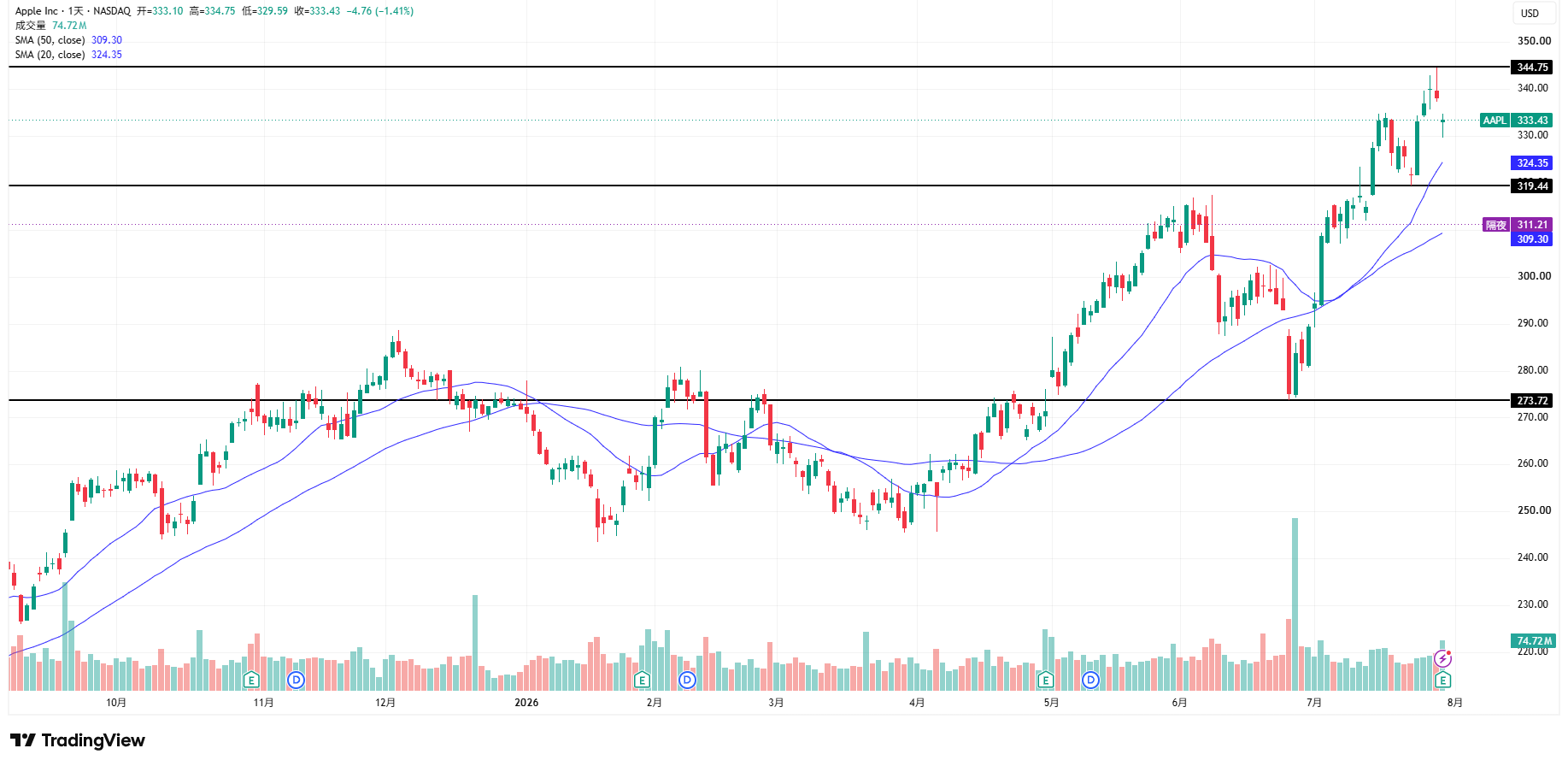
Source: TradingView
From a technical perspective, Apple has rebounded from its low near $274 and briefly touched the $340–$345 resistance zone, before pulling back to around $333.43 on Thursday. The 20-day moving average is at $324.35 and the 50-day moving average is at $309.30. The stock price continues to trade above both averages, while the 20-day moving average is higher than the 50-day moving average, indicating that the medium-term bullish structure remains intact.
Key resistance levels above are $344.75 and $350, while support levels below are $324.35 (20-day moving average), $319.44, $309.30 (50-day moving average), and $273.72.
If Apple's closing price breaks above $344.75, it will form a new higher high and potentially further challenge the $350 to $360 range. If the stock price faces resistance at this level, it may pull back to retest the support zone of $324.35 to $319.44.
Summary
Apple's market capitalization surpassing $5 trillion is not because the company is aggressively building out AI data centers like other tech giants, but is rather related to its relatively restrained capital expenditure strategy. As the market begins to worry about AI overinvestment, deteriorating cash flows, and rising debt, Apple's stable cash flow, massive user base, and asset-light AI model have gained favor among investors.
However, a $5 trillion market capitalization also means that the market has already priced in high expectations for Apple. Whether its stock price can continue to climb going forward no longer depends solely on iPhone sales, but rather on whether Apple Intelligence, the new version of Siri, and on-device AI can truly drive a new upgrade cycle and continuously boost services revenue.
This content was translated using AI and reviewed for clarity. It is for informational purposes only.
Recommended Articles






Comments (0)
Click the $ button, enter the symbol, and select to link a stock, ETF, or other ticker.