


KOSPI Tumbles Over 3%, SoftBank Plunges 11%, SK Hynix and Kioxia Drop 6%



AI Podcast


During the Asian trading session on September 14, Japanese and South Korean equities declined sharply, driven by US inflation concerns and rate-hike worries, a stronger yen, and local market liquidity adjustments. South Korea’s KOSPI Index fell 3.26% to 6,684.37 points, erasing weekly gains, with Samsung Electronics and SK Hynix dropping significantly. Japan’s Nikkei 225 Index proved more resilient, closing down 0.81% at 63,492.94 points, though Kioxia tumbled 6.37% and SoftBank plunged 10.72% amid OpenAI’s delayed IPO. The downturn reflects heightened regional risk aversion and monetary tightening pressures.

TradingKey - Japanese and South Korean stocks generally plunged, with the KOSPI falling over 3%, SoftBank slumping nearly 11%, and SK Hynix and Kioxia tumbling 6%.
During the Asian trading session on September 14, stock markets in Japan and South Korea opened significantly lower and continued to slide. Despite a brief mid-session rebound, they ultimately closed lower. Among them, the KOSPI Index fell 3.26% to close at 6,684.37 points, completely giving back last week's gains. Both major heavyweights suffered heavy losses: Samsung Electronics dropped 4.05%, breaching the 250,000 mark to close at 249,000 KRW; SK Hynix fell 6.35%, failing to reclaim the 1.7 million mark and closing at 1,697,000 KRW.
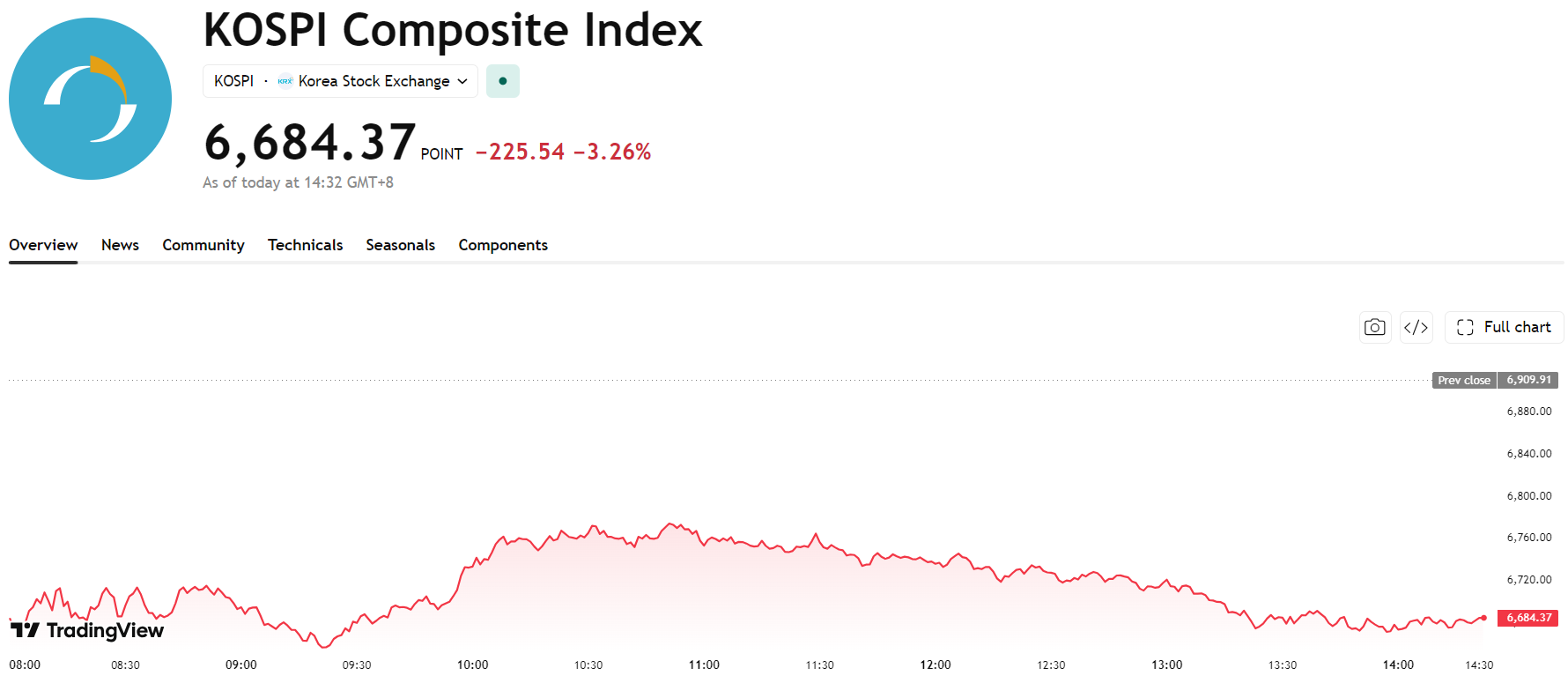 KOSPI Index chart, Source: TradingView
The Nikkei 225 Index proved more resilient, dropping over 2% intraday before narrowing its loss to 0.81% to close at 63,492.94 points. Two major heavyweights plummeted over 6%: Kioxia fell 6.37%, narrowly holding the 50,000 mark to close at 50,590 JPY; impacted by OpenAI delaying its IPO, SoftBank tumbled 10.72% to close at 5,839 JPY.
The downturn in Japanese and South Korean stock markets was driven by three main factors: rising US inflation triggering rate-hike concerns; a stronger yen fueling a wait-and-see stance on the South Korean won and monetary tightening; and liquidity adjustments alongside short-term risk-averse trading resulting from South Korea's implementation of a new system (the exchange officially launched extended night trading today).
This content was translated using AI and reviewed for clarity. It is for informational purposes only.
Recommended Articles



Comments (0)
Click the $ button, enter the symbol, and select to link a stock, ETF, or other ticker.