


Today’s Market Recap: U.S. Stocks Surged Broadly as Microsoft Jumped 15% to Lead AI Names, Memory Chips Exploded Higher, And Sandisk Soared 26%



AI Podcast


U.S. markets rebounded as cooling core PCE inflation and strong Microsoft earnings revitalized AI sentiment. Major indices gained, led by the semiconductor sector, while the U.S. dollar weakened amid reports of Japanese currency intervention. Despite second-quarter GDP growth missing expectations, domestic demand remains resilient. Amazon rose on robust AWS cloud demand despite increased capital expenditures, whereas Apple declined due to weak service revenue and supply constraints. Samsung reported record-breaking margins driven by the AI chip supercycle. Meanwhile, OpenAI launched aggressive pricing strategies, and TSMC accelerated advanced packaging R&D to maintain its competitive edge in the AI landscape.
Tracking the Market Trend
TradingKey - The slowdown in U.S. core PCE inflation dampened expectations for near-term interest rate hikes. Combined with Microsoft(MSFT) better-than-expected earnings report, which boosted confidence in the AI market, and the easing of selling pressure caused by the earlier liquidation of AI funds, this reversed the market’s previous downtrend. All three major U.S. stock indices rose, with memory stocks leading the gains while software stocks retreated.
At the close, the Dow Jones Industrial Average rose 1.19% to 52,208.06; the Nasdaq Composite gained 2.78% to 25,122.18; and the S&P 500 advanced 1.66% to 7,437.63.
The semiconductor sector led the gains, with the Philadelphia Semiconductor Index surging 8%. Among individual stocks, Microsoft soared more than 15%, marking the largest single-day increase in market capitalization for a single stock in Wall Street history and its biggest single-day gain in 18 years; the memory sector saw across-the-board gains, with Micron (MU) up 18% and SanDisk (SNDK) soaring 26%; AMD(AMD) rose 13%, and TSMC (TSM) surged more than 7%. In after-hours trading, Amazon (AMZN) soared nearly 10% following its earnings report, while Apple (AAPL) fell more than 6%.
In the bond market, the yield on the U.S. 2-year Treasury note fell by about 2.9 basis points. The foreign exchange market saw sharp volatility; the yen surged more than 3% at one point during the session following reports in Japanese media that Japan had intervened again; the U.S. Dollar Index fell more than 0.9% at one point, marking its largest single-day decline since January.
Cryptocurrencies followed the tech rally, with Bitcoin (BTC) breaking through $65,000 during the session and gaining about 2% on the day. The weaker dollar boosted precious metals, with spot gold rising 1% to reclaim the $4,100 level, while silver gained 2.5%. In the energy sector, WTI crude oil prices edged down 1%.
Market Headline
U.S. second-quarter GDP growth fell short of expectations, but domestic demand remains resilient and has not undermined the economy’s fundamentals. Data shows that the U.S. real GDP grew at an annualized rate of just 1.5% in the second quarter, falling short of widespread market expectations, primarily due to a decline in net exports. However, consumer spending and business investment—the core drivers of the economy—both maintained strong growth, largely offsetting the negative impact of weakening external demand. This indicates that while the U.S. economy has cooled somewhat, it remains a considerable distance from a recession.
Apple’s earnings report showed a clear divergence: while the iPhone performed exceptionally well, both services revenue and the Chinese market fell short of expectations. Combined with warnings of supply shortages, the stock price came under downward pressure in after-hours trading. Total revenue for the third fiscal quarter rose 16% year-over-year, slightly exceeding expectations; EPS surged 29% year-over-year to a record high for the period, though the portion exceeding expectations was primarily due to a one-time contribution from U.S. government tariff refunds. By business segment, iPhone revenue grew 22%, slightly exceeding expectations, while Mac revenue was 20% higher than expected, showing strong performance; iPad revenue, however, fell short of expectations by about 10%. Services revenue rose 12% year-over-year but declined slightly quarter-over-quarter, coming in nearly 2% below expectations, sparking market concerns about the growth momentum of this high-margin business. Revenue in Greater China grew 22% year-over-year, a significant slowdown from previous periods and below expectations. Operating cash flow hit a record high for the period, and a dividend of $0.27 per share was declared. During the earnings call, management warned that supply constraints would weigh on revenue; guidance for the current quarter projects growth of no more than 11%, which is below analysts’ expectations, causing the stock price to drop by more than 8% at one point in after-hours trading.
Amazon surged on the back of better-than-expected performance in its cloud business; despite weak Q3 guidance, a shift to negative free cash flow, and a significant upward revision to capital expenditures, the market remains focused on AWS’s long-term potential. In the second quarter, AWS revenue reached $42.2 billion, up 37% year-over-year, significantly exceeding the expected $40.6 billion, highlighting the strong demand for cloud services driven by AI computing power. However, the median Q3 revenue guidance of $197–202 billion and operating profit of $22.5–26.5 billion were both below market consensus. The company also raised its full-year capital expenditure forecast from $200 billion to $220 billion, while free cash flow turned negative to -$7.6 billion. Nevertheless, the market remained unfazed, with the stock price rising by over 9% in after-hours trading. This was primarily driven by the earnings call’s revelation that servers pay for themselves within three years, a backlog of nearly $500 billion in orders, and the explicit long-term goal that “AWS is expected to surpass $1 trillion in annual revenue,” which greatly boosted investor confidence.
Samsung Electronics delivered its strongest-ever quarterly performance amid the AI chip supercycle, with the HBM dividend fully evident. Second-quarter revenue surged 130% year-over-year to 171.5 trillion won, while operating profit soared 1,814% year-over-year to 89.49 trillion won, with an operating margin of 52.2%—a record high. HBM4 is now in mass production, and HBM4E samples have been shipped for the first time, solidifying the company’s technological leadership.
OpenAI introduced differentiated adjustments to its model pricing strategy, significantly reducing prices for certain models while exploring new monetization models through speed tiers. Specifically, prices for the Luna model were cut by as much as 80%, and those for the Terra model were reduced by 20%, aiming to lower the barrier to entry and expand the user base. Meanwhile, the Sol model has introduced a new “Fast” mode, which can boost inference speed by up to 2.5 times. Priced at twice the rate of the standard mode, it maintains the same level of intelligence. This “reverse pricing” strategy essentially seeks a new balance between computing efficiency and pricing, offering more flexible options for customers with varying needs.
TSMC is accelerating R&D on “EMIB-like” advanced packaging technology to directly compete with Intel. According to The Information, TSMC is developing a technology similar to Intel’s EMIB (Embedded Multi-Chip Interconnect Bridge), which uses silicon bridges to establish high-speed connections between processors and memory, supporting larger-scale AI chip designs. With the surge in AI demand, advanced packaging has become one of the core bottlenecks determining chip performance. Intel’s EMIB technology has already attracted the attention of clients such as NVIDIA. Internally, TSMC refers to this solution as “EMIB-like” and has engaged in preliminary discussions with some clients in an effort to stay competitive in the AI packaging race.
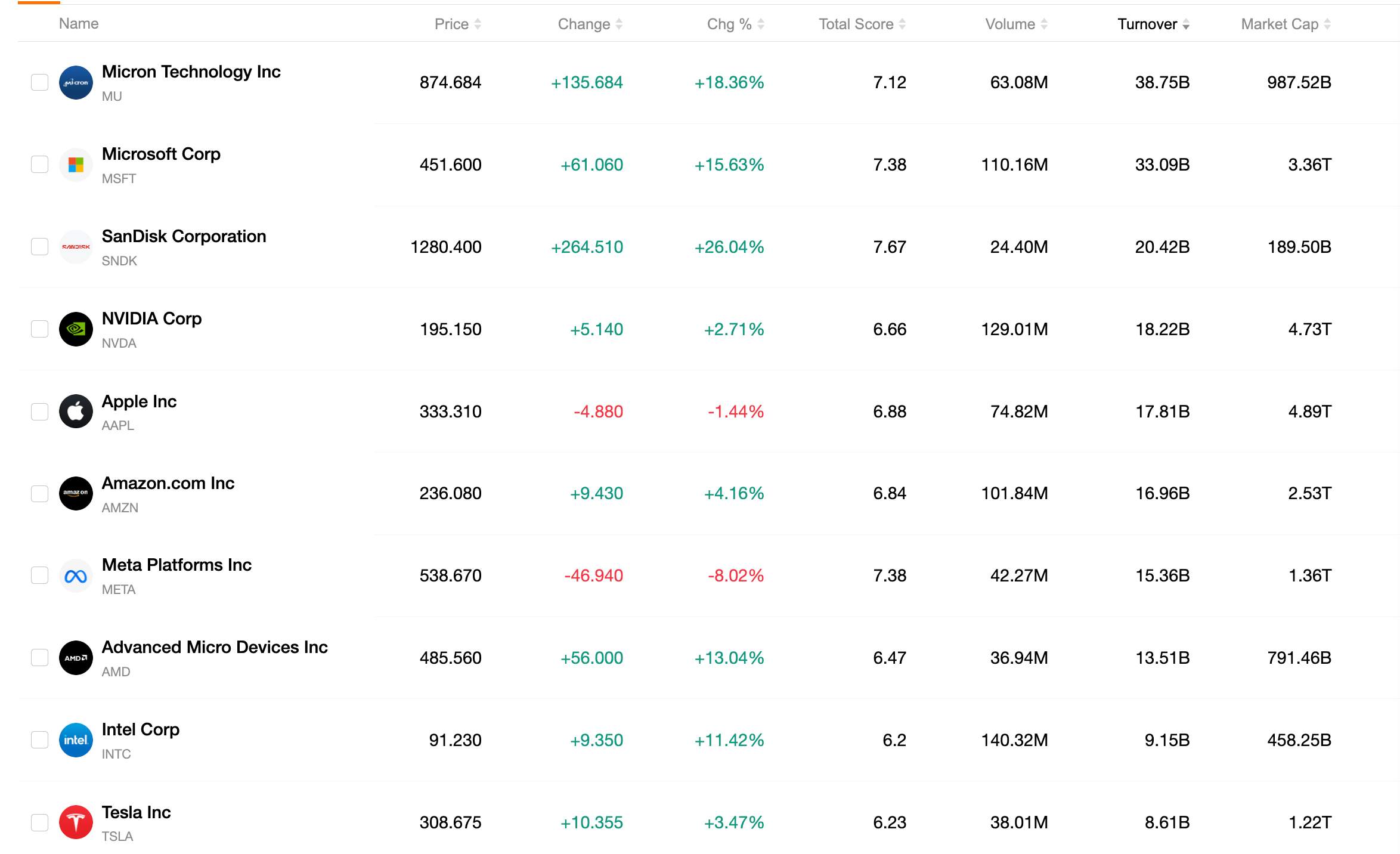
Top 10 Most Traded Stocks
The table below lists the ten most actively traded stocks in the market recently. Backed by massive trading volumes and excellent liquidity, these assets have become key benchmarks for tracking global market dynamics.
Recommended Articles








Comments (0)
Click the $ button, enter the symbol, and select to link a stock, ETF, or other ticker.