


US Senators Halt Apple Purchase of Chinese Memory Chips; Boost for Micron Stock?



AI Podcast


U.S. lawmakers have blocked Apple’s attempt to procure memory chips from blacklisted Chinese firms CXMT and YMTC. This intervention protects Micron Technology, which derives 10%–12% of its annual revenue from Apple, by preventing a potential loss of pricing power and market share. While this removes a competitive threat, Micron’s stock remains under pressure amid broader skepticism over AI capital expenditure returns. Down over 40% recently, the stock faces further downside risk. Technical analysis identifies $670 as a critical support level; a breach could trigger further declines toward $500, despite the favorable regulatory outcome for Micron.
TradingKey - Lawmakers have blocked Apple's plan to procure Chinese memory chips, which helps safeguard Micron Technology's interests and acts as a potential positive catalyst for its stock price.
According to a Cointelegraph report on July 30, U.S. senators urged Apple ( AAPL) to abandon plans to procure memory chips produced by Chinese companies, including ChangXin Memory Technologies (CXMT) and Yangtze Memory Technologies (YMTC). Currently, both Chinese memory chipmakers are blacklisted by the U.S. Department of Defense.
According to a report by The Wall Street Journal on July 24, to cope with skyrocketing global memory chip prices, Apple CEO Tim Cook recently lobbied the Trump administration for approval to use memory chips from CXMT and YMTC. This move drew opposition from bipartisan senators, including Chuck Schumer and Jim Banks, and also triggered pushback from Micron Technology ( MU) executives.
Apple has long been one of Micron's top two customers, with the other being Seagate Technology ( STX ). According to Micron's financial disclosures, Apple's annual revenue contribution to Micron is around 10% to 12%. Based on Micron's estimated annual revenue range of $25 billion to $30 billion, Apple directly or through contract manufacturers purchases an annual total of $2.5 billion to $3.5 billion worth of memory chips from Micron.
If Apple gains approval, Micron will directly lose a massive amount of orders, which would not only dent its revenue but could also lead to a loss of pricing power. Amid the explosive demand for AI servers, global DRAM and NAND flash memory prices have surged, enabling Micron to enjoy extremely high gross margins and command pricing power unseen in years.
Micron opposes Apple's use of Chinese memory to protect its high investment returns and chip pricing power, while leveraging geopolitical rules to prevent increasingly capable Chinese rivals from entering the top-tier supply chain, thus maintaining its dominant position. Currently, the U.S. senators' intervention to halt Apple essentially blocks the threat of Chinese memory makers launching a price war backed by Apple's endorsement, ensuring that Micron's earnings growth potential in the AI memory supercycle continues to materialize, providing support for its future stock price.
Currently, as Microsoft, Meta ( META ), Alphabet ( GOOG) and other tech giants incur massive capital expenditures (CapEx) that have begun to trigger market skepticism over the slow realization of AI return on investment (ROI), funds have started to flow out of highly valued semiconductor and AI-related stocks. As a major beneficiary of AI memory, Micron has also experienced heavy sell-offs, dropping over 40% in the past month.
As of press time, Micron Technology's stock price stands at $730, with the downward trend remaining intact. From a technical analysis perspective, Micron's stock price still has substantial downside room. Based on Fibonacci retracement and pattern structure, Micron's next support level is around $670, which represents the 0.618 Fibonacci level—a potential support and also the low point of the correction in May this year. If this level is breached, the stock will head toward the $500 mark.
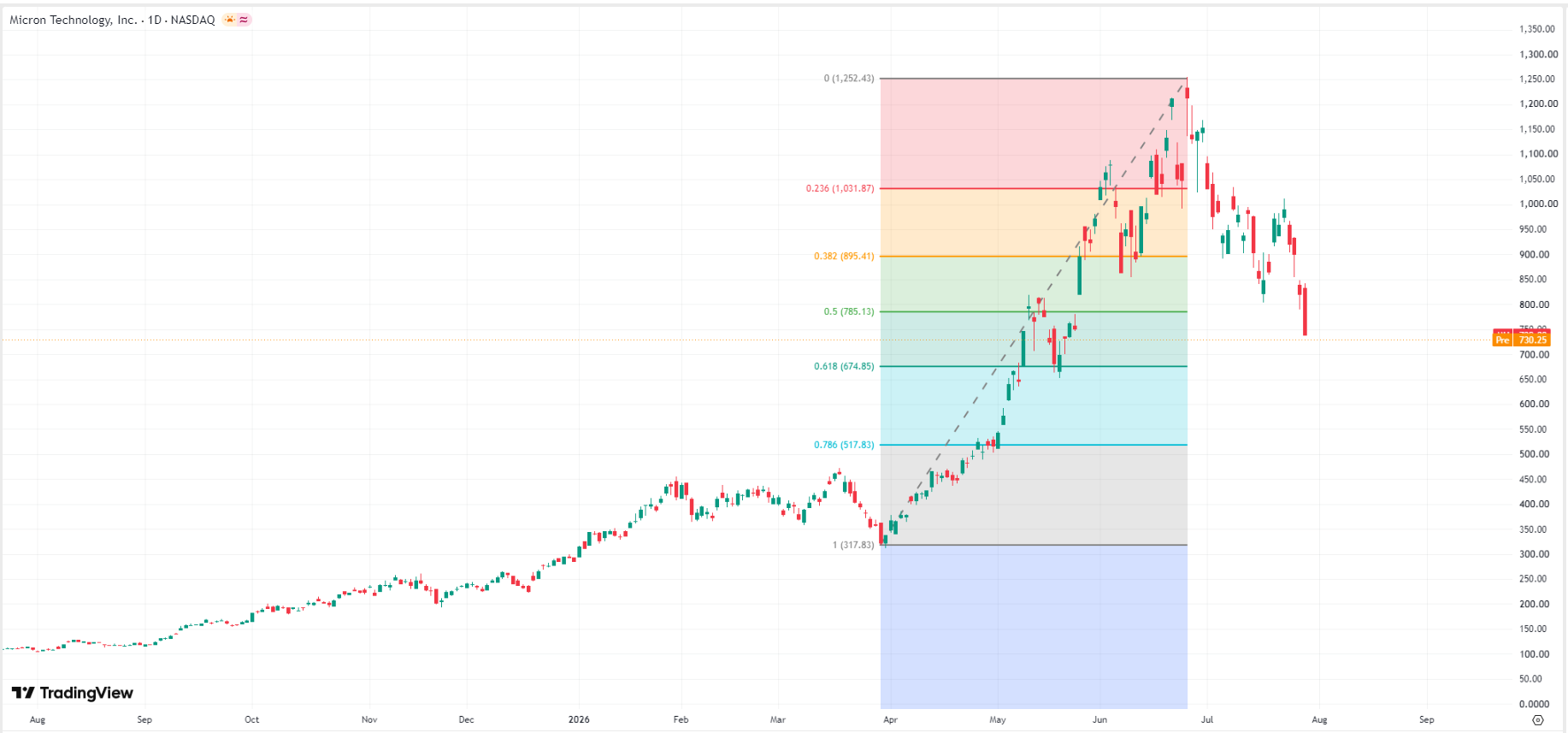 Micron Technology stock chart, Source: TradingView
This content was translated using AI and reviewed for clarity. It is for informational purposes only.
Recommended Articles












Comments (0)
Click the $ button, enter the symbol, and select to link a stock, ETF, or other ticker.