


Munster Warns Microsoft Is Falling Into AI ‘Value Trap’ Ahead of Earnings



AI Podcast


Ahead of Microsoft’s Q4 earnings on Wednesday, July 29, Eastern Time, analyst Gene Munster argues that the company’s structural transition is more critical than quarterly results. While implied volatility suggests a potential 7% post-earnings stock move, Munster warns of a "value trap" risk. The shift from a per-seat licensing model to a pay-per-use structure—necessitated by AI agents potentially reducing workforce software demand—creates revenue uncertainty. Although Azure’s growth remains a positive catalyst, the market will likely monitor whether Microsoft provides a clear roadmap to navigate this fundamental business model evolution despite lingering valuation headwinds.

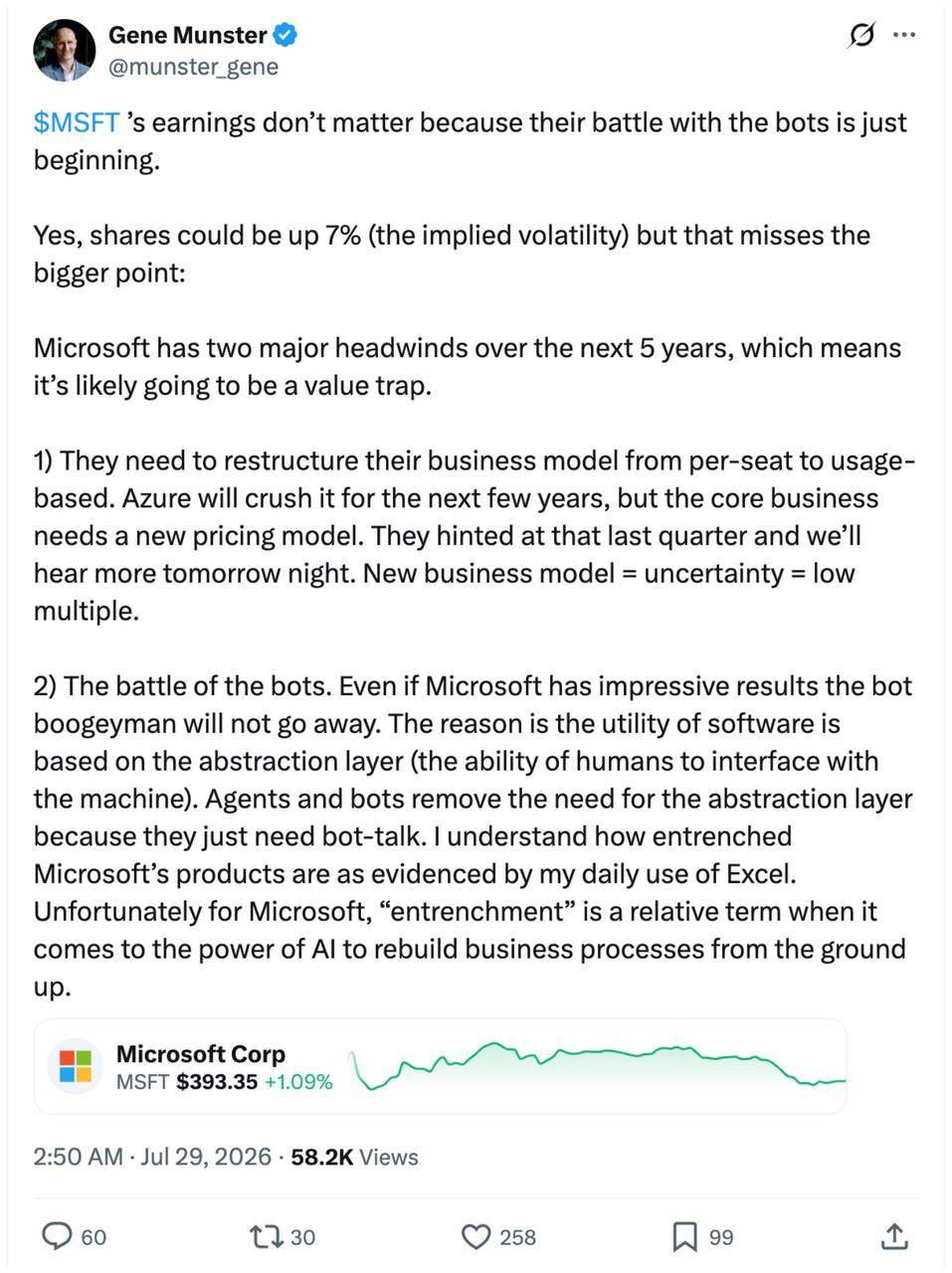
TradingKey - Microsoft ( MSFT) will release its fourth-quarter fiscal results after the market close on Wednesday, July 29, Eastern Time. Just one day before the earnings release, Gene Munster of Deepwater Asset Management posted on X that Microsoft's earnings numbers "don't matter," and the real issue is that "the battle with the bots is just beginning."
[Source: X]
Munster expects that Microsoft's stock price could rise by 7% post-earnings (based on implied volatility), but he also warned that the company will face two major structural challenges over the next five years: first, the traditional "per-seat" licensing model needs to transition to a "pay-per-use" model; second, AI agents are gradually eliminating the "abstraction layer" of human-computer interaction, directly replacing traditional software. Even if earnings beat expectations and the stock briefly spikes, Microsoft could still fall into a "value trap."
In his view, Microsoft's real dilemma lies in its business model itself. Currently, the company primarily charges software licensing fees based on the number of corporate employees, but as AI agents replace some human roles, the number of seats required by companies faces a contraction, and this revenue source will gradually shrink. He called on Microsoft to pivot to a new "pay-per-use" billing model.
Microsoft already hinted at potential adjustments to its pricing model last quarter, and this earnings report may disclose more details. However, Munster believes that the revenue scale and profitability of the new model remain uncertain, and the market typically applies a valuation discount to such uncertainty, meaning the transition process could continue to weigh on Microsoft's stock performance.
He remains optimistic about the prospects of Azure, believing it is expected to maintain strong growth over the next few years. However, cloud computing alone may not be enough to fully offset the impact on the traditional software model.
After the close on Wednesday, the market's focus will be not just on how much money Microsoft made this quarter, but also on how the company will cope with the impact of AI agents on the traditional software industry.
This content was translated using AI and reviewed for clarity. It is for informational purposes only.
Recommended Articles











Comments (0)
Click the $ button, enter the symbol, and select to link a stock, ETF, or other ticker.