


Microsoft Earnings Preview: Azure Growth and AI Capex in Focus; Will Microsoft Shares Surge or Remain Under Pressure?



AI Podcast


Microsoft (MSFT) reports fiscal Q4 2026 results on July 29, Eastern Time. Market projections suggest $87.71 billion in revenue and $4.24 EPS. Investors are focused on whether Azure growth hits 40% amid supply constraints, if capital expenditures—projected at $190 billion annually—outpace free cash flow, and if Copilot commercialization demonstrates scalable enterprise adoption. Despite year-to-date pressure, strong performance in Azure and Copilot, combined with disciplined spending, is critical for upward momentum. Key risks include rising infrastructure costs and unproven AI returns, with the stock currently consolidating near a $345 support level.
TradingKey - Microsoft ( MSFT) will report its fourth-quarter fiscal 2026 financial results after the market close on July 29, Eastern Time. As of July 27, Eastern Time, Microsoft's stock closed at $389.1, up 1.94% on the day, but has accumulated a year-to-date decline of 19.54%. The stock price has been under pressure due to factors such as the company's high AI capital expenditures, intensifying competition in the software industry, and slower-than-expected AI commercialization.
According to market expectations, Microsoft's fourth-quarter revenue is expected to reach $87.71 billion, up nearly 15% year-on-year; earnings per share are projected at $4.24, higher than the $3.65 recorded in the same period last year. Intelligent Cloud revenue is expected to reach $38.24 billion, up approximately 28% year-on-year.
For this earnings report, investors need to focus on three key questions: whether Azure's growth rate can surpass 40%, whether AI capital expenditures will continue to be revised upward, and whether Copilot can prove its AI commercialization capabilities.
Can Microsoft’s Azure Growth Top 40%?
Azure is a key focus of this earnings report. In the previous quarter, revenue from Azure and other cloud services grew 40% year-over-year, or 39% in constant currency, representing an acceleration from prior quarters. Microsoft management expects Azure to grow by 39% to 40% in constant currency in the fourth fiscal quarter, significantly higher than market expectations of around 36% to 37% at the time.
However, because Microsoft had already provided a higher guidance of 39% to 40% in advance, merely matching the midpoint of this range in this earnings report may not be enough to significantly boost the stock price. The market is more eager to see Azure's growth rate hit the upper end of 40% or even beat company guidance once again, and hopes that management will continue to provide a growth outlook close to 40% for the next quarter.
Microsoft previously stated that the primary issue facing Azure is not insufficient customer demand, but rather that the supply of AI computing capacity still cannot fully meet demand. The company not only needs to provide computing power for external Azure customers but also needs to support Microsoft 365 Copilot, GitHub Copilot, and internal model development.
If new data centers and GPU supply this quarter begin to ease this constraint, Azure's revenue growth rate could further accelerate. Conversely, if the computing capacity bottleneck persists, Microsoft may not be able to translate strong customer demand into revenue in a timely manner.
Morgan Stanley believes that Azure is the key variable to help Microsoft's stock price regain upward momentum. The firm expects growth in Microsoft's cloud business to accelerate in the second half of 2026, noting that if Azure's growth rate beats management's guidance by about 1 percentage point, while the company continues to project acceleration in the first half of fiscal year 2027, it will help improve market perception of Microsoft's AI return on investment (ROI). Morgan Stanley maintains an "Overweight" rating on Microsoft with a price target of $600.
Will AI Capital Expenditures Continue to Rise?
In addition to Azure's growth rate, capital expenditure is another key focus of this earnings report.
Microsoft's capital expenditures reached $31.9 billion last quarter, about two-thirds of which were used for relatively short-lifecycle equipment such as GPUs, CPUs, and servers, while the rest was mainly directed to data centers, land, power, and network infrastructure. The company previously expected that fourth-quarter capital expenditures would exceed $40 billion, and capital expenditures for the full fiscal year of 2026 could reach approximately $190 billion.
Microsoft Chief Financial Officer Amy Hood previously stated that the company sees customer demand and AI product usage continuing to rise, so management remains confident that these investments can generate long-term returns. Microsoft's logic is that the current increase in investment in data centers and chips can ease Azure's compute capacity constraints while supporting the growth of Copilot and other AI products.
From a market perspective, Microsoft's capital expenditure growth has begun to outpace its free cash flow growth significantly. Microsoft's operating cash flow reached $46.7 billion last quarter, but after deducting capital expenditures, free cash flow dropped to approximately $15.8 billion. As the scale of AI data center construction expands, Microsoft's historically relatively asset-light software business model is becoming more capital-intensive.
For investors, they want to see a clearer correlation between investment and return. If capital expenditures continue to rise, revenues from Azure, Copilot, and AI services must also accelerate in tandem to prove that these investments are yielding reasonable returns.
Deutsche Bank believes that the main risks in this earnings report include rising chip and memory prices pushing up construction costs, the return on AI investments remaining insufficiently proven, and high order backlog concentration on a few large customers like OpenAI. The institution maintains its 'Buy' rating and $550 price target on Microsoft, but expects the market to closely scrutinize the relationship among capital expenditures, profit margins, and free cash flow.
If Microsoft maintains its full-year capital expenditure forecast of approximately $190 billion while Azure and Copilot revenues continue to accelerate, the market may accept the current scale of investment. However, if the company significantly raises its capital expenditures again without a corresponding increase in guidance for Azure, Microsoft 365, or overall revenue, the stock price may experience a scenario where it 'beats expectations but still falls.'
Can Copilot Prove AI Commercialization Capability?
Copilot is key in Microsoft's latest earnings report to proving that AI investments can translate into high-margin software revenue. In the previous quarter, Microsoft 365 Copilot paid seats increased from 15 million to over 20 million, representing a single-quarter net addition of over 5 million. Microsoft 365 Commercial Cloud revenue grew by 19% year-over-year, or 15% at constant currency. Management noted that revenue growth was not only driven by the traditional premium E5 packages, but also supported by an increase in average revenue per user (ARPU) driven by Copilot.
Microsoft also disclosed that the annualized revenue run rate of its overall AI business has exceeded $37 billion, up 123% year-over-year. CEO Satya Nadella stated that customers who have adopted Copilot use it weekly at a frequency close to Outlook, indicating that in some enterprises, Copilot is gradually transforming from a trial tool into a daily work portal.
However, relative to Microsoft's massive enterprise user base, 20 million paid seats is still in the early stages. What the market truly cares about is not whether Copilot users continue to grow, but whether enterprise customers are shifting from small-scale testing to company-wide deployment, and whether Copilot can continuously boost average revenue per user and renewal pricing for Microsoft 365.
In addition to Microsoft 365, GitHub Copilot is also a key observation point for commercialization. Microsoft disclosed that nearly 140,000 organizations are using GitHub Copilot, with enterprise subscribers growing nearly threefold year-over-year. The company has also begun adopting a consumption-based pricing model, enabling revenue to increase as AI usage frequency rises.
Morgan Stanley believes Copilot has three potential growth paths: increasing paid seats, driving customers to upgrade to higher-priced Microsoft 365 suites, and expanding consumption-based billing. The firm suggested that if Microsoft 365 Copilot adds more than 6 million paid seats this quarter and management discloses stronger enterprise deployment trends, it will bolster market confidence in AI commercialization.
Microsoft Stock Price Forecast
Microsoft Stock Price Weekly Chart, Source: TradingView
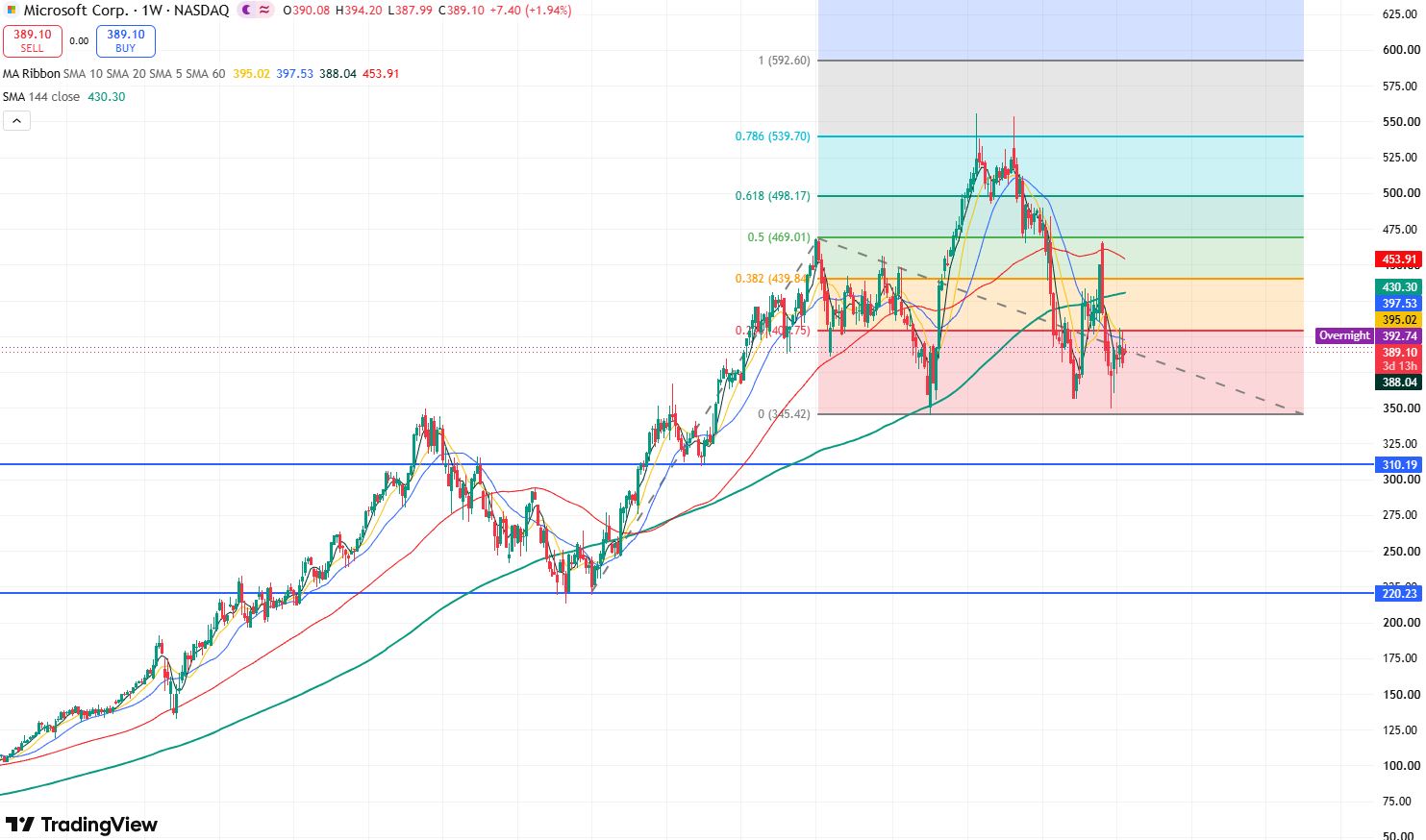
Looking at the weekly chart of Microsoft's stock price, the stock has recently exhibited a clear high-level consolidation range. The stock price has recently tested the $345 support downward three consecutive times without breaking through, indicating strong support at this level. A short-term rebound may be on the horizon, with the primary target of testing upward at $400-$410, followed by $470-$500. If the stock price stands above $500, the upside potential toward $600 will open up.
Conversely, if the stock price fails to hold the $345 support level, it may further test downward into the $310-$300 range, and further down, it could drop toward the $220 support level.
Therefore, regarding this earnings report, in an optimistic scenario, if Microsoft's revenue and EPS beat expectations, Azure's growth reaches or exceeds 40%, Copilot's paid seats continue to accelerate, and capital expenditures are not significantly raised again, the stock price is expected to break through $410 and further rebound toward the $470-$500 range.
In a neutral scenario, if Azure's growth remains at 39%-40%, Copilot users grow steadily, but capital expenditures remain high, the stock price may fluctuate within the $345-$410 range. The market will continue to wait for more evidence of AI revenue and cash flow improvements.
In a pessimistic scenario, if Azure's growth falls short of guidance, Copilot's commercialization progress is slow, or Microsoft significantly raises its capital expenditure expectations for fiscal year 2027, the stock price could break below $345 and further test support near $310-$300.
This content was translated using AI and reviewed for clarity. It is for informational purposes only.
Recommended Articles











Comments (0)
Click the $ button, enter the symbol, and select to link a stock, ETF, or other ticker.