


Nine Leveraged ETFs for Storage Giant Kioxia Poised for US Debut



AI Podcast


As of July 26, Eastern Time, U.S. issuers including Tuttle Capital are preparing to launch leveraged ETFs tracking Japanese chipmaker Kioxia, marking the first instance of a Japanese firm serving as an underlying asset for single-stock leveraged ETFs. While these products aim to provide amplified returns, their mandatory daily rebalancing risks exacerbating stock volatility, a phenomenon observed following similar product launches in South Korea. Analysts warn that such instruments may distort price discovery and undermine fundamental-based investing. Given Kioxia’s recent 51% price correction and high volatility, the potential introduction of these ETFs poses significant systemic risk.

TradingKey - On July 26, Eastern Time, Bloomberg reported that at least nine leveraged ETFs tracking Japanese memory chip giant Kioxia are preparing to list in the U.S. If successful, this will mark the first time a Japanese company serves as the underlying asset for a single-stock leveraged ETF. Issuers include Tuttle Capital, GraniteShares, and Corgi Strategies, with Tuttle Capital's products expected to list as early as August 2026.
These products are primarily divided into two categories: one providing a 2x daily leveraged return on Kioxia's stock price, and the other providing a 2x inverse return, meaning investors can obtain amplified returns when the stock price falls. Although leveraged ETFs can amplify investment returns, they also magnify market volatility.
How Leveraged ETFs Magnify Stock Price Volatility
Unlike traditional ETFs, leveraged ETFs must rebalance their positions daily to maintain their target leverage ratios. This means that when the underlying stock price rises, the ETF needs to continue buying the stock to maintain its 2x leverage; conversely, when the stock price falls, it is forced to sell down holdings to reduce risk, compounding the downward trend.
For individual stocks with relatively limited liquidity, this type of passive trading is more likely to amplify intraday price fluctuations. Some quantitative funds exploit this pattern for trading, while the passive buying and selling by market makers to hedge their own risks further exacerbates market volatility.
Matthew Tuttle, CEO of Tuttle Capital, revealed that capital from South Korean investors accounts for about one-third of the assets under management for the firm's similar products. Given that the South Korean market has just experienced severe volatility triggered by leveraged ETFs, this proportion is particularly noteworthy.
South Korean Stock Precedent: What Happened to Samsung and SK Hynix?
In May this year, South Korea officially launched single-stock leveraged ETFs linked to Samsung Electronics and SK Hynix. Following the listing of these products, funds rapidly flowed in, and the volatility of the related individual stocks and the entire semiconductor sector amplified significantly.
Subsequently, the volatility indicator of the Korea Composite Stock Price Index (KOSPI) rose above 75% at one point. Facing rapidly climbing market volatility, South Korean regulators ultimately suspended approvals of new single-stock leveraged ETF products to prevent risks from accumulating further.
Many market participants believe that this case provides an important reference for Japan.
Andrew Jackson, head of Japanese equity strategy at Ortus Advisors, pointed out that such products could distort the normal price discovery mechanism and further amplify the impact of short-term capital on stock prices, thereby weakening the effectiveness of long-term investors allocating based on fundamentals. Meanwhile, Kioxia itself is one of the highly volatile individual stocks in the Japanese stock market.
Kioxia Slumps 51% as Analysts See 110% Upside
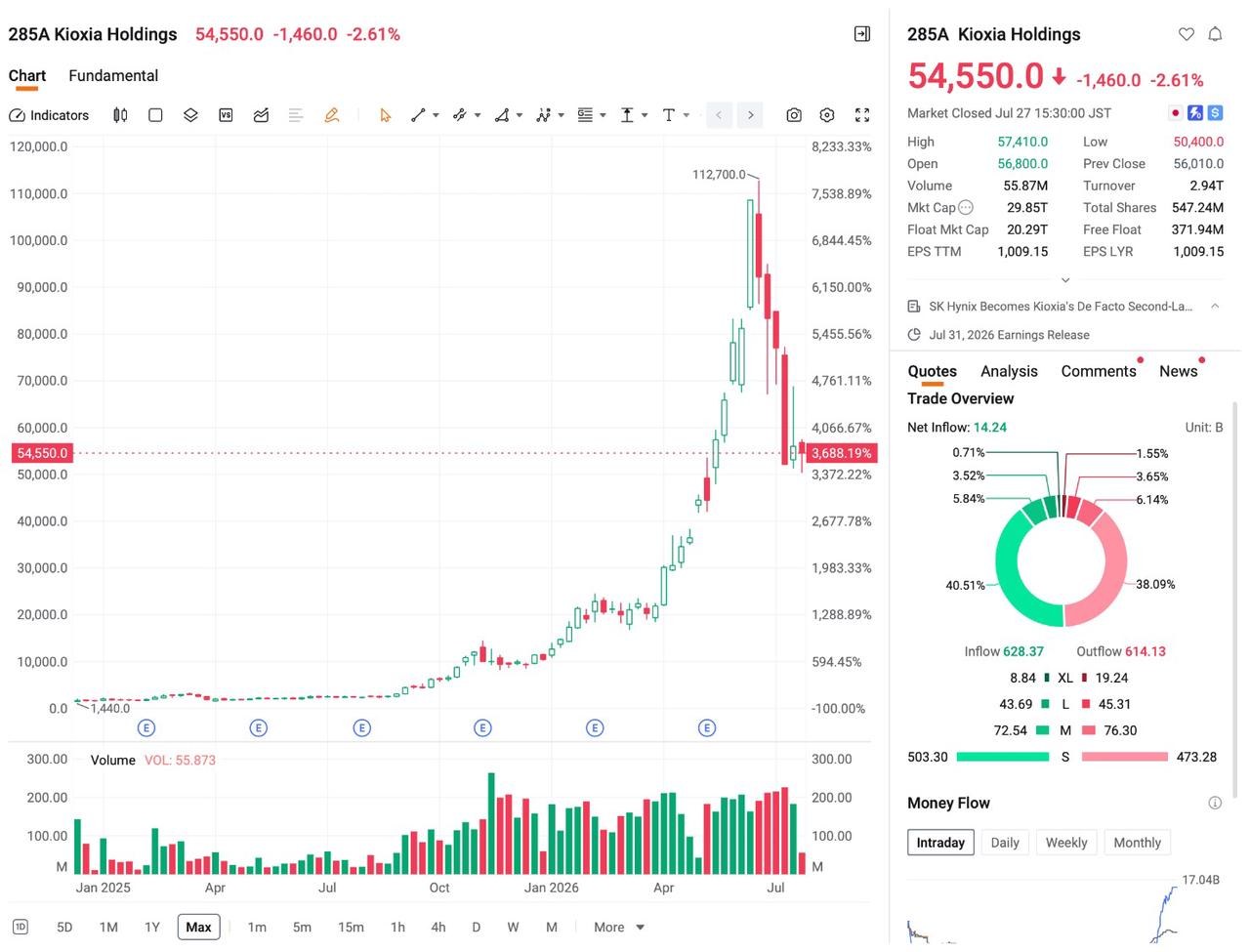
During Asian trading hours on June 22, Kioxia's share price once surged to 112,700 yen (about $689), topping Japan's market capitalization rankings. However, concerns over overheating in the AI sector quickly intensified, and by July 27, the stock price had fallen to approximately 54,550 yen (about $333.5), representing a drop of over 51% in less than a month and a half.
[Source: Futu]
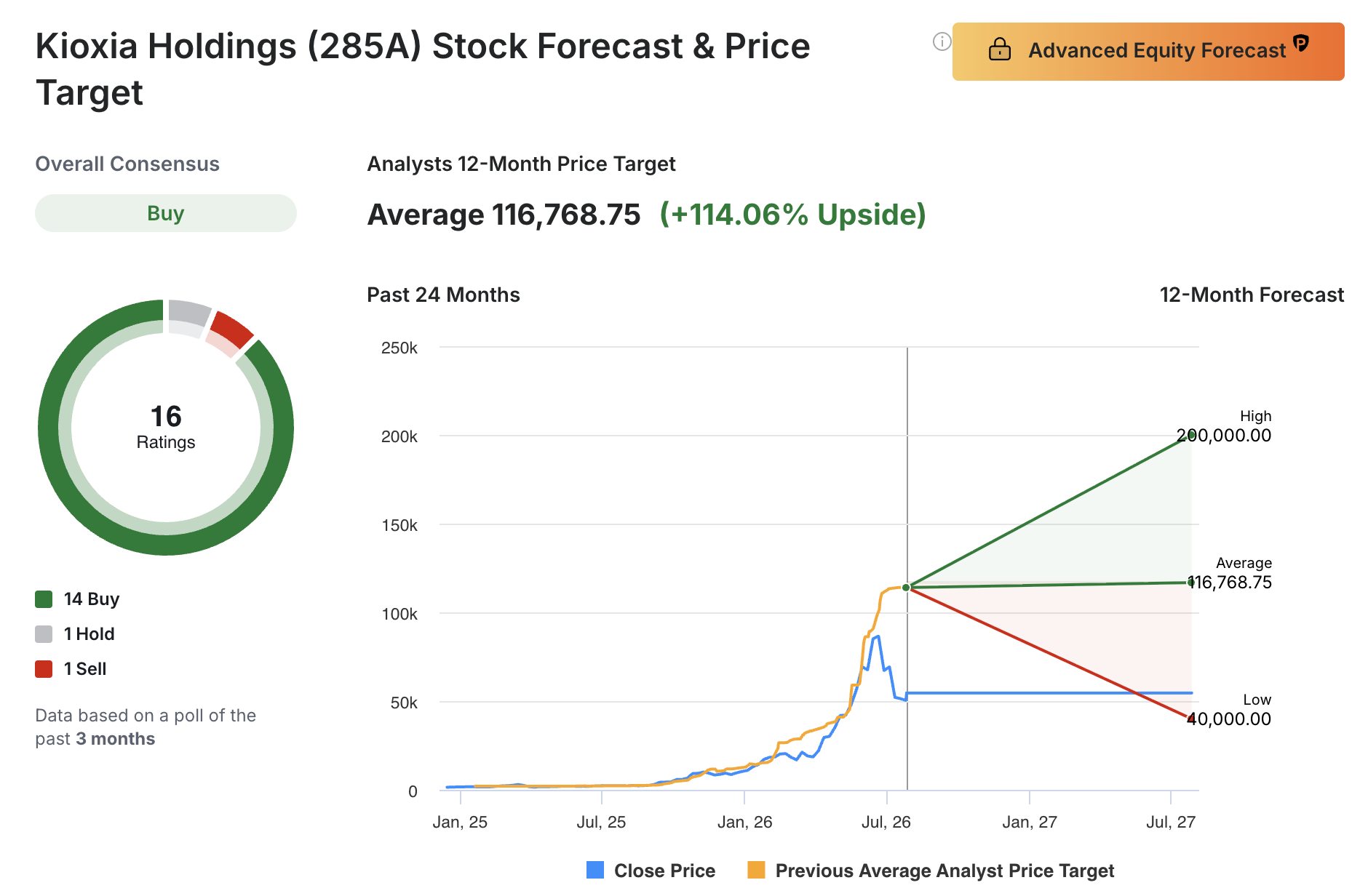
Despite the deep correction in the stock price, market sentiment remains optimistic. According to data from Investing.com, market analysts have set an average 12-month target price of 116,768.75 yen (about $713.5), which is still more than 110% higher than the current share price.
Such a massive divergence in expectations also suggests that Kioxia's future stock price volatility may remain high. Furthermore, if leveraged ETFs are officially listed, they could further amplify price fluctuations driven by capital trading, regardless of whether the stock goes up or down.
[Source: Investing.com Official Website]
It is worth noting that issuers are not focusing solely on Kioxia.
Tuttle Capital also plans to launch leveraged ETFs tied to companies like SoftBank Group and Nintendo; Direxion is targeting Tokyo Electron and Toyota Motor; and Themes ETF Trust plans to roll out similar products centered around popular tech stocks such as Fujikura and Lasertec.
Currently, Japanese regulatory frameworks still do not permit the issuance of single-stock leveraged ETFs in the domestic public market, meaning investors wishing to trade such products must still do so through overseas markets. The concentrated applications for related products by multiple U.S. issuers also reflect the ongoing surge in demand from offshore capital to trade Japanese tech stocks.
Whether this batch of leveraged ETFs will ultimately be listed on schedule and how the market will react post-listing remains to be seen. However, what is certain is that South Korea has already provided a highly prominent reference point for Japanese regulators and investors.
This content was translated using AI and reviewed for clarity. It is for informational purposes only.
Recommended Articles











Comments (0)
Click the $ button, enter the symbol, and select to link a stock, ETF, or other ticker.