


Intel Q2 Earnings Far Exceed Expectations: 59% Data Center Business Growth, CPUs Becoming AI Era Protagonists Again



AI Podcast


Intel’s Q2 fiscal 2026 earnings, reported on July 23, Eastern Time, exceeded expectations with $16.13 billion in revenue and $0.42 adjusted EPS. Growth was primarily driven by the Data Center and AI segment, which surged 59% year-over-year, signaling that AI infrastructure expansion is revitalizing demand for server CPUs. Third-quarter guidance also surpassed analyst forecasts, reflecting strong demand momentum. While management remains optimistic, the company faces long-term challenges in its Foundry strategy, which requires sustained, significant capital expenditure. Despite this, the results successfully demonstrate Intel’s ability to capitalize on the secular AI trend.
TradingKey - As the market continues to question whether Intel ( INTC) can truly ride the AI wave, the Q2 earnings report delivered by the company has provided the answer.
After the market close on July 23, Eastern Time, Intel released its second-quarter earnings report for fiscal year 2026, with revenue, earnings, and next-quarter guidance all significantly beating Wall Street's previous expectations.
Among these, the most noteworthy aspect is not just the single-quarter data, but the accelerated growth of the data center business and management's continued optimism regarding demand in the second half of the year. This means that the computing power demand driven by the continuous expansion of AI infrastructure is gradually becoming an important driver of Intel's earnings recovery.
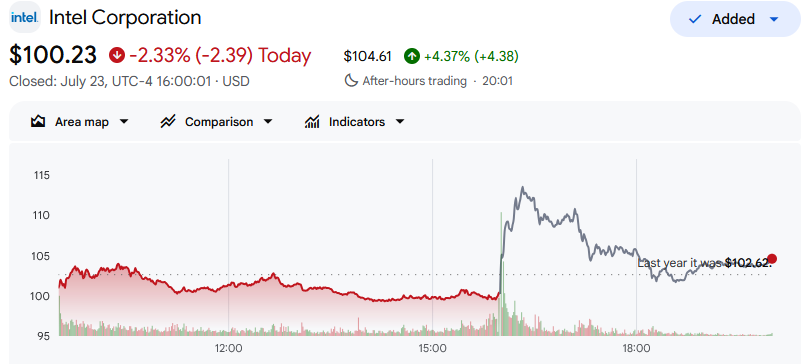
Boosted by the financial results, the company's stock price once surged over 10% in after-hours trading.
Source: Google Finance
Revenue and Earnings Both Substantially Beat Expectations, AI Becomes Largest Growth Engine
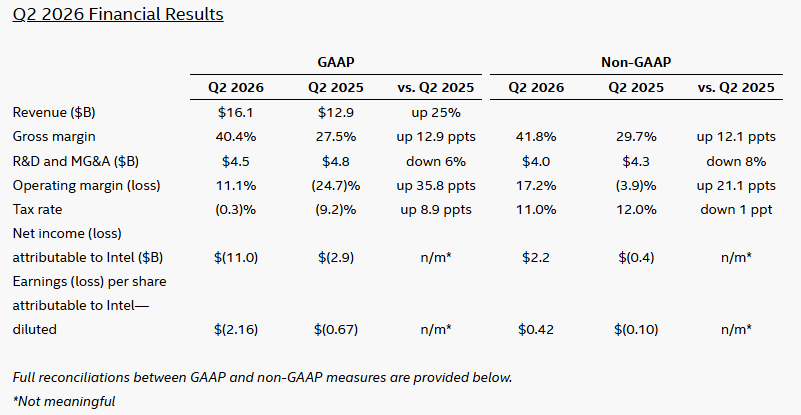
Looking at the core metrics, Intel's second-quarter revenue reached $16.13 billion, beating market expectations by approximately $1.7 billion, with a beat of nearly 12%. This represented a year-over-year growth of about 25%, which was not only significantly faster than the roughly 7% growth rate in the first quarter, but also marked its fastest quarterly revenue growth since the third quarter of 2011.
Source: Intel
Profitability also delivered a pleasant surprise. Adjusted earnings per share (EPS) came in at $0.42, nearly double the market consensus of $0.21; adjusted gross margin recovered to approximately 42%, representing a significant improvement compared to the same period last year and beating analysts' forecasts.
Management attributed the better-than-expected results to simultaneous improvements in market demand and operational execution. Chief Financial Officer Dave Zinsner stated that continuous optimization of factory yields and shortened production cycles have significantly enhanced product shipment capabilities, while the ongoing expansion of AI-related computing demand served as a key driver of business growth.
CEO Lip-Bu Tan also emphasized that AI is driving global computing demand to unprecedented levels, and the company is benefiting from this secular trend.
If there was a single standout highlight in the entire earnings report, it was undoubtedly the data center business.
In the second quarter, the Data Center and AI (DCAI) segment generated revenue of approximately $6.3 billion, up 59% year-over-year. This represents a further acceleration from the 22% growth rate in the previous quarter, with a growth rate more than double that of the company's overall revenue.
This shift indicates that AI infrastructure buildouts are continuing to drive demand for server CPUs. Although the market has largely focused its AI investment attention on GPUs, as more enterprises transition to the AI inference phase and applications like Agentic AI rapidly gain traction, large-scale data center construction is also driving demand for CPU procurement—the very traditional area where Intel holds its strongest competitive advantage.
Lip-Bu Tan admitted during the conference call that current data center customer demand has already exceeded the company's supply capacity, noting that "the CPU business is growing rapidly," with supply shortages even emerging.
Dave Zinsner also stated that the company has signed multiple long-term server CPU supply agreements with customers, aiming to lock in demand over the next few years through these long-term contracts.
Compared to prior market concerns over a continuous decline in server CPU demand, the latest data demonstrates that AI investments are revitalizing this market.
Third-Quarter Guidance Continues to Exceed Expectations, Management Sends Positive Signals
Intel expects third-quarter revenue to be between $15.8 billion and $16.8 billion, compared with the market's previous average forecast of only about $15.1 billion.

Source: Intel
Even calculated at the lower end of the guidance, it is nearly 5% higher than market expectations; if the upper limit is reached, it would be more than 11% higher. Calculated at the range's midpoint of $16.3 billion, the company expects third-quarter revenue to remain slightly above second-quarter levels.
For a mature semiconductor company, such a business outlook indicates that management believes current demand is not a short-term spike, but is expected to extend into the second half of the year.
Of course, the company still maintains a $1 billion guidance range, indicating that management has not overlooked the ongoing volatility in industry demand; factors such as corporate IT budgets, cloud computing capital expenditure, inventory fluctuations, and the global macroeconomic environment could all impact the final performance.
However, against the current industry backdrop, being able to provide a revenue range that is overall higher than market expectations is in itself sufficient to alleviate investors' previous concerns about cooling demand.
Transformation Remains in Validation Phase, Foundry Business Still Long-Term Key
Although this earnings report has significantly improved market confidence, the greater challenge is still not over for Intel.
In recent years, the company has continued to promote its Intel Foundry strategy, hoping to re-establish its advanced manufacturing edge and expand into the global foundry market. However, this strategy requires sustained, massive capital expenditures—from advanced node R&D to fab construction, equipment procurement, and customer qualification—all of which imply a long investment payback period.
According to the earnings report, the company has decided to further increase capital expenditures, with the investment scale in 2027 expected to be even higher than this year's. Management stated that the R&D progress of the next-generation 14A node is better than previous technologies at the same stage, and the company is also seeing more and more customers express interest in collaboration.
Currently, Intel's foundry business has won orders from customers such as Tesla ( TSLA ), using its next-generation 14A process to manufacture for Tesla's "Terafab" AI chip project, though it has not yet disclosed a broader list of major customers.
Intel CEO Lip-Bu Tan stated that the company is fully committed to mass-producing chips using 14A manufacturing technology by 2028, with customer interest in the technology growing, and 14A is expected to become a highly competitive manufacturing process.
This earnings report has proven that the AI wave belongs not only to GPUs, but is also revitalizing demand for server CPUs, providing Intel with an opportunity to regain market attention.
This content was translated using AI and reviewed for clarity. It is for informational purposes only.
Recommended Articles










Comments (0)
Click the $ button, enter the symbol, and select to link a stock, ETF, or other ticker.