


Intel Q2 Net Profit Swings to Profit YoY, Adjusted EPS Doubles Estimates: Revenue Up 25%, After-Hours Shares Rise Over 13%



AI Podcast


Intel’s Q2 2026 results, released Eastern Time July 23, significantly exceeded expectations, with revenue rising 25% year-over-year to $16.128 billion. Growth was propelled by a 59% surge in the Data Center and AI segment. Non-GAAP net income reached $2.2 billion, while EPS of $0.42 nearly doubled forecasts. Despite a large GAAP net loss driven by non-operating expenses, effective cost controls improved operating margins. Intel raised its Q3 revenue guidance to a $16.3 billion midpoint, reflecting strong AI-driven momentum. The company’s successful execution in high-growth segments indicates a robust operational turnaround and solid competitive positioning.

TradingKey - Intel ( INTC) released its second-quarter 2026 financial results after the U.S. market close on July 23, Eastern Time. As of press time, the stock rose 12.44% to $112.7.
During the period, Intel's revenue increased by 25% year-over-year to $16.128 billion, far exceeding the market expectation of $14.42 billion by approximately 12%. Company CEO Lip-Bu Tan stated that this is the company's strongest quarterly revenue growth in over fifteen years, driven by faster speed, stronger execution, and customer focus.
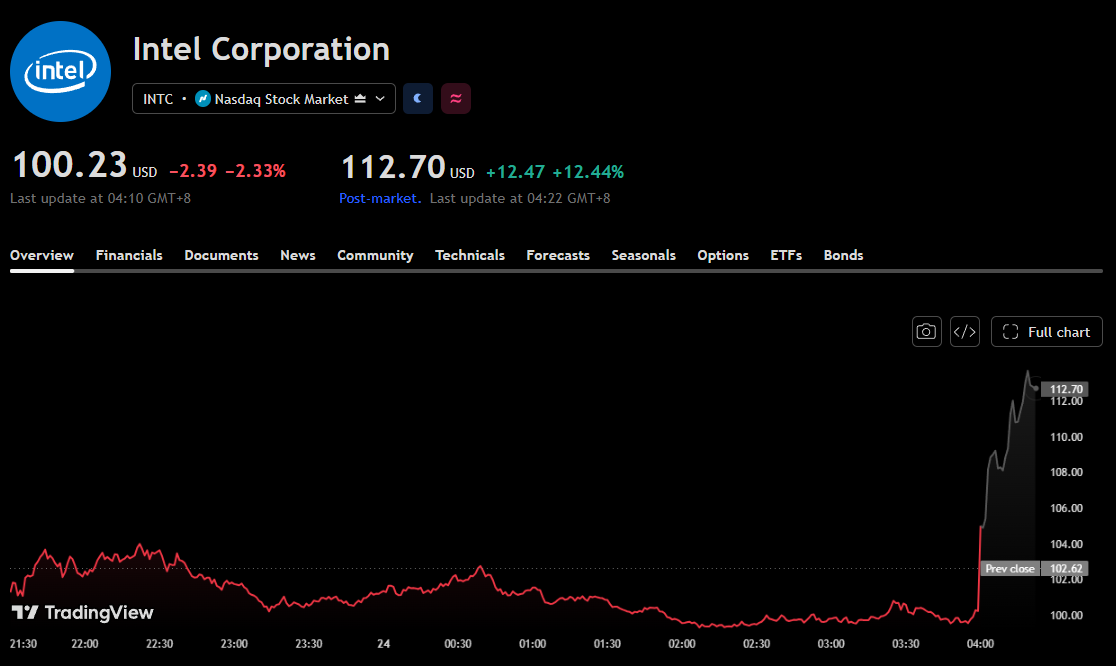
[Intel Stock Price Chart, Source: TradingView]
Looking at the business segments, the Data Center and AI (DCAI) segment revenue was $6.3 billion, a substantial year-over-year increase of 59%, making it the highlight of this quarter; the Client Computing and Physical AI (CCPG) segment revenue was $8.9 billion, up 13% year-over-year; total product business revenue was $15.1 billion, up 28% year-over-year. Intel Foundry revenue was $5.8 billion, up 31% year-over-year.
It is worth noting that the company sold a 51% stake in Altera and deconsolidated it in September 2025, which has had some impact on the year-over-year comparability of the data.
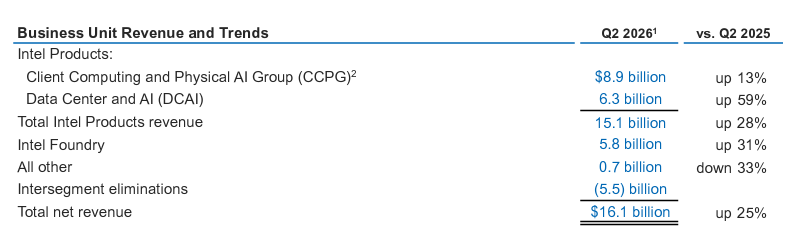
[Source: Intel Q2 2026 Financial Report]
On the profit side, under non-GAAP standards, Intel's second-quarter net income was $2.2 billion, turning a profit compared to a loss of $400 million in the same period last year; adjusted EPS was $0.42, nearly double the market expectation of $0.22; non-GAAP gross margin was 41.8%, up 12.1 percentage points year-over-year; non-GAAP operating margin was 17.2%, compared to -3.9% in the same period last year.
Under GAAP, the company's operating income was $1.796 billion, compared to a loss of $3.176 billion in the same period last year, with an operating margin of 11.1%, up 35.8 percentage points year-over-year. However, dragged down by a huge net expense of $12.576 billion recorded under the "Interest and Other" item during the period (compared to just $95 million in the same period last year), the GAAP net loss reached $11.033 billion, corresponding to a loss per share of $2.16, compared to a loss per share of $0.67 in the same period last year.
In terms of expenses, total R&D and administrative expenses were $4.5 billion, down 6% year-over-year; restructuring charges significantly decreased to $170 million from $1.89 billion in the same period last year, demonstrating highly effective cost control.
In terms of cash flow, operating cash flow in the second quarter reached $7 billion.
In terms of guidance, Intel expects third-quarter revenue to be between $15.8 billion and $16.8 billion (with a midpoint of $16.3 billion, higher than the previous market expectation of $15.1 billion); GAAP EPS is expected to be $0.31, and non-GAAP EPS is expected to be $0.38, also higher than the previous market expectation of $0.27; GAAP gross margin is expected to be 41.0%, and non-GAAP gross margin is expected to be 42.0%.
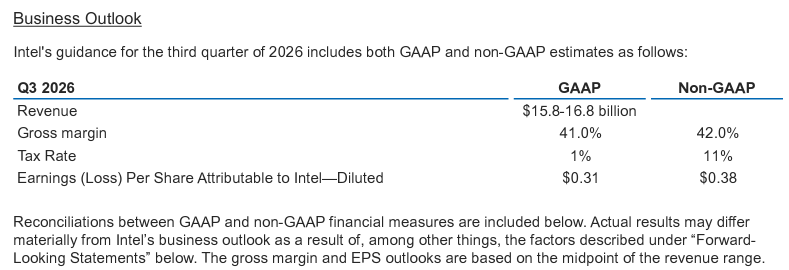
[Source: Intel Q2 2026 Financial Report]
Lip-Bu Tan stated: "AI is driving unprecedented demand for computing power. As we continue to execute, Intel is well-positioned to capture sustainable growth across our CPU business, ASICs, advanced packaging, and our massive foundry network."
Overall, Intel's performance this quarter far exceeded market expectations. Meanwhile, the 59% growth rate of the Data Center and AI business proves that the demand for AI computing power is substantially converting into Intel's revenue and driving a comprehensive turnaround on a non-GAAP basis.
This content was translated using AI and reviewed for clarity. It is for informational purposes only.
Recommended Articles









Comments (0)
Click the $ button, enter the symbol, and select to link a stock, ETF, or other ticker.