


OpenAI Raises 2030 Compute Spending Forecast to $750 Billion, Spending $20 Billion to Build Own Data Centers



AI Podcast


OpenAI has increased its 2030 computing expenditure forecast to approximately $750 billion, up from $600 billion. This escalation reflects sustained demand for AI model development. Simultaneously, the company launched "Project Camellia," a $20 billion data center in Savannah, Georgia, marking its transition from a compute tenant to an infrastructure developer. By standardizing designs and leading construction, OpenAI aims to optimize costs and deployment speed. Strategic hires, including former xAI executive Brent Mayo, underscore this vertical integration. This shift towards proprietary infrastructure represents a significant realignment of OpenAI’s long-term operational strategy and capital allocation.
TradingKey - OpenAI announced on Wednesday that it has raised its compute spending forecast through 2030 to approximately $750 billion, up from about $600 billion earlier this year. On the same day, it announced a $20 billion investment to launch the construction of a data center project named "Project Camellia" in Savannah, Georgia.
This marks the first time OpenAI is building its own data center as the lead designer and builder, signaling its transition from a "tenant" to a "landlord" in its compute infrastructure layout.
Computing Power Budget Raised Again: From $600 Billion to $750 Billion
According to a report by The Wall Street Journal, OpenAI has raised its projected spending on computing power through 2030 from approximately $600 billion to about $750 billion. The increase is mainly driven by a series of new deals with cloud providers, as OpenAI continues to secure the massive computing resources needed to develop and run AI models.
CEO Sam Altman had previously stated publicly that OpenAI planned to spend $1.4 trillion on computing power, a statement that caused external unease; CFO Sarah Friar subsequently stepped in to "correct course," clarifying to investors that the actual projected spending through 2030 was around $600 billion. Now, that figure has been raised by another $150 billion.
First Self-Built Data Center
Project Camellia marks a pivotal shift in OpenAI's business model. Previously, OpenAI primarily obtained computing power by renting chip capacity from providers such as Oracle and Amazon Web Services (AWS). This time, however, OpenAI is leading its own data centers as the primary builder for the first time.
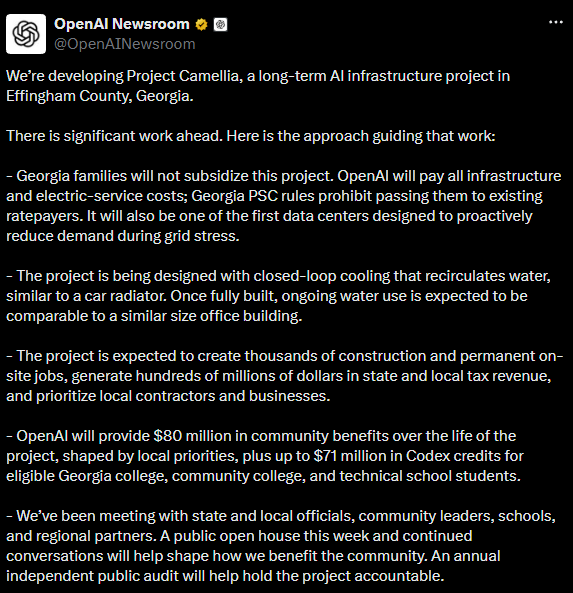
[Source: X]
Sachin Katti, OpenAI's Vice President of Compute Strategy, explained the reason: "After going through two or three generations of compute iterations, we have learned many lessons on how to design these facilities to both cut costs and speed up construction. That is why we are stepping up to lead the design and the entire process."
OpenAI's goal is to standardize its AI data center designs and publicly release them for other companies to use—open-sourcing hardware, networking, and data center designs, similar to the Open Compute Project co-founded by Meta in 2011.
OpenAI has reportedly hired Brent Mayo as Head of Data Center Construction and Delivery. Mayo left xAI earlier this year, having previously been one of the core architects of Musk's data center construction projects. He led the construction of xAI's Colossus supercomputing campus in Memphis, where he was responsible for the rapid procurement, commissioning, and deployment of large-scale AI chip clusters. At OpenAI, Mayo will be responsible for ensuring cloud partners advance construction on schedule, while also participating in advancing projects for the new facility in Georgia.
This content was translated using AI and reviewed for clarity. It is for informational purposes only.
Recommended Articles







Comments (0)
Click the $ button, enter the symbol, and select to link a stock, ETF, or other ticker.