


Novo Nordisk Sues Eli Lilly for False Advertising: Weight-Loss Drug Data War Escalates, GLP-1 $100 Billion Market Fight Heats Up



AI Podcast


Novo Nordisk has filed a lawsuit against Eli Lilly in the U.S. District Court for the District of New Jersey, alleging false advertising regarding their respective GLP-1 weight-loss medications, Zepbound and Wegovy. Novo Nordisk contends that Eli Lilly’s television advertisements rely on selective, outdated clinical data to exaggerate efficacy differences. While Eli Lilly maintains its marketing reflects the only direct, head-to-head clinical trial available, Novo Nordisk argues the comparison excludes current, high-dose trial results that demonstrate equivalent performance. The litigation underscores the intense competition within the multi-billion-dollar weight-loss drug market as both firms protect their market positioning.
TradingKey - Novo Nordisk ( NVO) has officially filed a lawsuit in the U.S. District Court for the District of New Jersey, accusing Eli Lilly ( LLY) of misleading advertising for its bestselling weight-loss drug Zepbound and diabetes injection drug Mounjaro, violating federal and state laws regarding false advertising and unfair competition.
The essence of this lawsuit is a data war between the two pharmaceutical giants over the hundred-billion-dollar market for GLP-1 drugs—and the key weapon on the battlefield is a set of clinical comparison data accused of being "outdated".
As of press time, the share prices of the two weight-loss drugmakers showed little fluctuation, with Eli Lilly rising 1.25% to $1,161.19, and Novo Nordisk falling 0.51% to $49.36.
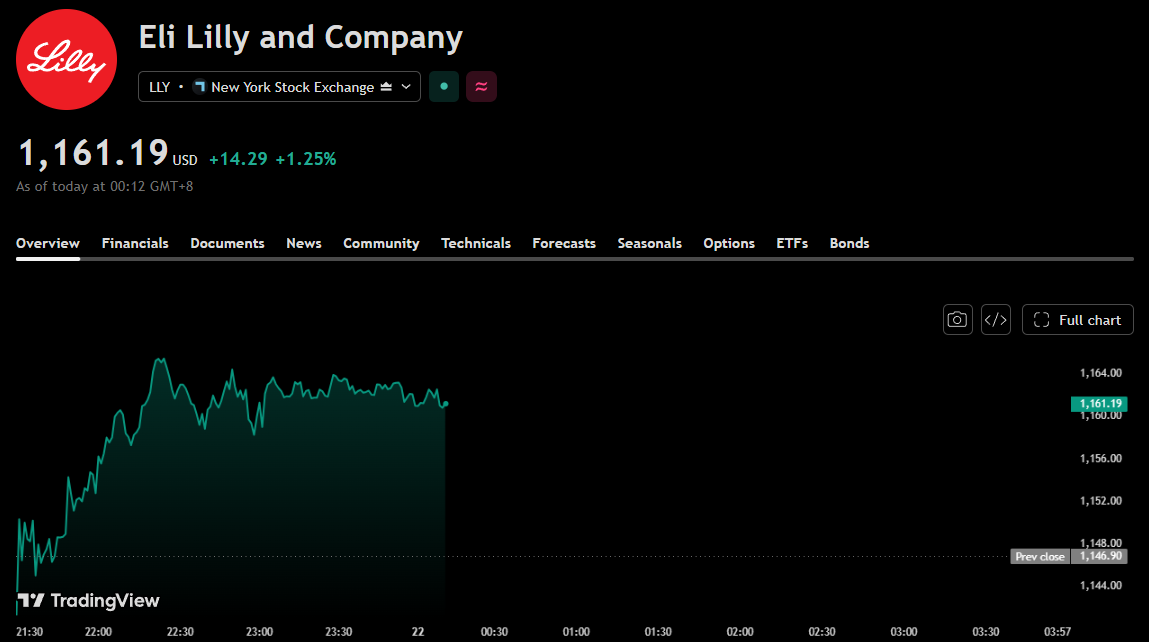
Source: TradingView
What Happened: A Lawsuit Sparked by an Ad
At the heart of Novo Nordisk's lawsuit is a television advertisement that Eli Lilly has been running nationwide since April. John Kuckelman, General Counsel of Novo Nordisk, said in an interview that the ad cites results from a head-to-head study of the two drugs, claiming that patients using Zepbound lost an average of 50 pounds, while those on Wegovy lost an average of 33 pounds.
Novo Nordisk's allegations target the "selective" nature of this data: Eli Lilly compared the maximum dose of its own drug with a lower dose of Novo Nordisk's drug in the ad, while deliberately omitting the latest clinical data for Novo Nordisk's higher-dose version.
Kuckelman said that Novo Nordisk had sent a formal cease-and-desist letter to Eli Lilly in April, but Eli Lilly not only refused to pull the ad, but instead added a disclaimer that Novo Nordisk described as "inadequate."
"They have caused misinformation to spread, and now they need to clean it up," Kuckelman said.
Core Dispute: Outdated Data vs. Only Direct Evidence
Novo Nordisk's logic: The head-to-head clinical trial cited in Eli Lilly's advertisement used the 1.7 mg and 2.4 mg doses of Wegovy. However, Novo Nordisk subsequently obtained approval for a higher dose—7.2 mg Wegovy, which entered the market in March 2026, with clinical studies showing it helps patients lose an average of 47 pounds (about a 19% reduction in body weight). Novo Nordisk believes a more reasonable comparison should refer to two different studies: one showing that high-dose Wegovy led to an average weight loss of 47 pounds, and another showing Zepbound achieved an average weight loss of 48 pounds—making them "clinically consistent." In other words, at their highest doses, the weight-loss efficacy of the two drugs is nearly equivalent.
Novo Nordisk also pointed out that Eli Lilly only mentioned the existence of high-dose Wegovy in its advertisement via a "small footnote," but that this footnote was "vague, confusing, nearly illegible, and entirely inadequate"—failing to convey the key fact that the high-dose version is significantly superior to the low-dose version.
Eli Lilly's logic: Eli Lilly clearly stated in a Tuesday statement that it "stands firmly behind our advertising." The company emphasized that "the gold standard for comparing drugs is a rigorously designed, well-executed head-to-head clinical trial"—and the study it used remains the only clinical trial to date that directly compares the two drugs.
At the same time, the litigation documents disclosed a key data point: since launching in late April, Eli Lilly's television commercials for Zepbound have accumulated more than 700 million impressions. Novo Nordisk is using this figure as direct evidence of the "scale of competitive harm." The same logic applies to the diabetes drug field. Novo Nordisk alleges that Eli Lilly's Mounjaro ads compare its highest 15 mg dose with the 1 mg version of Novo Nordisk's Ozempic, while failing to mention the higher 2 mg maintenance dose that has been approved for years.
This content was translated using AI and reviewed for clarity. It is for informational purposes only.
Recommended Articles










Comments (0)
Click the $ button, enter the symbol, and select to link a stock, ETF, or other ticker.