


Memory Giant Kioxia’s US IPO: Key Information You Need to Know



AI Podcast


On May 15, 2026, Kioxia announced plans for a U.S. ADS listing to expand its international investor base. Following a 70-fold stock surge since its December 2024 Tokyo debut, the company has become Japan’s largest by market capitalization. Kioxia’s financial turnaround is fueled by record-breaking revenue and strong AI-driven NAND demand, with 2026 capacity fully committed. Analysts emphasize that structural shifts toward enterprise SSDs and severe industry-wide supply constraints underpin this growth. The U.S. listing aims to capitalize on high market liquidity, positioning Kioxia alongside other memory giants as a primary vehicle for global AI infrastructure exposure.
TradingKey - On May 15, 2026, Japanese memory giant Kioxia Holdings officially announced plans to list its American Depositary Shares (ADS) on a U.S. stock exchange. Over the past year and a half, this Toshiba 'castoff' focusing on NAND flash memory has skyrocketed from its nadir. In just 18 months since its listing, Kioxia's stock price has surged over 70-fold cumulatively, with its total market capitalization surpassing Toyota to claim the top spot in the Japanese stock market.
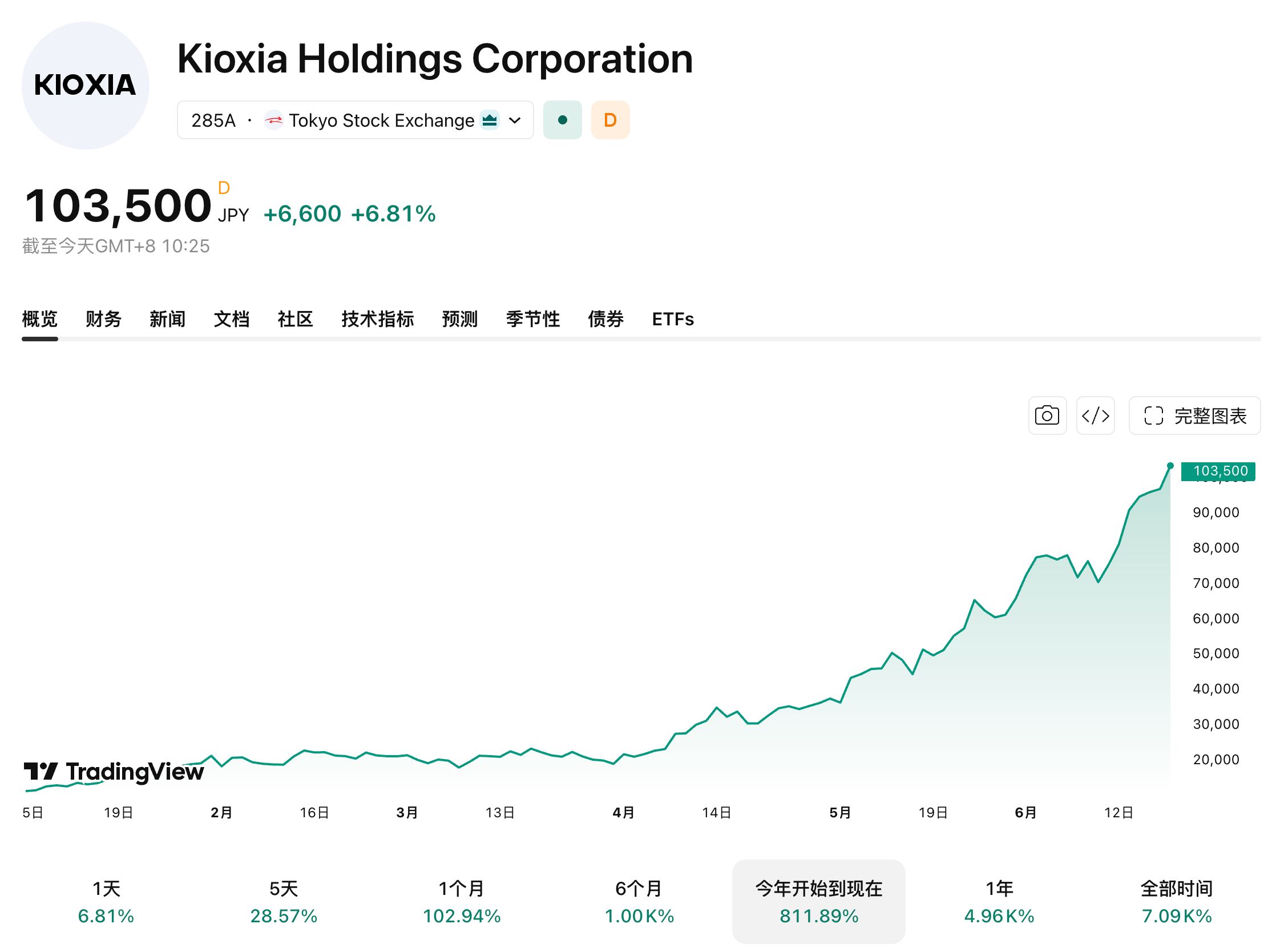
[Source: TradingView]
What kind of company is Kioxia?
Kioxia was formerly Toshiba's memory division. In 1987, Toshiba pioneered the development of NAND flash memory technology, sparking a digital revolution in the storage industry. In 2015, Toshiba plunged into crisis due to an accounting scandal. In 2018, a consortium led by US private equity firm Bain Capital (including SK Hynix) acquired its memory business for approximately $18 billion. In October 2019, Toshiba Memory was renamed "Kioxia," a name that combines the Japanese word for "memory" and the Greek word for "value."
Kioxia's journey after gaining independence has not been smooth. Affected by weak NAND market demand and falling prices, the company suffered massive consecutive losses from 2023 to 2024, and its IPO plans were repeatedly shelved: although the Tokyo Stock Exchange approved its listing in 2020, it was cancelled due to US-China trade tensions; in 2021, its proposed merger with Western Digital was also opposed by SK Hynix. A turning point came on December 18, 2024, when Kioxia finally debuted on the Tokyo Stock Exchange's Prime Market, with an offering price of 1,455 yen and a valuation of approximately 784 billion yen.
Kioxia's US Listing Timeline and Plans
As of the close of trading on June 19, following the explosion in AI demand, Kioxia's share price surged from its IPO price to over 100,000 yen, representing a cumulative gain of approximately 70-fold. Its total market capitalization surpassed 56 trillion yen, and its ranking among listed companies in Japan jumped from 43rd at the end of 2024 to 1st.
On May 15, 2026, Kioxia announced plans to issue American Depositary Shares (ADS) in the U.S. to expand its international investor base and enhance corporate value. The plan is subject to U.S. regulatory approval, with the exchange, timing, and offering size yet to be finalized. With global memory chips currently facing a severe supply shortage, analysts believe Kioxia is striving to complete its international capital positioning before a new wave of supply is released in 2027. Andrew Jackson, head of Japanese equities strategy at Ortus Advisors, commented that the U.S. listing will tangibly boost liquidity, making Kioxia a preferred target for ADR arbitrage trading.
Notably, SK Hynix also confidentially filed for an ADS listing with the U.S. SEC in March 2026, aiming to raise $14 billion. With the two memory giants heading to the U.S. concurrently, it has shaped a market narrative of the 'twin memory giants flocking to U.S. equities.'
Kioxia Posts Record Financial Results as Sold-Out Capacity Drives Surge
Kioxia's confidence in advancing its secondary listing stems primarily from its record-breaking financial performance. In the fourth quarter of fiscal year 2025, single-quarter revenue reached 1.0029 trillion yen, surging 459% quarter-on-quarter, while operating profit hit a record high of 596.8 billion yen. For the full year, revenue reached 2.337 trillion yen, up 37% year-on-year; operating profit was 870.4 billion yen, up 93% year-on-year; and net profit doubled year-on-year to 554.49 billion yen.
The core driver is the rapid surge in NAND flash prices, with U.S. dollar-denominated prices more than doubling during the quarter. In 2026, major NAND manufacturers will have almost no new production capacity, while AI server demand remains strong, leading the industry to project a supply shortage for the entire year. Kioxia confirmed as early as February that all of its 2026 NAND capacity had been locked in advance by customers, with some hyperscale clients even requesting long-term supply covering 2027 to 2028. TrendForce projects that NAND contract prices could increase by another 70% to 75% quarter-on-quarter in the second quarter of 2026.
Looking ahead to the first quarter of fiscal year 2026, Kioxia has provided revenue guidance of up to 1.75 trillion yen, with operating profit expected to reach 1.298 trillion yen, representing another 117.5% increase in quarterly operating profit. If these expectations are met, quarterly net profit will increase by more than 48-fold year-on-year.
Global NAND Competitive Landscape
According to Counterpoint data, global NAND market revenue reached $46 billion in Q1 2026, representing a year-on-year increase of 246%, with a single-quarter scale exceeding that of the entire year of 2023. Enterprise SSDs accounted for 43% and are expected to exceed 60% by the end of the year. Market shares and revenues of major manufacturers are as follows:
Rank | Vendor | Market Share | Q1 Revenue | QoQ Revenue Growth | Key Highlights |
1 | Samsung | 29% | $13.51 billion | 1.047 | Solidly in first place |
2 | SK Hynix | 18% | $7.53 billion | 0.446 | Dual-focus layout on DRAM + NAND |
3 | Kioxia | 14% | $5.96 billion | 0.8 | Revenue grew 80% QoQ, ranking third |
4 | Micron | 13% | $5.95 billion | 0.967 | Tied with SanDisk |
4 | SanDisk | 13% | $5.95 billion | 0.967 | Data center business grew over 200% QoQ |
4 | YMTC | 13% | — | — | Domestic dark horse, with market share surging YoY |
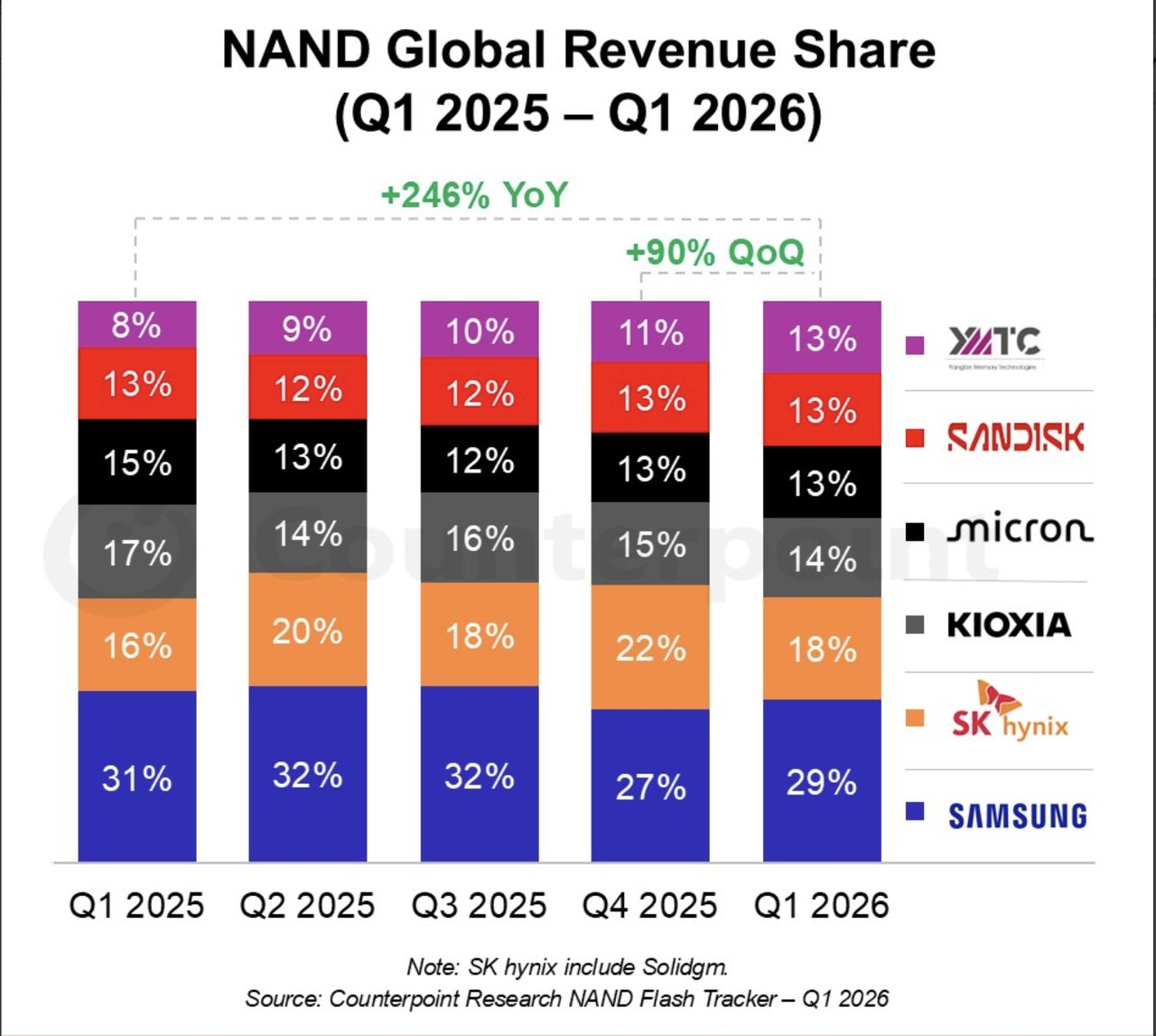
[Source: Counterpoint]
The battle for third place is exceptionally fierce, with Kioxia, Micron ( MU ), SanDisk ( SNDK ), and YMTC all seeing their shares fall within the 13% to 14% range. In terms of industry trends, TrendForce stated that major NAND original manufacturers will have almost no new capacity in 2026, and a supply shortage is expected for the entire year amid robust AI demand. Micron's CEO warned that the shortage could persist beyond 2026, with new capacity not being released until at least 2028, making the tight supply-demand situation difficult to ease in the short term. For Kioxia, which is planning a US IPO to issue ADSs, its pricing in the US stock market will depend on its growth resilience and competitive position within this landscape.
What are the available investment channels for Kioxia?
Currently, K iox ia is only listed on the Tokyo S tock Exchange under the ticker T YO : 285A.
Ch annel 1: Open a Japanese brokerage account
Individual investors can open a Japanese trading account through brokerages with trading access to the Japanese stock market to directly buy and sell K iox ia shares. Some international brokerages provide access to the Japanese stock market.
Ch annel 2: Indirect holdings through E T Fs
Global X Japan Mid & Small C ap Leaders E T F (listed in Japan, ticker 2837) : With a single weight of 48.13%, it has become the world's most concentrated E T F holding K iox ia, far exceeding other similar products. The E T F primarily covers Japanese mid- and small-cap stocks, with the top five holdings accounting for 71.58%, representing an extremely high risk concentration.
Ren aissance International I PO E T F ( I POS ) : Focuses on investing in global I POs listed within the past year and a half. As of April 30, 2026, Japanese stocks accounted for approximately 38.25% of its regional weight, with K iox ia's current holding weight at around 15.85%.
V ic tory Sh ares International Free C ash F low Growth E T F ( G R IN ) : As of early June 2026, its assets under management (A UM ) stood at approximately $268 million, with an expense ratio of 0.56%. It maintains a moderate holding size among actively managed E T Fs and features a diversified international stock portfolio, with K iox ia's current weighting at approximately 11.79%.
Round hill Memory E T F ( D R AM ) : Listed on April 2, 2026, it is the market's first pure-play memory chip E T F. Its portfolio is highly concentrated in three giants—Mic ron, S am sung Electronics, and S K H yn ix—with K iox ia's weighting ranging between 6.81% and 8.22%.
Ch annel 3: Through the A D R channel (pending listing completion)
K iox ia has announced plans to issue A DS in the U.S. If approved, the American Deposit ary Shares will be listed and traded on a U.S. stock exchange, at which point investors can directly invest in K iox ia A DS through U.S. stock accounts. As of the completion of this draft, the listing exchange and timing have not been announced, and this channel is still awaiting regulatory approval.
Investment Perspective and Summary
The core investment thesis for Kioxia's US listing is as follows:
First, AI-driven NAND demand has transcended traditional cyclical fluctuations. In the first quarter of 2026, enterprise solid-state drives (eSSDs) accounted for 43% of the total NAND market, and Counterpoint expects this figure to exceed 60% by the end of the year. Kioxia's primary growth driver is shifting from consumer electronics to data centers, as structural demand increasingly overshadows the industry's cyclical nature.
Second, supply-side constraints have amplified price elasticity. In 2026, major NAND chipmakers have no plans to add new capacity, and Kioxia's full-year capacity is already sold out, with some customers locking in supply for 2027 to 2028. Driven by these three factors, prices are unlikely to decline rapidly, providing solid support for Kioxia's financial performance.
Currently, Kioxia's US listing is still awaiting approval from the U.S. SEC. Looking ahead, key areas to watch include the approval progress, IPO pricing, and its valuation relative to other memory chip ADRs. For international investors who want to tap into the global AI memory sector but are deterred by the entry barriers of the Japanese market, Kioxia's ADSs will be an option worth tracking.
This content was translated using AI and reviewed for clarity. It is for informational purposes only.
Recommended Articles






Comments (0)
Click the $ button, enter the symbol, and select to link a stock, ETF, or other ticker.