


Nokia Stock Forecast: Why Private Wireless Could Be More Important Than 5G; NOK To Break Above $16?



AI Podcast


Nokia's Q1 2026 revenue was €5.1 billion, with an 11.5% non-IFRS operating margin, meeting full-year outlook. While Mobile Networks faces 5G capex slowdowns, the Enterprise segment, particularly private wireless, is a key growth driver independent of telecom cycles. Nokia's proactive 6G research and standards leadership via Bell Labs offer long-term licensing revenue potential. Technically, NOK trades above key EMAs, suggesting a neutral-to-bullish bias, with a potential target of $16.68. Risks include sustained telecom capex decline and competition.
TradingKey - Nokia (NYSE: NOK) trades at $14.45, remaining above the EMA50 ($14.41) and EMA200 ($14.27) lines of its 4H chart following a measured retracement from its $16.68 top. An RSI of 58.66 is neutral-bullish with no bearish divergences and green candles reflecting buyer absorption with limited red follow-through. The company reported Q1 2026 revenue of approximately €5.1 billion in modest growth, improved its non-IFRS operating margin to about 11.5%, and stood by its full-year outlook of flat to marginally higher net sales and a margin between 11% and 13.5%.
Mobile Networks faces the impact of softening 5G spending, while the Enterprise segment, particularly private wireless, is its fastest-growing unit and often a neglected part of the overall story in light of the magnitude.
Nokia’s Enterprise Private Wireless – Most Important Growth Story
The macro 5G capex cycle driving the telecom equipment makers narrative is largely a telecom operators story, Verizon, AT&T, Deutsche Telekom, and their global counterparts, which is slowing the pace of new tower and base station construction as the first generation 5G build-out completes. That is true, and that is why Mobile Networks is under pressure.
Nokia’s Enterprise unit, which includes the growth engine of private wireless, sells to a completely different customer, on a completely different capex cycle, i.e. factory manufacturers, logistics companies, ports and mining firms building their own isolated ultra-reliable low-latency wireless networks for industrial automation, robotics, and IoT.
That is a key distinction. These enterprise private network customers are not reducing capex in the face of the same macro forces that telecom operators are feeling. Rather, they are building networks to achieve their digitization/automation agenda in a way that is not directly tied to telecom capex cycles. A port company going after private 5G for automated container cranes, or a mining company going after private wireless for self-driving underground vehicles, is an operational efficiency project with its own ROI, not a telecom infrastructure renewal cycle.
That Nokia is well-positioned to win that market, given the years of building carrier-grade network reliability infrastructure and adapting it to the industrial customer, suggests Nokia can maintain Enterprise growth while Mobile Networks flattens or falls, which is a true offset growth driver in one company.
6G Research Leadership – How Nokia Bell Labs’ Pre-Positioning Becomes More Important A Decade Ago
Nokia’s work via Nokia Bell Labs towards the development of 6G, and its stated intention to be a 6G standard leader ahead of the 6G cycle starting in the early 2030s, seems like a very early play given that the current 5G cycle is still coming of age.
But in the telecom equipment world, setting the standards has historically been the longest lasting competitive advantage an equipment maker can enjoy, with patents embedded in a global standard producing a licensing revenue stream and first-mover advantage on selling equipment, all the way until the standard cycles itself and becomes the technology of the day (which can be 10+ years).
Nokia’s performance across the 4G and 5G eras has proved the power of this, as Nokia was still able to derive licensing fees from a core cellular patent portfolio, even as its equipment market share was eroded by Huawei and Samsung in some markets.
Investing in 6G research today when the payoff is 10 years out is Nokia securing the advantage that has historically been one of the least dependent on equipment revenue streams for the company. For Nokia stock today a defensive telecom equipment name, Nokia’s 6G pre-positioning is the option value Nokia should be valued more highly for today.
NOK Technical Summary – EMA50/EMA200 Support At $14.27–$14.41, $16.68 Target
4H chart: NOK $14.45, above EMA50 $14.41 and EMA200 $14.27, with both EMAs clustered immediately underneath, forming a layered moving average support stack. An ascending black trendline from lower lows marks higher lows in a rising channel.
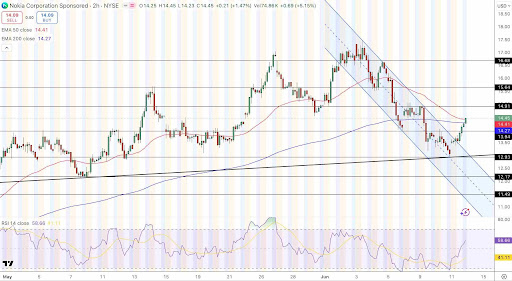
A descending blue trendline from $18.50 highs defines a range between $14.91 and $15.64. An RSI of 58.66 is neutral-bullish with no bearish divergence and space above before overbought. A 4H close above $14.91 breaks the resistance to aim for the channel extension and higher $16.68.
- Entry: Long above $14.91, desc trendline broken
- Target: $16.68, channel extension, prior high
- Stop Loss: Daily close below $14.27, EMA200 support failure
What Did Nokia Report in Q1 2026?
Nokia announced Q1 2026 revenue of roughly €5.1 billion with modest year-over-year growth. Mobile Networks continue to face headwinds from softer 5G capex, but Fixed Networks and Enterprise continued their strong showing. Non-IFRS operating margin came in at approximately 11.5%.
Company-wide guidance stood by the full-year outlook of flat to modestly higher comparable net sales, and 11% to 13.5% operating margin. Chief Executive Pekka Lundmark cited continued advancement in private wireless networks and in optical infrastructure as a key highlight.
What Is Private Wireless and Why Is It Nokia’s Fastest-Growing Segment?
A private wireless network is a dedicated wireless system deployed specifically for an enterprise site, typically optimized for extremely high reliability and low latency in order to support industrial automation, robotic control, or IoT use cases in the context of manufacturing facilities, warehouses and distribution centers, ports and terminals, and mines.
Unlike public telecom operator 5G networks, where growth has been tapering as networks move past peak deployment, private wireless spending is instead driven by corporate demand to digitize and automate operations and to capture associated efficiency benefits.
This growth is independent of telecom network capex and therefore provides an alternative revenue source within Nokia’s Enterprise segment even as Nokia’s Mobile Networks business continues to face cyclical headwinds.
Is NOK a Buy at $14.45 Given the Slow 5G Capex Cycle?
Technical: The stock price remains above EMA50 at $14.41 and above EMA200 at $14.27. Relative strength index (RSI) has come in at 58.66, signaling the uptrend is likely still intact. There are no obvious signs of bearish divergence to note. A long position initiated above $14.91 carries a price target of $16.68, with a stop placed at $14.27.
Fundamental: With the company's private wireless network business within the Enterprise segment growing, and improving margins toward the 11 to 13.5% guided range, combined with Nokia's leading role in 6G Bell Labs and standards setting for the next 10+ years, and also with its dependable dividend payout, NOK remains a defensive telecom stock, but with significant built-in optionality.
Risks are, of course, a prolonged slowdown in telecom 5G capex spending as well as intensifying competition from Huawei in cost-driven markets.
Bottom Line
Nokia trading at $14.45 is a defensive telecom stock offering two compelling hidden growth catalysts: enterprise private wireless networks which are expanding even as telecom operator 5G capex growth stalls, as well as Bell Labs 6G standards leadership that has translated into a strong revenue stream from licensing for 10+ years in the past. Nokia's margin rebound in Q1 2026 to 11.5% along with a stable full-year margin target indicate the company is successfully managing costs.
The stock is technically sound, trading above EMA50 and EMA200 with RSI showing a neutral-to-bullish bias. A long entry above $14.91 is a logical play targeting $16.68, with a stop at $14.27. The steady dividend and strong balance sheet give the stock stability as the enterprise and 6G stories evolve.
Recommended Articles









Comments (0)
Click the $ button, enter the symbol, and select to link a stock, ETF, or other ticker.