


GameStop Stock Forecast: Can Ryan Cohen’s $1.1B Cash War Chest Lift GME?



AI Podcast


GameStop's Q1 2026 revenue fell 8% to $880 million, though gross margins improved and net loss decreased, ending with $1.1 billion in cash and minimal debt. Technicals show a breakout above a downward trendline, with RSI indicating building momentum. The stock's $1.1 billion cash serves as a strategic asset, providing runway for potential acquisitions, buybacks, or dividends under Ryan Cohen. However, the legacy physical business continues to decline, and new growth engines have not yet offset this erosion. Further information is expected in the Q2 2026 earnings report.
TradingKey - GameStop (NYSE: GME) sits at $22.56 as of June 3, having just pushed through the downward-sloping trendline drawn from the $24.28 peak on the hourly chart. This breakout was accompanied by bullish engulfing patterns and a noticeable surge in volume. The Relative Strength Index (RSI) is ranging 46 to 70 which shows building momentum before reaching overbought territory. Fundamentals are quite strange for the stock to receive this amount of retail trader interest with its Q1 2026 revenue $880 million down 8% from the prior year, physical game sales continuing to be a secular decline while the company has managed to decrease its net loss while at the same time improving its gross margins and finished the quarter with $1.1 billion or so in cash and not much long-term debt to speak of. GameStop holds more cash per share as a retailer than many, the question is how much of a catalyst that cash could be or will it act simply as a buffer.
The $1.1B Cash: What Ryan Cohen Can Actually Do
It is worth emphasizing that the financials in the $1.1 billion figure are somewhat unique: GameStop has almost no long-term debt. That cash position is both the company’s biggest strategic asset and the central argument in the bull thesis at current prices: even if the physical retail business continues to decline, the $1.1 billion provides years of runway and meaningful optionality for capital allocation. The bull case in part hinges on the premise that even if the core retail business continues to bleed cash, the company’s $1.1 billion balance sheet still affords the business years of runway and significant potential to allocate capital.
Ryan Cohen has a clear set of options in regard to capital allocations:
- Acquisitions: use cash to buy a business to change the revenue profile away from physical retail. Cohen has a history of being careful to not overpay (activism history Chewy, and GameStop), and we’ve heard a lot about him, but he hasn’t done an acquisition yet (years of cash).
- Share buybacks: return capital back to shareholders at a stock price that trades for a reasonable premium to cash on the balance sheet
- Special dividends
- Continued operational investment in e-commerce and collectibles
I have said for some time that Cohen is very patient when it comes to making moves, and if he makes a significant acquisition or substantial buyback, that would be the best positive catalyst for the stock since the 2021 squeezers ran up the stock.
What the Q1 2026 Results Tell Us About the Speed of the Transformation
I think the Q1 results are the most honest assessment we have of where this transformation stands. We can take it as a fact that physical game sales is declining — revenue of $880 million in Q1 is down 8% year-over-year — and that we have yet to reach an inflection point with respect to the new businesses in terms of the ability to offset the erosion in physical sales. As I said, the gaming industry is shifting from physical to digital. That trend started over 10 years ago and it is clear where it will go.
GameStop is doing things in the right direction: shutting unprofitable stores, expanding collectibles, growing e-commerce, but it simply hasn’t grown new revenue fast enough to compensate for the pace of physical sales decline. Gross margin improvement is real and cost cutting is very real, and the company has not yet achieved consistent positive free cash flow from the business.
However, what is exciting to me is what has driven the gross margin improvement and what will be the growth engines for the company over the next several quarters (at least). In particular, it is the collectibles, higher margins accessories that will be the biggest driver of organic revenue growth from here.
This business is less sensitive to digital distribution because a physical pop and a physical limited edition controller does not have a digital equivalent: collectibles and accessories are still driven by discretionary spending. GameStop benefits from its network of physical stores and its brand recognition within gaming culture, both a major competitive advantage that pure-play e-commerce sellers will struggle to replicate in the category. Whether that will be enough to overcome physical game sales declines is the key question and will be more fully answered in the Q2 2026 earnings report in late August.
GME Technical Setup: Descending Trendline Break at $22.56, Targets $23.68 and $24.28
In particular, in the 1H chart, we see GME break out of the declining blue line (from $24.28 high), bullish engulfing candles and higher volume in the breakout of the horizontal resistance ($21.98 to 22.01). On any dips we’ve had to 20.88, long lower wicks are holding at least $20.88 support. RSI 46 to 70 is building momentum with room to run before being overbought.
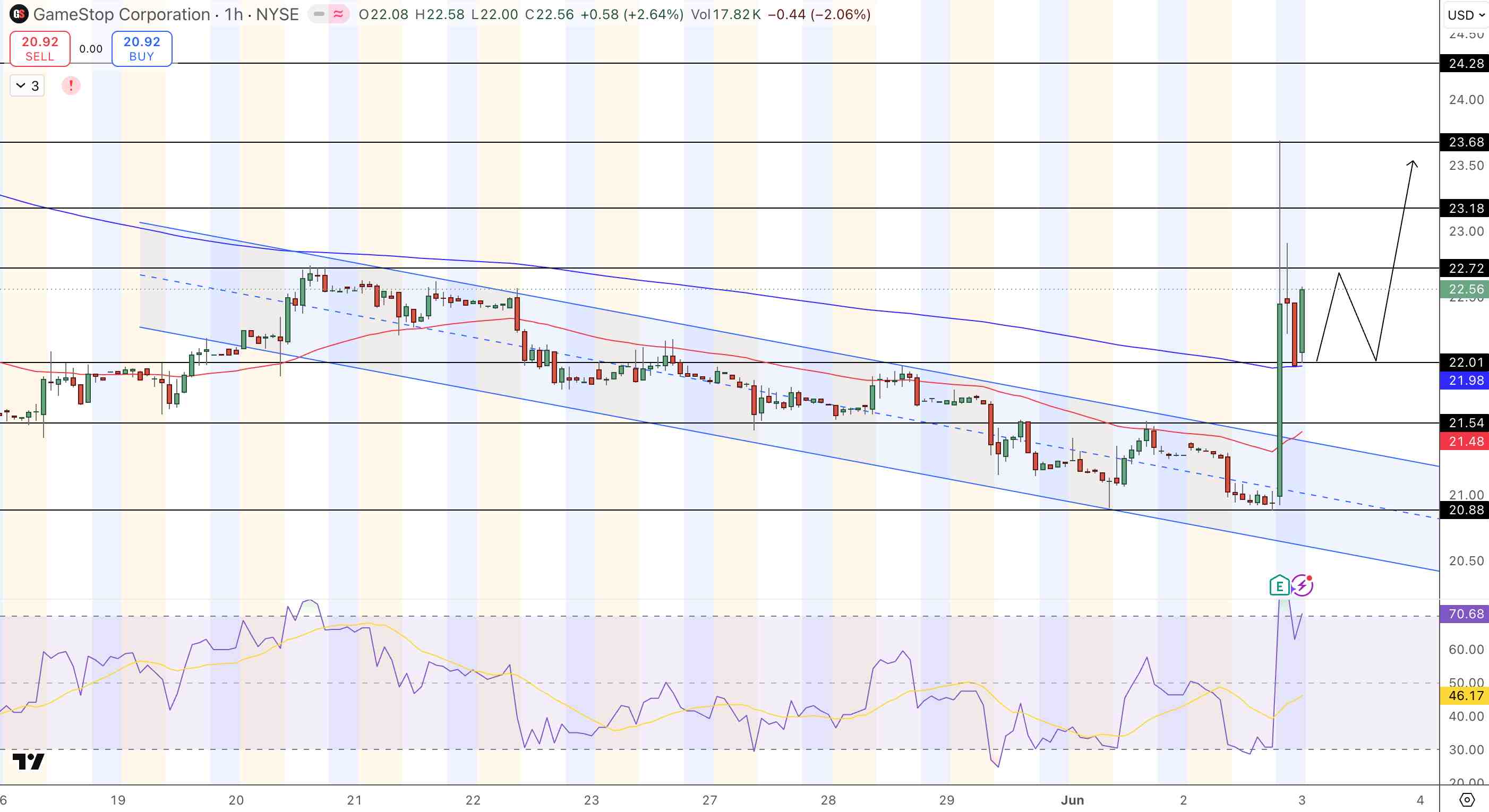
We have resistance at 22.72, then 23.68 to 24.28, where the channel projection converges with prior high resistance level. Support at 21.54 to 20.88. A close at 21.54 on the daily would undermine the near-term short-term breakout.
TRADE SETUP
- Entry: Buy above 23.18, confirmation of breakout on the trendline
- Target: 23.68, extension on the channel
- 2nd Target: 24.28, prior resistance highs
- Stop loss: Close of daily below 21.54, support level failure
What is GameStop's current financial standing as of 2026?
GameStop finished Q1 2026 with approximately $1.1 billion in cash and cash equivalents, as well as almost zero long-term debt. This is one of the most secure liquidity positions in the retail industry. Q1 revenue came in at $880 million and fell 8% compared to the same period last year as traditional video game sales continued to suffer from their secular downturn. The company managed to reduce its net loss from the year-ago quarter and increased gross profit margins by exercising more cost controls, optimizing its inventory, and growing sales of higher-margin merchandise, collectibles, and accessories. It has yet to reach a stage of positive free cash flow driven by organic activities.
What is Ryan Cohen's plan for GameStop?
Cohen, the Executive Chairman, has promoted operational control, extensive store reductions, growth of the digital marketplace and collectibles business since he took up a more active management role. Hundreds of poorly-performing outlets have been shuttered in the last two years. The strategy is transforming the retailer from a failing physical games business into a streamlined, higher profit operation by expanding online channels, growing the collectibles business and potentially adding technology-centric growth opportunities. The $1.1 billion cash balance gives him the flexibility to fund an acquisition, a buyback or a special dividend, all of which have not yet been utilized on a significant basis.
Would GME be a good purchase at $22 in June 2026?
The technicals illustrate a short-term move over the descending trendline on the 1H chart with the RSI starting from 46 and some space remaining before becoming overbought. A long trade above $23.18 would aim at $23.68 and $24.28 with a protective stop placed at $21.54. From a fundamental standpoint, the cash position of $1.1 billion sets the minimum floor for valuation, and provides strategic optionality. However, the risks remain that the legacy physical business will continue to contract faster than the nascent growth engines, Cohen will not utilize the cash for a transaction that adds shareholder value, and the stock will revert to pricing itself off of short-term retail sentiment and short covering activity.
The Bottom Line
GameStop's $1.1 billion in cash, with almost no debt, is the only hard piece of value in the investment thesis. A fall in revenue of 8% and the fact that positive cash flow from continued growth has yet to occur are the honest caveats. The move over the 1H trendline above $22.01 aims at $23.68 and $24.28, with a protective stop at $21.54. A capital deployment action, whether an acquisition, buyback or dividend, not a return to growth from the core business would be the driver of a significant rise in the shares. The earnings report coming at the end of August would be the next piece of information. Until he does something with the cash, the shares can be used as a speculative long-term investment in the cash, and a vehicle for short term trading.
Recommended Articles





Comments (0)
Click the $ button, enter the symbol, and select to link a stock, ETF, or other ticker.