


Snowflake Stock Forecast: Can AI Demand Drive SNOW Back to Its $317 Record High?



AI Podcast


Snowflake (SNOW) surged on strong Q1 FY2027 earnings, driven by 31% product revenue growth and 28% RPO expansion. The stock broke previous resistance and targets $299.75 and $317.60. Sustaining this momentum requires Q2 results to confirm continued revenue growth above 31% and RPO growth exceeding 25%, indicating an acceleration cycle. The Snowflake Marketplace, an "app store for data" with significant network effects, presents an under-modeled upside. Key support is at $256.91.
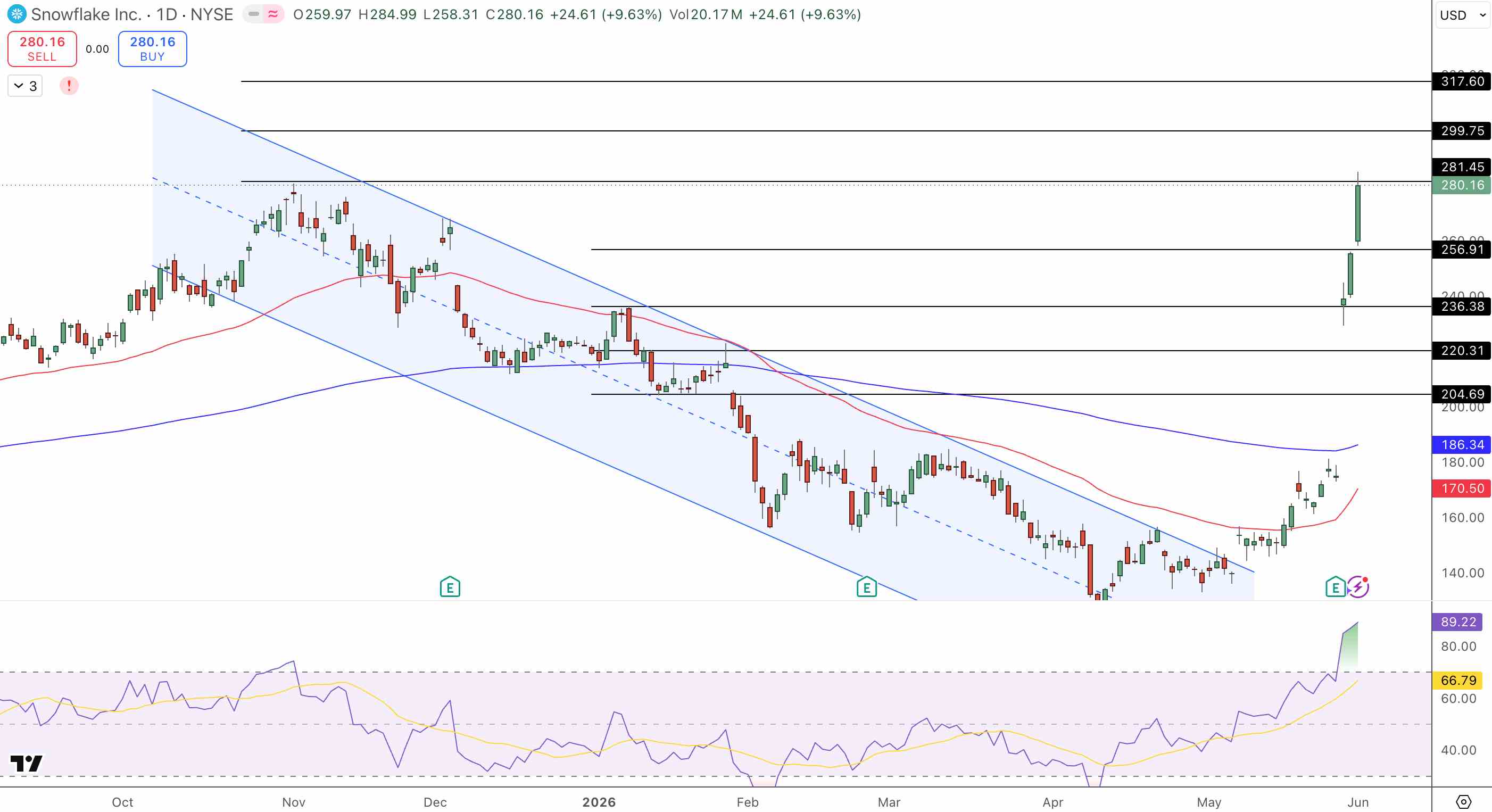
TradingKey - Snowflake (NYSE: SNOW) sits at $280.16 on June 2, rising an additional 9.63% on heavy volume to continue the breakout that got underway when Q1 FY2027 earnings rose 36% on May 29. The daily chart reflects a clear break of the $317.60 all-time high trendline, the former resistance zone at $236 to $257 now acting as support, and a projected extension to $299.75 and $317.60. Snowflake has advanced from $184 to $280 across five trading sessions, a 52% move driven by authentic fundamental re-rating, not a squeeze. The question at $280 is no longer about the authenticity of the breakout; it's about what Q2 FY2027 needs to produce to fill the remaining $37 gap back to the previous high, and what the risk would be if it doesn't.
Why the $280–$317 Move Requires Q2 to Confirm Consumption Acceleration
The May 29 earnings beat was 31% product revenue growth, 28% acceleration in RPO and $68 million in non-GAAP operating income. The result was the end of a two-year thesis of declining rates and contracting margins. The stock now carries a premium, which necessitates that Q2 FY2027 earnings (due in late August) confirm Q1 was the beginning of an acceleration cycle rather than a one-off quarterly blip.
Two numbers will decide if the $280-$317 extension is sustainable: First, will product revenue growth at or above 31% continue? A decline to 25% or below would indicate a one-quarter catch-up period, rather than a newly set run-rate. Second, how will AI-related consumption growth (which CEO Ramaswamy has termed accelerating) show in Q2: as a specific % growth disclosure, or as an AI workload % disclosure of all platform consumption?
$4.8 billion in RPO at 28% growth is the forward indicator that justifies this. RPO represents the amount a customer is contractually obligated to spend with Snowflake over the next 12-24 months; there is no re-stating or re-booking it. 28% growth of an existing $4.8 billion RPO represents approximately $1.34 billion of new committed revenue added to Q1 alone. Should Q2 see growth rate at or above 25%, revenue deceleration risk drops significantly because future committed revenue is already recorded on the books. A trade towards $317 is not dependent on Q2 consumption numbers to confirm the thesis.
The Snowflake Marketplace and Data Monetisation — the Revenue Layer Most Analysts Are Not Modelling
The two articles leading up to this one explored Snowflake's cloud-agnostic nature, Cortex AI and Iceberg. The upside that most are not modelling is the Snowflake Marketplace. Marketplaces let third parties publish data sets, AI models and applications that Snowflake customers can consume within their own Snowflake data cloud. There has been accelerated growth in the number of listings and associated consumption during 2026. The business model is inherently profitable; Snowflake takes a cut of the transaction fees generated by marketplace activity, and every marketplace consumption event generates Snowflake Compute product revenue as well. It is the app store for data.
The market's strategic significance goes beyond revenue. A data set listed on the Snowflake Marketplace means that company lists its data on a Snowflake standard, since that company's customers are consuming it inside Snowflake. The same is true of AI models; any AI model available via the marketplace creates a Cortex AI inference workload inside Snowflake. This becomes a flywheel: More models and data attract more customers. More customers = more consumption. More consumption = marketplace becomes more attractive to more model and data providers. This is a network effect Databricks doesn't possess at anywhere near the same scale, and is a key reason the Snowflake competitive advantage continues to compound rather than simply stay flat.
SNOW Technical Setup — $256.91 Is Now Support, Targets $299.75 and $317.60
The 9.63% day has cleared the $236-256.91 former resistance zone on significant volume. The $317.60 all-time high trendline has been breached. The price point at $256.91 has flipped from resistance to support (a daily closing price below it invalidates the breakout). All moving averages are trailing well below the stock. The projected channel projection points towards $299.75 as the initial target, and the full extension to $317.60. RSI reflects strong momentum without the stock becoming overbought.
TRADE SETUP
- Entry: Long at $281.45+ on price continuation to the upside above former resistance zone
- Target 1: $299.75, based on channel extension projection
- Target 2: $317.60, the stock's former all-time high
- Stop Loss: Daily close at $256.91, representing the failure of former resistance turning support
What Is Driving Snowflake Stock Higher After Earnings?
SNOW has gone up more than 50% from $184 low to $280 in 5 trading days after Q1 FY2027 earnings beat in May 29 due to product revenue up 31%, RPO up 28% to $4.8 billion and non-GAAP operating income of $68 million ending the two-year decline/deceleration and margin compression cycle. CEO Ramaswamy built back Cortex AI and Iceberg products to enable consumption acceleration to justify re-rating and volume on the move has been very heavy to indicate institutions in the stock versus retail.
What Does Snowflake Need to Deliver in Q2 FY2027 to Sustain $280?
Q2 FY2027 due out in late August will need to have product revenue growth at 31% or better to avoid looking like Q1 was an one-time quarter to make up for missed numbers and RPO growth of over 25% as $4.8 billion with 28% RPO growth means $1.34 billion of contracts committed in Q1 alone and to see continued RPO growth will help confidence in contracted future revenue in support of multiple before we have actual consumption numbers that show the trend.
What Is the Snowflake Marketplace and Why Does It Matter?
The Snowflake Marketplace is where third parties list datasets, AI models and apps to allow Snowflake customers to consume these directly inside their Snowflake environment and Snowflake gets a revenue share of the transaction and Snowflake also makes product revenue from the consumption. The marketplace AppStore model on enterprise data has network effect where more listings mean more Snowflake customers which means more consumption so more new listings. It's the compounding moat Databricks doesn't have at this scale.
Bottom Line
SNOW moved from $184 to $280 in 5 trading days after fundamentals re-rating the stock and the $317.60 ATH is only 37 away and we have the chart structure to see more. We need the Q2 FY2027 results with product revenue growth at 31% and RPO growth of over 25% in late August to confirm Q1 results was not an one time quarter and a start to re-acceleration and the marketplace network effect is the upside that has been undermodelled. At $280, my stop is at $256.91 and I have targets at $299.75 and the $317.60 ATH and the late August earnings are where our thesis plays out as to whether we hold or test.
Recommended Articles









Comments (0)
Click the $ button, enter the symbol, and select to link a stock, ETF, or other ticker.