


Oracle Stock Compresses Below $149 as Sept. 10 Earnings Near



AI Podcast


Oracle demonstrates robust AI-cloud fundamentals, highlighted by 93% OCI growth and a $638 billion backlog, reinforced by a new networking deal with HPE. However, capital expenditure, potential debt issuance, higher Treasury yields, and EU software-licensing scrutiny present financial and regulatory risks. Technically, Oracle maintains a cautiously bullish stance above the $142.13 support level. A decisive breakout above $148.75 could drive momentum toward the $159.23 all-time high, with the upcoming September 10 earnings report serving as an immediate catalyst for assessing revenue sustainability and capital deployment.
TradingKey - Oracle's price on September 3 is around $145.80. This is close to the $145.76 price on the provided chart. Prices are more or less linearly bounded between some upper and lower limits. As such, this formation is more or less neutral and can be construed bullish above $142.13. From a fundamentals perspective, the story is also bullish. Growth of OCI was 93% in the latest quarter. There is also a backlog of around $638 billion, and Oracle's new networking agreement with HPE greatly facilitates Oracle's building of AI infrastructure. The first big event that can change this is the earnings on September 10.
OCI Growth Is the Core Bull Case
Oracle's earnings for Q4 of fiscal 2026 were $19.2 billion in revenue, meaning a year on year growth of 21%. Of the total, cloud services made up $9.9 billion. This total also reflects a year on year growth of 47% and an even higher growth rate of 93% for Oracle's Cloud Infrastructure. There was also a 20% year on year growth for GAAP operating income to $6.1 billion.
These results also provide evidence that Oracle is becoming an AI hyperscale cloud service provider. However, to Oracle's detriment, this growth does also mean increased costs for Oracle for services and infrastructure.
$638 Billion Backlog Gives Exceptional Visibility
At the end of fiscal 2026, the remaining obligations for Oracle amounted to $638 billion. This backlog, comprised of large multi-year AI cloud contracts, gives excellent long-term revenue visibility.
Investors should not consider this backlog a guarantee of revenue in the short-term. To fulfill these obligations, Oracle must first invest capital, and therefore the revenue backlog is only a starting point of the business case when combined with power availability.
HPE Deal Supports Gigawatt-Scale AI Infrastructure
Hewlett Packard Enterprises (HPE) announced a significant deal on September 2, with a multi-year global deployment of Juniper Networking gear across Oracle's AI data centers. This placement includes high-capacity routing and switching, as well as support and financing offerings.
Although the deal's monetary value remains undisclosed, its weight carries notable effect. Given this deal, it's apparent Oracle is scaling its network fabric to support the operation of even larger GPU clusters (an AI compute backbone). As part of the agreement, HPE issued warrants to Oracle, permitting the latter to purchase HPE share stock.
September 10 Earnings Are the Immediate Catalyst
Oracle's fiscal Q1 2027 earnings report will be released after the markets close on September 10 and the accompanying conference call will be held at 4:00 p.m. Central. Analysts will monitor OCI growth, backlog conversion, Q2 guidance, capex, free cash flow and debt issuance.
For its fiscal 2027 target of approximately $90 billion of total revenue, Oracle intends to target the first assessment of whether the company can maintain the AI-cloud acceleration. The company anticipates creating a major revenue stream, albeit with the potential for increased financial burden.
EU Licensing Scrutiny Adds Regulatory Risk
Reuters reported on September 1 that the EU antitrust authorities are gathering information from third parties about Oracle's software-licensing practices. Among other things, they are tracking potential Oracle customer restrictions and the cost implications associated with moving Oracle software to other cloud providers.
Though no finding of a violation has occurred, there is currently no formal investigation. Software licensing is a major net runner, and any rule changes that reduce Oracle's control over pricing or ease the software migration would negatively affect profitability.
Debt and Higher Yields Are the Main Financial Risks
Oracle's focus on AI, along with a significant investment in GPU, network, lease, and cloud infrastructure, has been reported by Reuters in conjunction with plans to issue additional debt.
With an increase in Treasury yields, the financial burden of these projects increases for Oracle. For the company, the increase in yields is not just an issue of valuation of financial projects with a long payback period, but increases the cost of financing long-duration AI projects.
Oracle Technical Analysis: $148.75 Is the Confirmation Level
ORCL is roughly trading at $145.80 and matches the reference level at $145.76. Price is currently trading in a tight range between a descending trendline and a rising support structure which buyers defended at around $140.
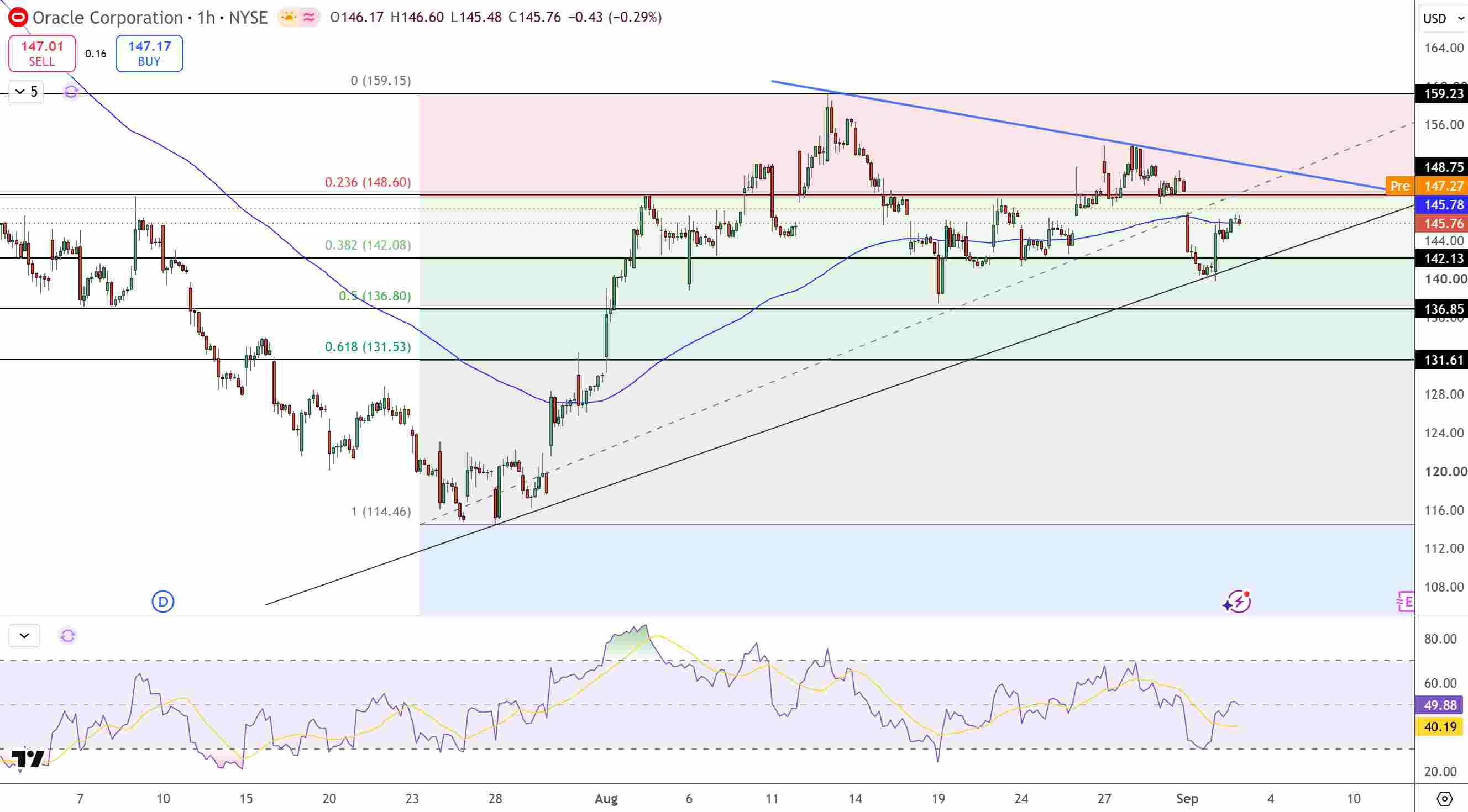
Oracle Stock Price Chart - Source: Tradingview
The first major resistance sits between $147.27 and $148.75 and includes the 23.6% Fibonacci level at roughly $148.60. A break above $148.75 would clear the descending trendline and would put focus on the bullish target of $153-$156 and beyond the previous all-time high of $159.23.
RSI at the 50 level is above its signal line at 40, reflecting neutral but improving momentum. Key support is at $142.13. A move below the rising trendline and $142.13 would open the 50% Fib level at $136.80 with $131.61 even lower.
Key Levels
· Current price is roughly at $145.80
· Important support at $142.13.
· Deeper supports at $136.80 and $131.61
· Potential breakout resistance of $147.27-$148.75
· Potential focus area of $153-$156
· Major target of $159.23
· RSI at around 50, neutral and improving
Why is Oracle's AI-cloud story important?
OCI (Oracle Cloud Infrastructure) is growing at nearly 93% and Oracle has roughly $638 billion of remaining performance obligations, demonstrating strong customer demand for cloud based AI Infrastructure and database services.
What level confirms a stronger ORCL breakout?
A move above $148.75 clears the descending trendline and supports the potential for the bullish focus on $153-$156 and beyond $159.23.
Bottom Line
Oracle's AI-cloud fundamentals remain strong, but the market is increasingly focused on the cost of fulfilling its enormous Oracle has a strong foundation for AI and cloud computing, but the market is more interested in the cost of fulfilling a large backlog. The HPE networking deal supports additional capacity, but the European Union scrutiny, increasing debt, and higher yields create major concerns. ORCL will remain cautiously bullish above $142.13. An improvement in momentum is only expected above $148.75, and if that level is broken, then the price can be expected to rise toward $159.23.
Recommended Articles










Comments (0)
Click the $ button, enter the symbol, and select to link a stock, ETF, or other ticker.