


Snowflake Stock: Is the AI Data Cloud Moat Worth the 36% Pop to $255?



AI Podcast


Snowflake's multi-cloud neutrality, Cortex AI, and Iceberg address historical criticisms of cost and lock-in, positioning it as an open AI data platform. This is supported by Q1 FY2027 results showing 31% product revenue growth and 28% RPO growth to $4.8 billion. Technically, the stock exhibits higher highs and lows above a broken trendline, with near-term support at $239.20 and targets at $281.45 and $299.75. The primary risk involves the elevated multiple and potential slowdown in consumption growth.

Snowflake (NYSE: SNOW) is at $255.40 on June 1, continuing higher above the descending trendline breakout that triggered the 36% pop in a single day on May 29. On the 4H timeframe, Snowflake is showing higher highs and higher lows above the red dynamic trendline, with near-term support coming in at $239.20 and the breakout extension target at $281.45 and $299.75. The May 29 article discussed the Q1 FY2027 beat, and why 31% product revenue growth and 28% RPO growth signaled a structural re-rating rather than just a one-day rally. This article explains why the competitive advantage is strong enough to hold Snowflake for $281 instead of taking profits at $255.
The Multi-Cloud Neutrality Advantage Is Even More Important in 2026 Than in 2021
Snowflake’s multi-cloud neutrality, the capability of being deployed identically on AWS, Azure, and Google Cloud, without data locking or data movement costs, has always been a differentiator. In 2026, it is critical for enterprises to build AI infrastructure. This is because every hyperscaler has launched its own competing data and AI platforms: AWS has SageMaker and Redshift, Microsoft has Fabric and Azure AI, and Google has BigQuery and Vertex AI. These data and AI platforms have deep discounts and are tightly coupled to the hyperscaler’s own compute stack. Once an enterprise commits to a data and AI platform in its native cloud, it gets attractive discounts and integrations but incurs permanently higher switching costs as new models are trained and new pipelines created.
Snowflake’s advantage in that competitive setting is not competing on the price of hyperscalers, but providing the neutral space that gives enterprises the choice to run AI workloads on any hyperscalers, without rebuilding the data infrastructure if they need a different cloud. Many Fortune 500 IT departments have multi-cloud strategies, and these enterprises need a single data layer spanning multiple clouds. Snowflake is the single data platform that sits above all three clouds. Snowflake consumption pricing means customers pay for what they use across any cloud, without incurring a minimum spend requirement on any specific vendor’s data infrastructure. The 28% RPO growth in Q1 to $4.8 billion shows that enterprises are leaning into Snowflake, rather than leaving for hyperscaler data and AI platforms.
Cortex AI and Iceberg: How Ramaswamy’s Product Changes Filled the Gap
With two major complaints against Snowflake before the arrival of CEO Sridhar Ramaswamy in early 2024, Snowflake was too expensive, and Snowflake locked customers in to its proprietary table format. The former complaint was that Snowflake was much costlier to run than open-source data lakehouse alternatives, and the latter was that Snowflake table format is proprietary and customers incur data egress fees to run Snowflake data on any tools outside of Snowflake. Both criticisms were fair, and both pushed many customers over to Databricks, which could deploy open-source compute on open data tables via the Delta Lake table format.
Cortex AI and Iceberg tackle both of those criticisms head-on. Cortex AI is Snowflake’s built-in AI platform that lets enterprises create, deploy, and run AI apps with major LLMs directly on Snowflake-managed and governed data, without moving Snowflake data. Data egress is the biggest expense at scale for AI workloads, and Cortex AI removes this cost. Iceberg is Snowflake’s open table format to run Spark, Trino, and Flink on Snowflake data without egressing data from Snowflake. These two products transform Snowflake from a proprietary data warehouse to an open and interoperable data foundation that can run AI applications and any data workloads without egressing Snowflake data. Consumption growth in Q1 tells us if these product changes were accepted by the market.
Technical Outlook For SNOW: Higher Targets of $281 and $300
The 4H timeframe for SNOW is at $255.40. Higher highs and higher lows above a rising channel are occurring after the trendline was broken above from the $317.60 peak. The nearest support sits at $239.20, from the breakout consolidation period on May 29.
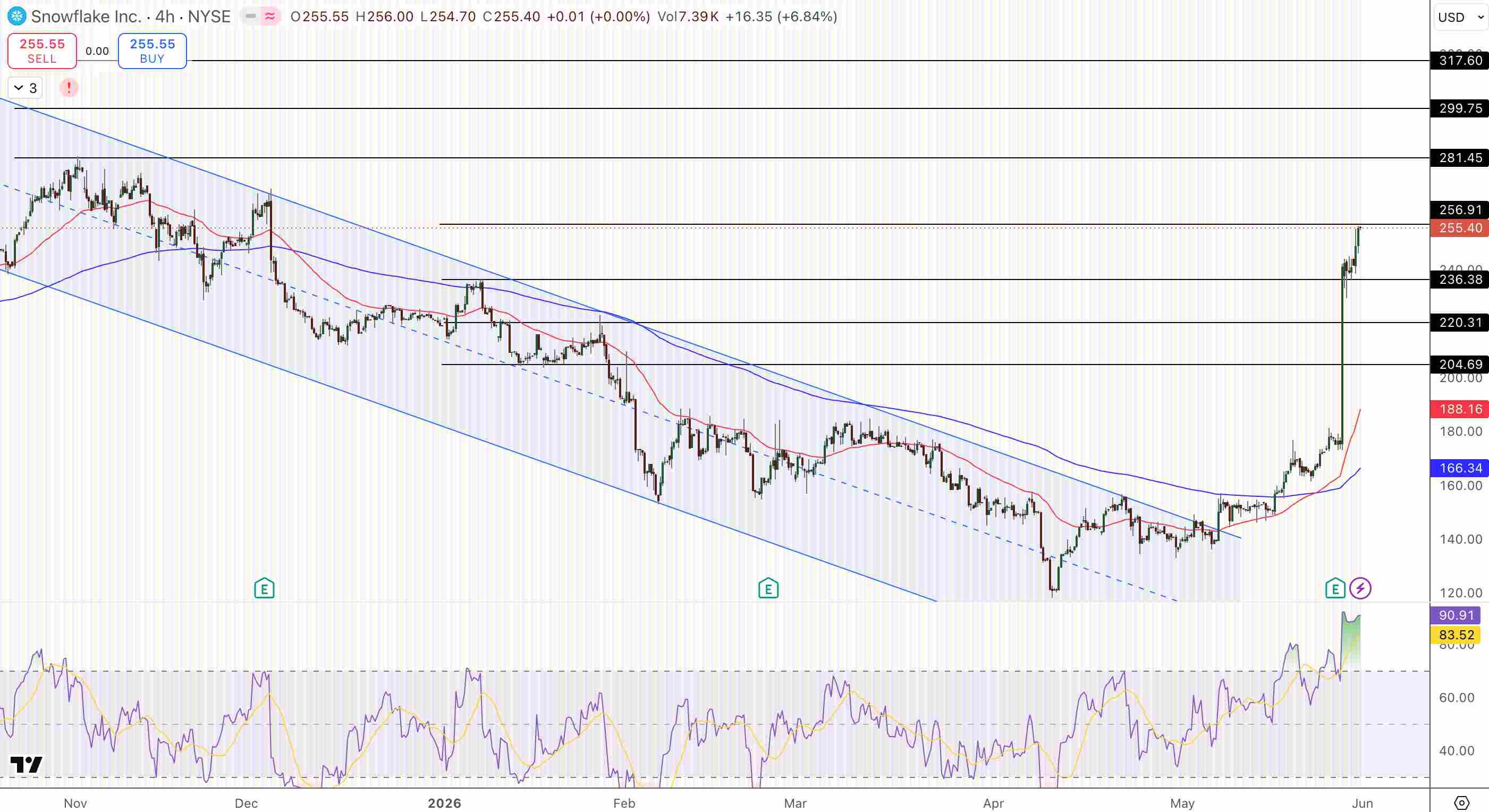
All moving averages are below SNOW, which is positive for continuation. Momentum is strong on the RSI. The breakout extension first target is $281.45, followed by the upper target of $299.75. A daily close under $239.20 would negate the validity of the breakout structure.
TRADE SETUP
- Entry: Long above $256.91, 4H resistance is being broken
- Target 1: $281.45, Breakout extension
- Target 2: $299.75, Upper trend channel
- Stop Loss: Daily close under $239.20, Breakout support fails
Why Is Snowflake’s Multi-Cloud Approach a Competitive Advantage?
Because Snowflake functions the exact same way whether your data lives on AWS, Azure, or Google Cloud, as there is zero cost or complexity to moving data across them. By 2026, every major hyperscaler rolled out its own AI and data platform offering, with price cuts to try to keep customers working within their own ecosystem. Companies that operate across multiple clouds, which most Fortune 500 businesses and their CIOs, cannot afford separate data stacks for each cloud.
So Snowflake operates a neutral data tier, over and above these three big hyperscalers, and charges a variable per-consumption usage rate. This matches the variable usage rate needed for variable AI workloads. This is why first-quarter remaining performance obligation grew 28% year-over-year to a record $4.8 billion, which tells us companies will continue to extend their Snowflake spending.
What Are Cortex AI and Iceberg and Why Do They Matter?
Cortex AI is the built-in AI toolset, which enables enterprises to build and run AI applications directly on their Snowflake data, governed by Snowflake. This lets enterprises work with the largest foundation models and eliminates costs incurred by moving data between separate databases, AI tools and external platforms. Iceberg is an open table format that allows the data Snowflake stores to be queried by external platforms. External data compute engines, like Spark, Trino, or Flink, can access Snowflake data without moving it.
Snowflake has two historical criticisms: cost and proprietary lock-in. These two features address this critique, turning the data warehouse from a closed data silo into a neutral, open AI data foundation. This is why first-quarter product revenue accelerated 31%.
Is SNOW Still a Buy at $255 After the 36% Earnings Pop?
The breakout is continuing with a series of higher highs and higher lows above the descending trend that was previously broken. A long entry price above $256.91 targets $281.45 and $299.75 and has a stop below $239.20. On a fundamentals level, 31% growth in product revenue, $4.8 billion in remaining performance obligation up 28% year-over-year, total revenue growth of 29%, and a non-GAAP operating profit of $68 million, provides a solid re-rating of Snowflake’s multiple.
The primary risk is that the 36% move could have left little near-term risk/reward. If consumption growth slows down for the second quarter, or there is negative competitive commentary from Databricks, this would be more magnified, given the elevated multiple post-earnings. The thesis remains intact as long as consumption growth in AI continues to strengthen at the platform level.
Bottom Line
To summarize, Snowflake at $255 is not a trading opportunity on a single quarter of earnings; it is a fundamental multiple re-rating for a platform that built a product for two years to answer their two main critiques. With the three main features, multi-cloud support, Cortex AI, and Iceberg, Snowflake is no longer a proprietary, expensive data warehouse. It is now a neutral, open, AI data platform for companies with multi-cloud infrastructures.
These hyperscaler data platforms, like Azure, Amazon, and Google do not offer this solution. This price is breaking through a descending trendline on the 4-H chart, and we can expect the price to move toward $281.45 and $299.75. The thesis will remain as long as AI consumption accelerates in the second quarter. The next proof point would be the second-quarter fiscal year 2027 earnings report in late August.
Recommended Articles








Comments (0)
Click the $ button, enter the symbol, and select to link a stock, ETF, or other ticker.