


After Trillion-Dollar Market Cap, Micron Rises Another 8% Pre-Market. By Contrast, Nvidia Stock Price Seems Slightly Dim.



AI Podcast


Micron Technology's stock surged significantly following a UBS price target increase, pushing its market cap over $1 trillion and highlighting the AI rally's expansion. Storage companies are benefiting from escalating data volumes and AI-driven demand for high-performance chips like HBM and DRAM. Analysts suggest the AI boom and related storage demand represent a multi-year industrial cycle. While Nvidia's growth has moderated, storage manufacturers are now attracting significant investor attention due to sustained demand and supply constraints, with overcapacity remaining a potential long-term risk.
TradingKey - US storage concept stocks collectively strengthened in pre-market trading, with Micron Technology ( MU) expanding its gains to 8%, once again drawing market attention.
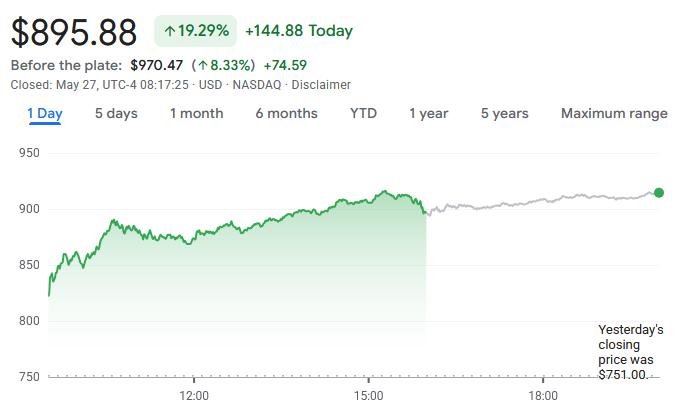
In the previous trading session, Micron's stock price surged over 19% in a single day, breaking through the trillion-dollar market capitalization milestone. The direct catalyst for this rally was a major research report from UBS ( UBS )—the bank significantly raised Micron's price target from $535 to $1,525, a threefold increase.
Renowned US financial host Jim Cramer believes the AI rally has entered a new phase. The "trillion-dollar market cap threshold," once exclusive to a few top tech companies, is becoming easier to cross under the empowerment of AI. This does not mean the value of the elite club is being diluted, but rather that AI technology is providing more companies with the fundamental strength to rise as global giants.
Alongside the surge in Micron's share price, storage companies such as Western Digital ( WDC ), Seagate Technology ( STX ), and others also saw pre-market gains exceeding 4%.
The storage industry has continued to benefit from the explosive growth of global data volumes in recent years. In particular, the rapid popularization of cloud computing and big data analytics has significantly increased enterprise demand for high-performance storage solutions.
According to IDC forecasts, total global data will reach 175 ZB by 2026, further driving innovation in storage technology and industrial investment. As one of the industry leaders, Micron Technology is at the core of this growth wave.
Meanwhile, amidst the wave of AI infrastructure construction, demand for storage chips such as HBM, DRAM, and NAND is experiencing explosive growth. Unlike the traditional cloud computing era, generative AI models require higher data throughput, larger memory capacity, and more complex memory architectures, which is rapidly elevating the strategic importance of storage chips.
The rapid expansion of AI servers, inference clusters, and agent workloads is triggering a global memory shortage. Storage manufacturers like Micron and SK Hynix have become the biggest beneficiaries of this supply-demand imbalance.
Wedbush Securities analyst Dan Ives described the current AI boom as the "third inning of a nine-inning game." He believes the AI revolution is just beginning and that the storage demand driven by AI is not a short-term trend but an industrial cycle that could last for years.
Ives pointed out that demand for HBM, DRAM, and NAND flash has reached historic peaks. As cloud giants like Microsoft, Google, Meta, and Amazon continue to ramp up AI infrastructure construction, the capital expenditure of global tech giants is expected to reach $725 billion in the future.
Against this backdrop, the HBM supply shortage is unlikely to ease in the short term, while the risk that could potentially break the semiconductor supercycle remains overcapacity. However, several analysts believe that building new capacity in the storage industry typically takes several years, so the short-term supply-demand imbalance will persist.
Compared to Micron's stellar performance, Nvidia ( NVDA ), which led the AI race early on, faces different market expectations.
Since the beginning of this year, Nvidia's stock gain has been relatively modest, recording only a 14% increase, in contrast to Micron's cumulative rise of over 210% over the past year.
Furthermore, a pattern has often emerged over the past few quarters where the stock pulls back on "selling the news" after earnings, only to climb slowly mid-quarter. Despite Nvidia delivering an excellent report that exceeded expectations across the board, its share price still trended lower post-earnings.
This divergence in stock performance may reflect that the AI rally is entering a new phase. From GPUs to memory, demand for AI computing power is spreading. Storage chip manufacturers like Micron are becoming Wall Street's new favorites, while Nvidia, the early leader, faces more pragmatic market demands regarding its return on capital.
This content was translated using AI and reviewed for clarity. It is for informational purposes only.
Recommended Articles








Comments (0)
Click the $ button, enter the symbol, and select to link a stock, ETF, or other ticker.