


 Discount


Kospi Falls Below 5,000 Mark, Nikkei 225 Drops Over 3%; SoftBank Plunges 14%, Kioxia Tumbles Over 10%, Samsung and SK Hynix Fall Over 4%



AI Podcast


Japanese and South Korean stock markets plunged sharply at the open on November 20, driven by external tech headwinds and overnight Wall Street losses. The KOSPI fell 3.69% to 4,948.20, while the Nikkei 225 dropped 3.24% to 57,519.17, with major chipmakers and heavyweights like SoftBank recording steep double-digit losses. The downturn reflects dampened regional risk appetite stemming from U.S. semiconductor weakness, regulatory tightening concerns, AI investment scrutiny, and capital reallocation toward new listings, triggering broad profit-taking and risk deleveraging across existing AI hardware and memory supply chains.

TradingKey - Japanese and South Korean stocks tumbled at the open, with the KOSPI breaking below the key 5,000 mark, the Nikkei 225 dropping 3.24%, and both SoftBank and Kioxia plunging more than 10%.
During Asian trading hours on November 20, Japanese and South Korean stock markets both opened under noticeable pressure from external tech headwinds and heavyweight stock adjustments, with both markets exhibiting high volatility.
South Korea's benchmark KOSPI index opened sharply lower by 4.08%, tumbling directly below the key 5,000 mark, with losses currently narrowing to 3.69% at 4,948.20 points; Samsung Electronics slumped 4.57%, falling below the 190,000 mark to trade at 187,900 won; SK Hynix plunged 6.17% to trade at 1,110,000 won.
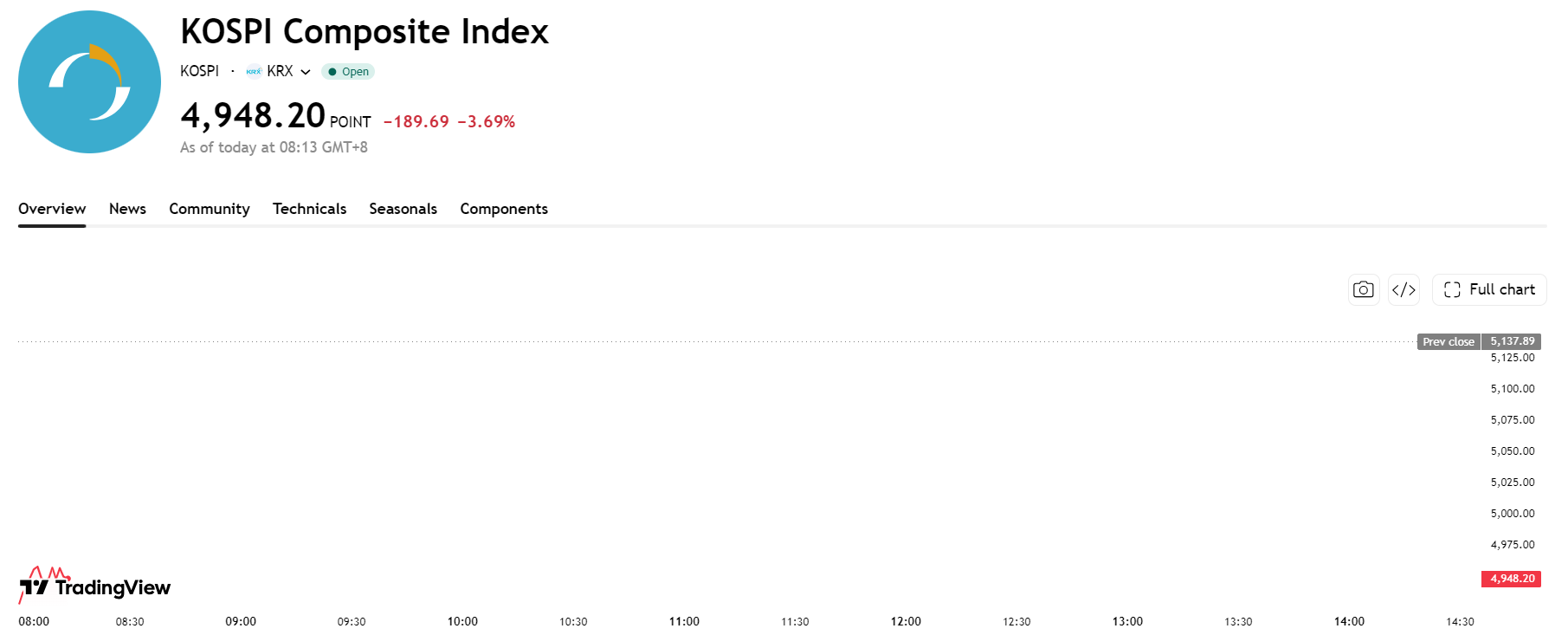 KOSPI index chart, Source: TradingView
The Nikkei 225 index plunged sharply after the open, opening lower and moving downward to drop 3.24% at 57,519.17 points; both major heavyweight stocks plummeted, with Kioxia tumbling 10.37% to trade at 7,413 yen, and SoftBank crashing 14.05%, nearing the 3,000 mark to trade at 3,040 yen.
Overnight, all three major U.S. stock indices fell more than 2%, with tech and chip stocks weakening, including Nvidia (NVDA) giving up intraday gains to close lower, (AMD) plunging over 7%, and Broadcom (AVGO), Micron (MU) and other semiconductor names heading lower, which quickly spilled over into Asia-Pacific markets and dampened risk appetite at the open in Japan and South Korea.
Recently, in addition to facing concerns over U.S.-China tech and export compliance allegations and regulatory tightening, the semiconductor industry has seen the market remain highly alert to AI infrastructure returns on investment, financing structure transparency, and the pace of expansion; moreover, as Anthropic (ANT)'s listing attracts massive attention and capital reallocation, some capital has engaged in phased profit-taking and risk deleveraging across existing AI hardware and memory supply chains.
This content was translated using AI and reviewed for clarity. It is for informational purposes only.
Recommended Articles








Comments (0)
Click the $ button, enter the symbol, and select to link a stock, ETF, or other ticker.