


South Korea’s Kospi Plunges 8% to Trigger 10th Circuit Breaker This Year; SK Hynix, Kioxia Drop Over 11% as AI Funding Worries Sweep Asia



AI Podcast


On October 15, Asian tech stocks experienced a sharp sell-off, with South Korea's KOSPI plunging over 8% and triggering a circuit breaker amid a seven-day losing streak. Japan's Nikkei 225 similarly dropped 5%. This correction was triggered by hotter-than-expected U.S. inflation data, raising concerns over prolonged high interest rates and increased financing costs for AI infrastructure. Surging borrowing costs for capital-intensive firms like CoreWeave heightened credit risk fears, weighing heavily on high-valuation semiconductor giants such as Samsung Electronics and SK Hynix. Analysts note that market volatility will persist until U.S. interest rate trajectories and AI cash flows clarify.

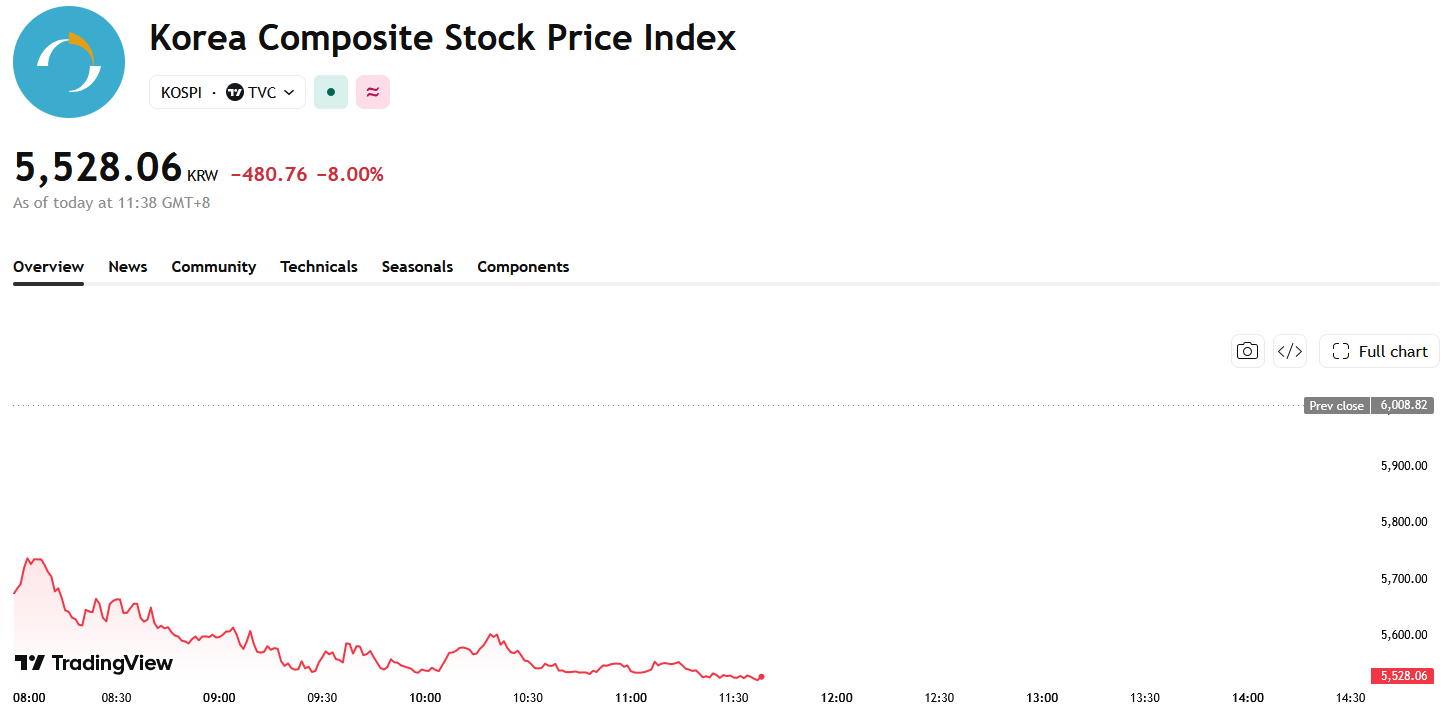
TradingKey - On October 15, the sell-off in Asian tech stocks escalated further. South Korea's KOSPI index extended its intraday losses to over 8%, triggering a circuit breaker that halted stock trading for 20 minutes. This marked the tenth time the South Korean stock market has triggered a circuit breaker this year.
Source: TradingView
The KOSPI has fallen for seven consecutive trading days, declining by a cumulative total of approximately 21% over the period—its longest losing streak since September 2024—and dropping to a low since late July. As the two heavily weighted stocks in the South Korean market, SK Hynix fell more than 11% intraday, while Samsung Electronics dropped nearly 10%. Concentrated selling in both companies directly amplified the index's decline.
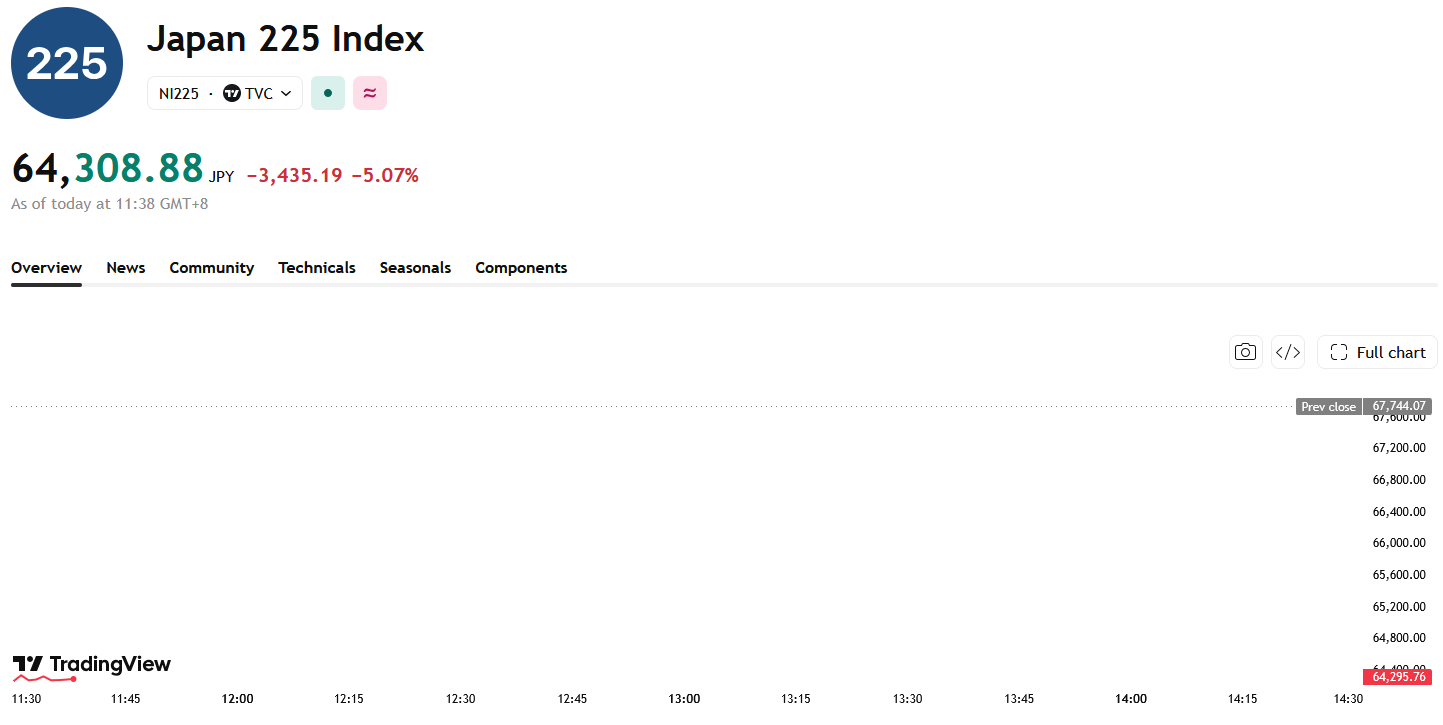
The tech slide also spread to Japan, with the Nikkei 225 index falling about 5% at one point, on track for its largest single-day drop since March 9. AI and semiconductor-related companies such as SoftBank Group, Kioxia, and Tokyo Electron led the decline. Among them, SoftBank fell over 9%, while Kioxia dropped more than 11%, indicating that investors are sharply trimming their exposure to high-valuation tech assets.
Source: TradingView
The immediate catalyst for this round of correction in Asian stock markets was reheating U.S. inflation. In September, the U.S. Consumer Price Index rose 0.6% month-on-month and 3.7% year-on-year, both exceeding market expectations. Rapidly rising energy costs have raised investor concerns that inflationary pressures could persist for longer, forcing the Federal Reserve to raise interest rates further or keep them elevated.
As U.S. Treasury yields pushed higher, the market began re-evaluating the financing costs of AI infrastructure investments. Building data centers, GPUs, and advanced memory capacity requires massive capital. The expansion model previously supported by low-cost financing could face greater debt service and refinancing pressures in a rising interest rate environment. Semiconductor companies that previously enjoyed high valuations driven by the AI boom have consequently become the primary targets of capital outflows.
Such concerns first surfaced in the U.S. market, where the closely watched Philadelphia Semiconductor Index fell for six consecutive trading days, wiping out approximately $1.6 trillion in market capitalization. Although Samsung Electronics and ASML recently reported relatively strong financial results, positive earnings failed to dispel investor doubts over valuations, interest rates, and the sustainability of AI capital expenditures.
A slump in both the stock and bond prices of CoreWeave further heightened market anxiety. The AI cloud provider's stock plunged over 15% on Wednesday, while some of its corporate bond prices fell to around 80% of par value, pushing yields up to about 15%—entering territory typically regarded as high-risk. CoreWeave relies heavily on debt to build data centers, and its rapidly rising borrowing costs are seen by the market as a key barometer for monitoring AI credit risk.
For the South Korean market, the impact of cooling AI trades is particularly pronounced. Samsung Electronics and SK Hynix carry heavy weights in the KOSPI, and both are core players in the global DRAM and high-bandwidth memory (HBM) supply chains. Markets had previously bet that AI server demand would sustain the HBM upcycle beyond 2028, fueling sharp rallies in both stocks. Now, capital is beginning to question how long memory prices, customer capex, and the industry's peak profitability can be sustained.
Jo Hyunik, investment manager at Iroom Investment Advisory in Seoul, believes that weak market sentiment continues to build up. Until there is greater clarity on the U.S. interest rate path and midterm election results, Asian equities may continue to exhibit high volatility driven primarily by capital flows.
Meanwhile, Kang Dae-kwon, CEO of Life Asset Management, noted that South Korean stock valuations have fallen to low levels and that further share price declines might gradually create buying opportunities, provided that financing pressures in the AI sector subside. In other words, cheap valuations alone are insufficient to trigger a market reversal; investors still need to see corporate borrowing costs decline and AI investments generate stable cash flows.
This content was translated using AI and reviewed for clarity. It is for informational purposes only.
Recommended Articles









Comments (0)
Click the $ button, enter the symbol, and select to link a stock, ETF, or other ticker.