


South Korea’s 2027 Budget Hits Record $597 Billion as Semiconductor Taxes Drive AI Investment



AI Podcast


On September 1 Asia-Pacific time, South Korea announced a record 2027 budget proposal of 820.9 trillion won, up 12.8% year-on-year. Driven by a semiconductor boom, projected corporate tax revenue will more than double, helping narrow the fiscal deficit-to-GDP ratio to -0.1% and lower the debt-to-GDP ratio to 48.3%. Excess revenues will establish a 162.3 trillion won "Future Response Fund" to buffer volatility and fund strategic growth. However, this model heightens fiscal reliance on the semiconductor cycle. The proposal will be finalized by December 2, testing South Korea's ability to translate chip manufacturing advantages into broader AI competitiveness.

TradingKey - On September 1 Asia-Pacific time, the South Korean government announced its 2027 budget proposal, with total expenditure reaching 820.9 trillion won (approx. $597 billion), a year-on-year increase of 12.8%, setting a record high for South Korea's annual budget increase and surpassing the 10.6% during the 2009 global financial crisis.
On the day of the budget announcement, South Korea's KOSPI index fell in early trading due to overseas market weakness and geopolitical factors, touching an intraday low of 6,732.47 points. Subsequently, semiconductor stocks such as Samsung Electronics and SK Hynix (SKHY) rose, driving the index to recover. By the close, the KOSPI index gained about 0.23%, with Samsung Electronics and SK Hynix rising approximately 0.1% and 1.37%, respectively.
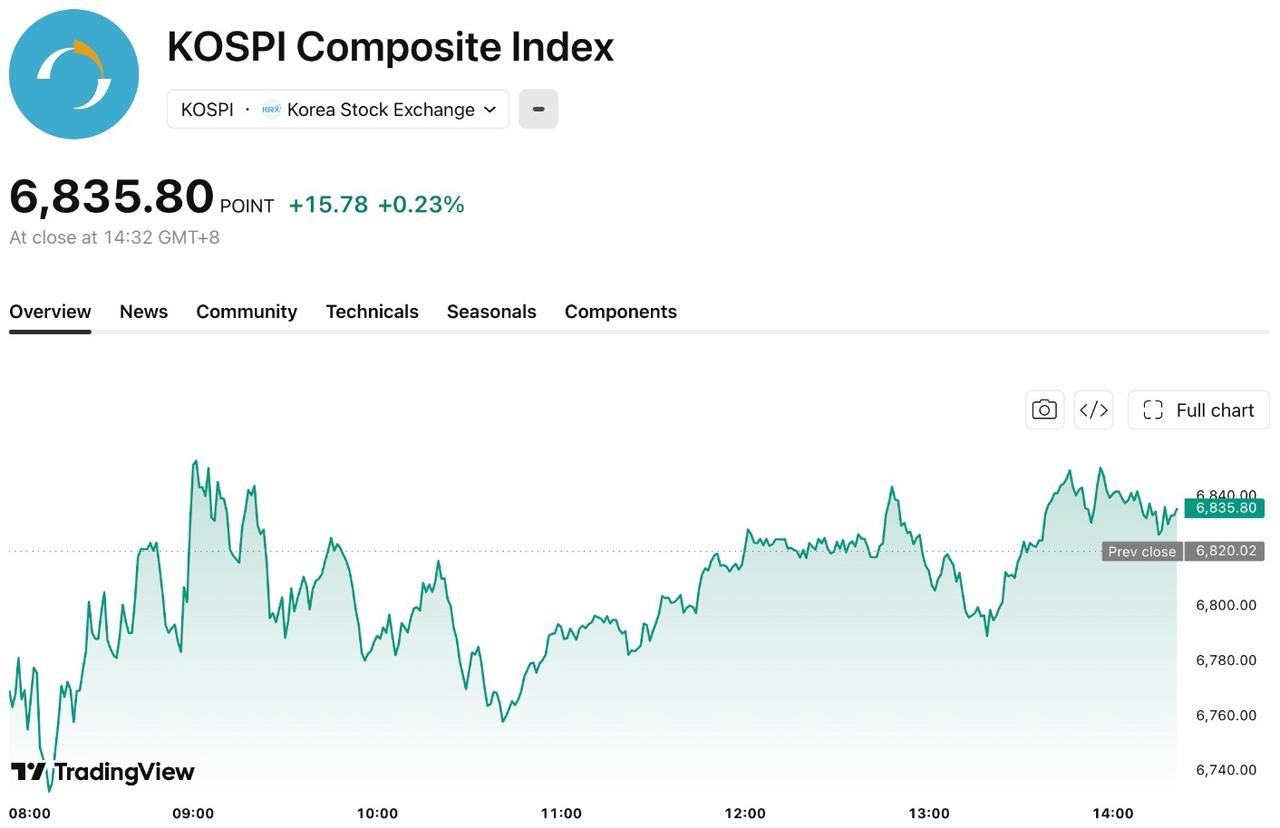
[Source: TradingView]
The South Korean government expects total revenue (including tax and non-tax revenue) to reach 880.8 trillion won in 2027, up 30.4% year-on-year. Among this, national tax revenue is projected at 584.4 trillion won, up 40.7% year-on-year, while corporate tax revenue is expected to more than double to 216.7 trillion won, mainly driven by the semiconductor industry boom.
To prevent short-term windfall profits from blindly inflating routine government spending, the government plans to establish a 162.3 trillion won "Future Response Fund." Government legislation will mandate that "excess tax revenue" exceeding the long-term tax trend line over the past 10 years be set aside separately and injected into the fund.
The fund is divided into four major project accounts (52.9 trillion won) and an overall account (109.4 trillion won). Capital will be directed toward areas such as youth, growth drivers, local economies, education, and talent, while reserving a portion to buffer future tax revenue fluctuations.
In addition, although the national debt balance is projected to rise to 1,519.8 trillion won, faster GDP growth is expected to lower the national debt-to-GDP ratio from 51.6% to 48.3%. The managed fiscal deficit as a percentage of GDP is expected to narrow significantly from -3.9% to -0.1%.
The risk of this model lies in South Korea's deepening fiscal reliance on the semiconductor cycle. If global AI investment or memory chip demand slows down, tax revenue growth may fall short of expectations.
South Korea's 2027 budget proposal represents an industrial policy adjustment centered on AI and semiconductors. The key test lies in whether it can translate memory chip manufacturing advantages into comprehensive competitiveness across AI computing infrastructure, chip design, and industry applications. The budget proposal will be submitted to the National Assembly by September 3 and finalized by a plenary vote before December 2.
This content was translated using AI and reviewed for clarity. It is for informational purposes only.
Recommended Articles








Comments (0)
Click the $ button, enter the symbol, and select to link a stock, ETF, or other ticker.