


Japan-South Korea Stock Market Stampede Storm Continues: Nikkei 225 and KOSPI Struggle Under Pressure, SoftBank and Kioxia Tumble 5%, Samsung and SK Hynix Decline Slows



AI Podcast


During the Asian session on July 14, Japanese and South Korean markets faced continued downward pressure following recent historic sell-offs. The Nikkei 225 and KOSPI indices opened lower as investors maintained a defensive stance amid ongoing global risk aversion. Significant declines in major tech stocks, including SoftBank and Kioxia, reflect unresolved market volatility. Escalating geopolitical tensions and tightening liquidity weigh heavily on sentiment. Investors remain cautious, anticipating upcoming U.S. CPI data and Federal Reserve testimony, which will likely dictate the short-term trajectory of Asia-Pacific markets as they navigate a period of volatile bottom-searching.

TradingKey - Japanese and South Korean stock markets continue to stampede, with the KOSPI Index and the Nikkei 225 under pressure; SoftBank and Kioxia both fell over 5%, while Samsung Electronics and SK Hynix saw their declines slow.
During the Asian session on July 14, following yesterday's historic crash tsunami and circuit breakers in Japanese and South Korean stock markets, today's opening performance remained deeply mired in pessimistic sentiment, presenting a defensive posture with both markets opening lower and facing pressure across the board . South Korea's KOSPI index plunged 2.47% at the open, temporarily trading at 6,639.09 points; Samsung Electronics fell 1.08%, temporarily at 252,000 won; SK Hynix fell 3.14%, temporarily at 1,787,000 won.
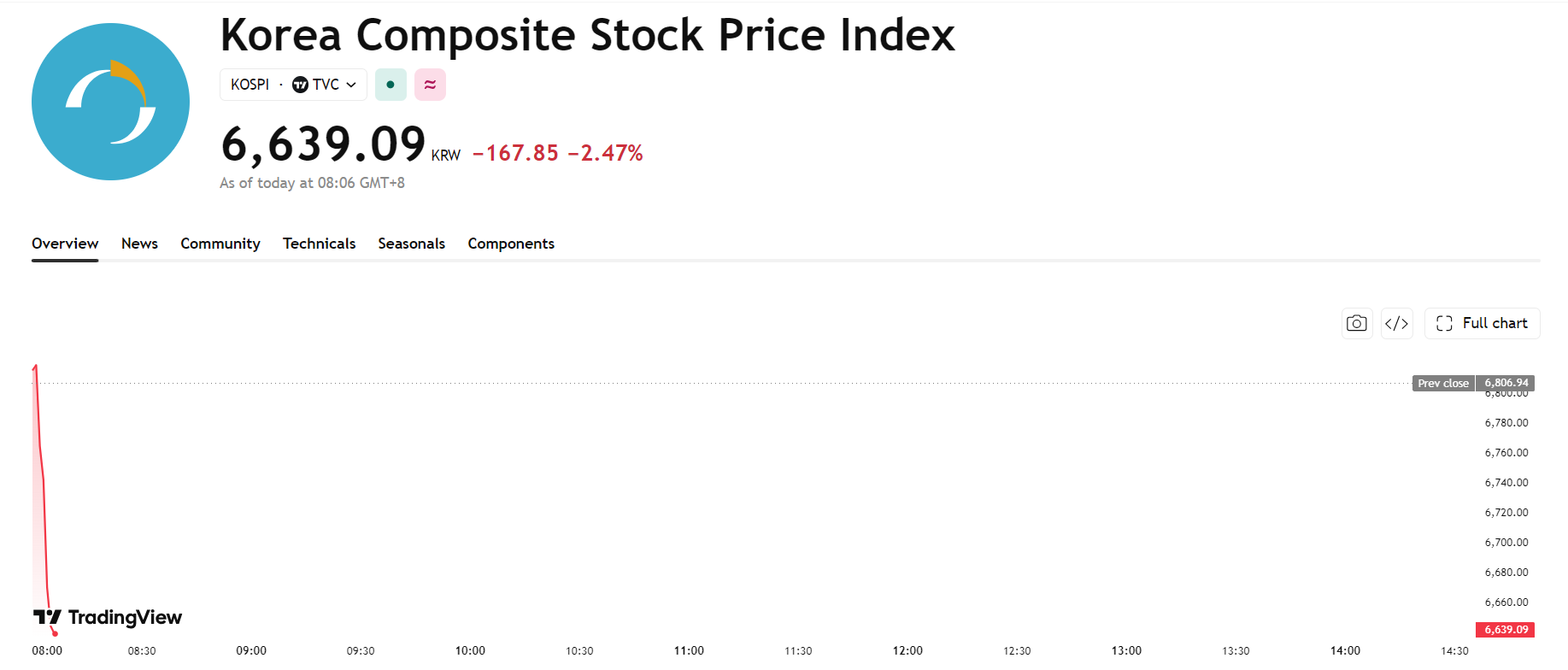 KOSPI Index Chart, Source: TradingView
Japanese stock markets were similarly affected by the spillover from the global sell-off of risky assets, opening with a direct gap down. The Nikkei 225 Index opened down by more than 700 points, or 1.1%, briefly dropping to a low of 66,000, and is temporarily trading at 66,500.06 points. Kioxia fell 5.05%, temporarily at 63,710 yen; SoftBank fell 5.06%, temporarily at 6,042 yen.
The continued sluggishness at the Tuesday open for Japanese and South Korean stock markets clearly reflects that the market's "cascading stampede effect" has not yet been fully digested. As the risk of conflict in the Middle East's crude oil shipping lanes continues to escalate, macro liquidity is tightening across the board. Before the dropping of the two giant shoes—the shocking U.S. June CPI data on Tuesday and Wednesday, and the Federal Reserve "new king's" congressional hearing—the Asia-Pacific markets are highly likely to maintain a defensive pattern of volatile bottom-searching in the short term.
This content was translated using AI and reviewed for clarity. It is for informational purposes only.
Recommended Articles










Comments (0)
Click the $ button, enter the symbol, and select to link a stock, ETF, or other ticker.