


Samsung Electronics Wins Foundry Orders From Google, AMD and BYD as TSMC Capacity Tightness Drives Client Shift



AI Podcast


During the Asian trading session on June 17, major tech firms including Google, AMD, BYD, and Tesla intensified foundry cooperation with Samsung Electronics. Driven by TSMC’s capacity constraints and supply chain diversification, these companies are seeking advanced chip production alternatives. Samsung’s strategic position is bolstered by orders for 4nm and 2nm GAA technology. Despite ongoing yield challenges, rising utilization rates and order inflows suggest Samsung could achieve foundry profitability by Q3 2026. As AI chip demand persists, Samsung is emerging as a critical secondary supplier, potentially capturing significant market share in the high-end semiconductor ecosystem.
TradingKey - During the Asian trading session on June 17, Nikkei Asia reported that due to TSMC's ( TSM) advanced process capacity remaining tight, Google ( GOOGL ), AMD ( AMD ), BYD, and Tesla ( TSLA) have recently intensified their engagement with Samsung Electronics regarding foundry cooperation, leading to a significant increase in orders for Samsung's foundry business.
Capital markets reacted quickly. Samsung Electronics' share price fell over 3% in early trading, affected by the overnight decline in the US semiconductor sector, before gradually recovering to recoup its losses. As of press time, Samsung's stock price was at 346,500 KRW, up 1.02%.
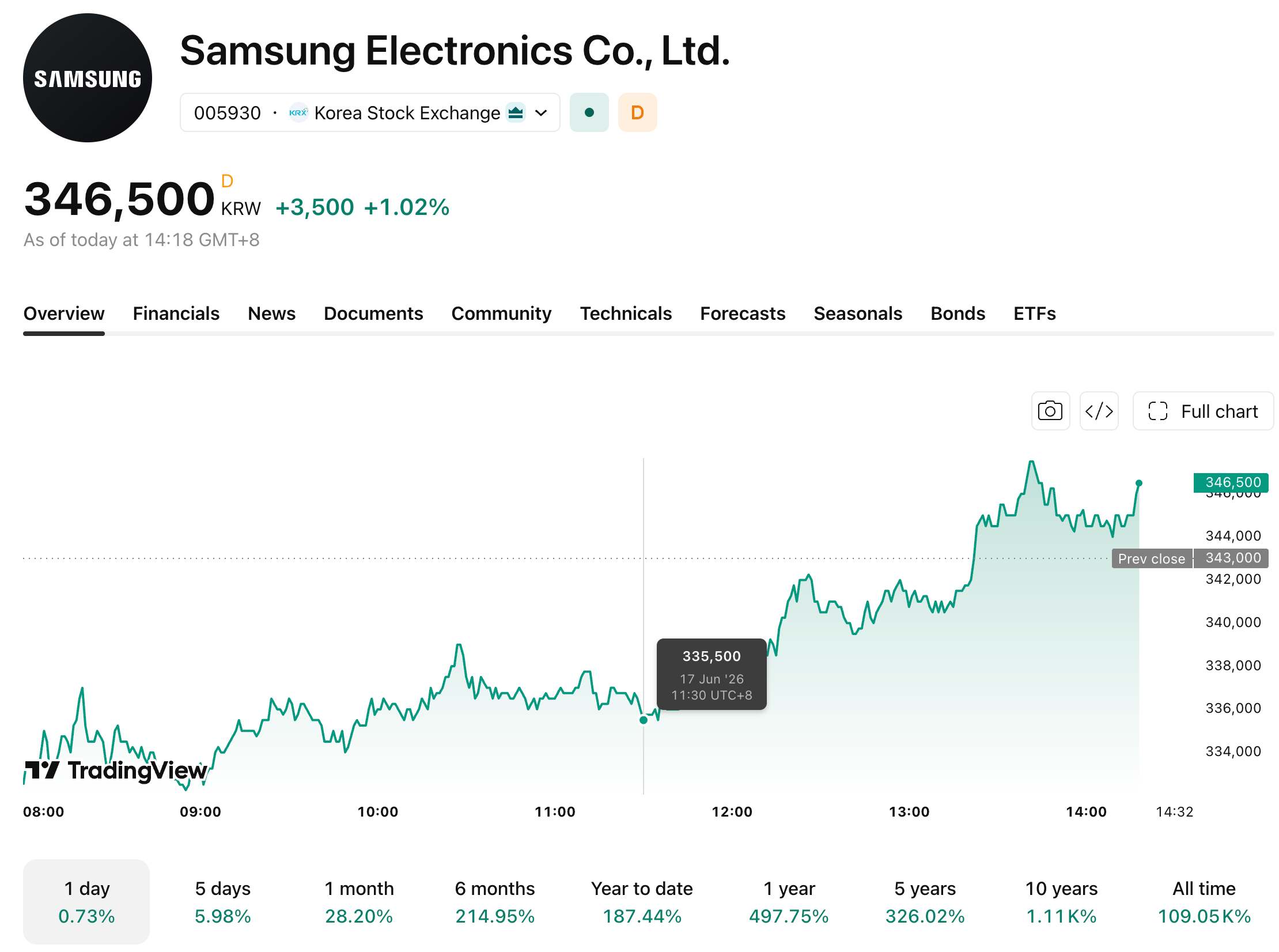
[Source: TradingView]
It is reported that BYD is currently negotiating with Samsung on future autonomous driving chip production, involving the Xuanji A3 series 4nm and next-generation 2nm GAA smart driving chips. Google is exploring having Samsung manufacture its next-generation Axion processor, scheduled for release in 2028, and some TPU chips; if the partnership is finalized, it would mark the first time Google has shifted TPU manufacturing orders away from TSMC. AMD is also in talks to have Samsung produce some of its CPUs starting in 2028. In addition, Tesla's AI6 chip has been confirmed for production at Samsung's Taylor plant in Texas.
TSMC's capacity bottlenecks and geopolitical factors are driving more companies to adopt supply chain strategies that diversify their foundry sources. Although Samsung still lags behind TSMC in yield rates, its available capacity has become an important supplementary option.
Benefiting from improved yield rates and order growth, Samsung's foundry capacity utilization rate continues to rise, with profitability expected to resume in the third quarter of 2026—ahead of its previous target of late 2026 to 2027. Analysts believe that against the backdrop of robust global demand for AI chips and TSMC's tight advanced capacity unlikely to ease this year, Samsung, as one of only three companies currently capable of mass-producing advanced semiconductors, is facing a major opportunity to enter the AI chip foundry race.
This content was translated using AI and reviewed for clarity. It is for informational purposes only.
Recommended Articles










Comments (0)
Click the $ button, enter the symbol, and select to link a stock, ETF, or other ticker.