


Japan, South Korea Close: Samsung Jumps Nearly 6% to Lead, Japanese MLCC Stocks Surge Collectively



AI Podcast


Japanese and South Korean equity markets closed higher, driven by overnight US gains and ceasefire expectations. The Nikkei 225 rose 2.53% and the TOPIX trended upward, primarily supported by semiconductor and electronic components sectors like SUMCO and Taiyo Yuden. Brokerage reports forecasting strong demand for MLCCs and silicon wafers for AI servers through H2 2026 fueled this rally. South Korea's KOSPI gained 3.55%, breaking 8,400, led by Samsung Electronics' HBM4E advancements. However, risks include South Korea's market concentration in chip giants and high valuations in Japanese electronics, posing potential correction triggers if order expectations aren't met.
TradingKey - May 29 Asia Session , Boosted by overnight gains in U.S. stocks and expectations of a ceasefire between the U.S. and Iran, Japanese and South Korean equity markets both closed higher.
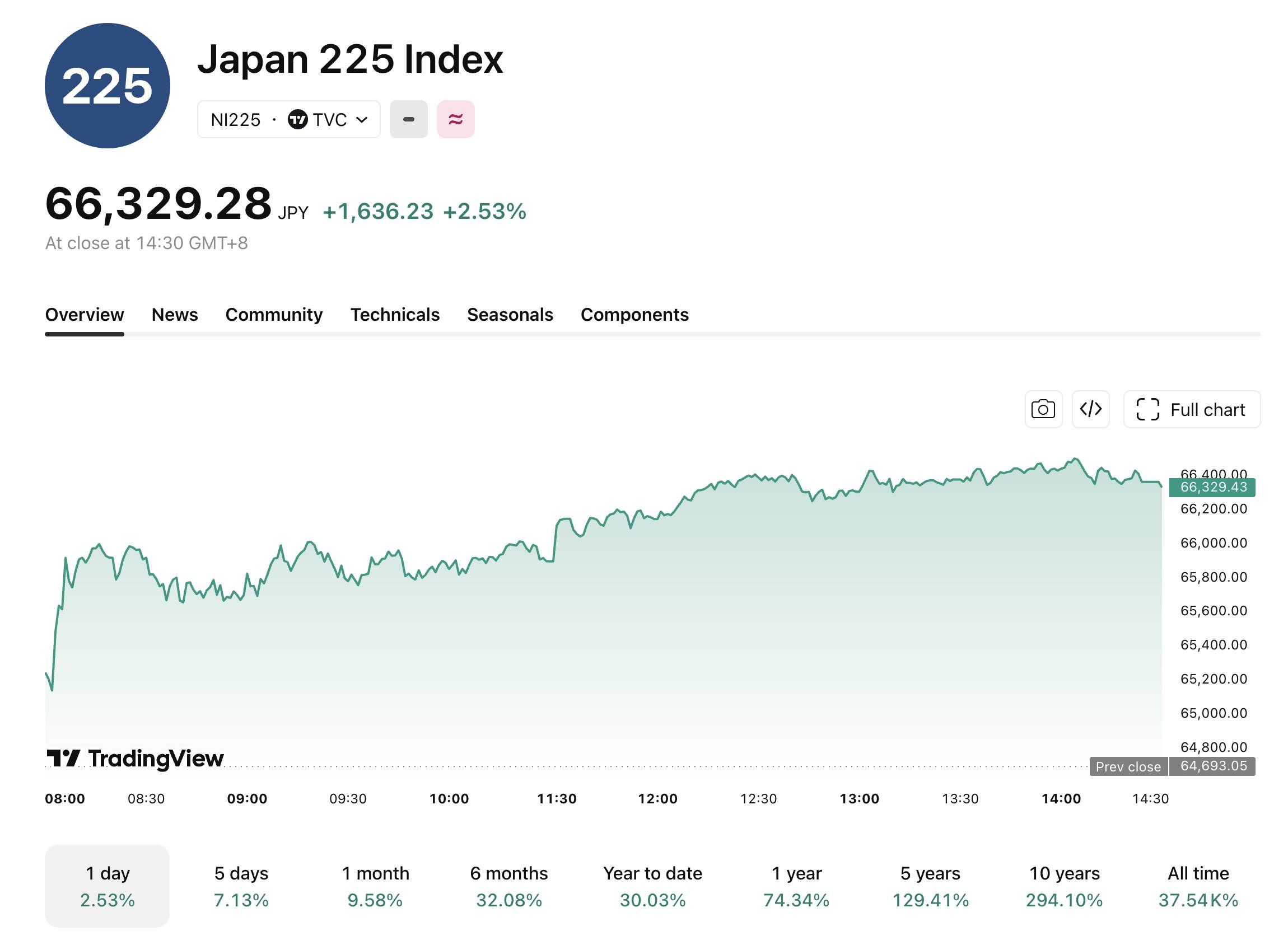
In Japan, the Nikkei 225 opened higher and continued to climb, closing up approximately 2.53%, while the TOPIX also trended higher. The upward momentum was driven almost entirely by the semiconductor and electronic components sectors.
[Source: TradingView]
The most eye-catching performance came from the passive components and electronic ceramics segments. Silicon wafer manufacturer SUMCO rose 19.3%, Taiyo Yuden gained 11.87%, Murata Manufacturing climbed 12.73%, and TDK advanced 8.22%. The direct catalyst was a shift in supply-demand expectations at the industry level. , Several brokerages recently released reports upwardly revising demand forecasts for multi-layer ceramic capacitors (MLCCs) and silicon wafers used in AI servers, noting that order visibility is expected to improve significantly starting in the second half of 2026.
SoftBank Group rose approximately 4%, continuing a trend driven by Arm's valuation rerating. Memory manufacturer Kioxia gained about 4.5%.
The automotive sector saw significant internal divergence; while Honda and Nissan fluctuated slightly, Mitsubishi Motors plunged 8.54% after the company announced a downward revision to its full-year export targets and recognized restructuring charges for several overseas plants.
Japan's Ministry of Internal Affairs and Communications announced on the 29th that Tokyo's core CPI rose just 1.3% year-on-year in May, slowing for the sixth consecutive month and missing the 1.5% expectation. Weak inflation further dampened expectations for a Bank of Japan rate hike in June, putting pressure on the yen, with USD/JPY trading near 159.3. Finance Minister Satsuki Katayama reiterated that "intervention will occur if fluctuations are excessive," but the market views the 160 level as the actual red line.
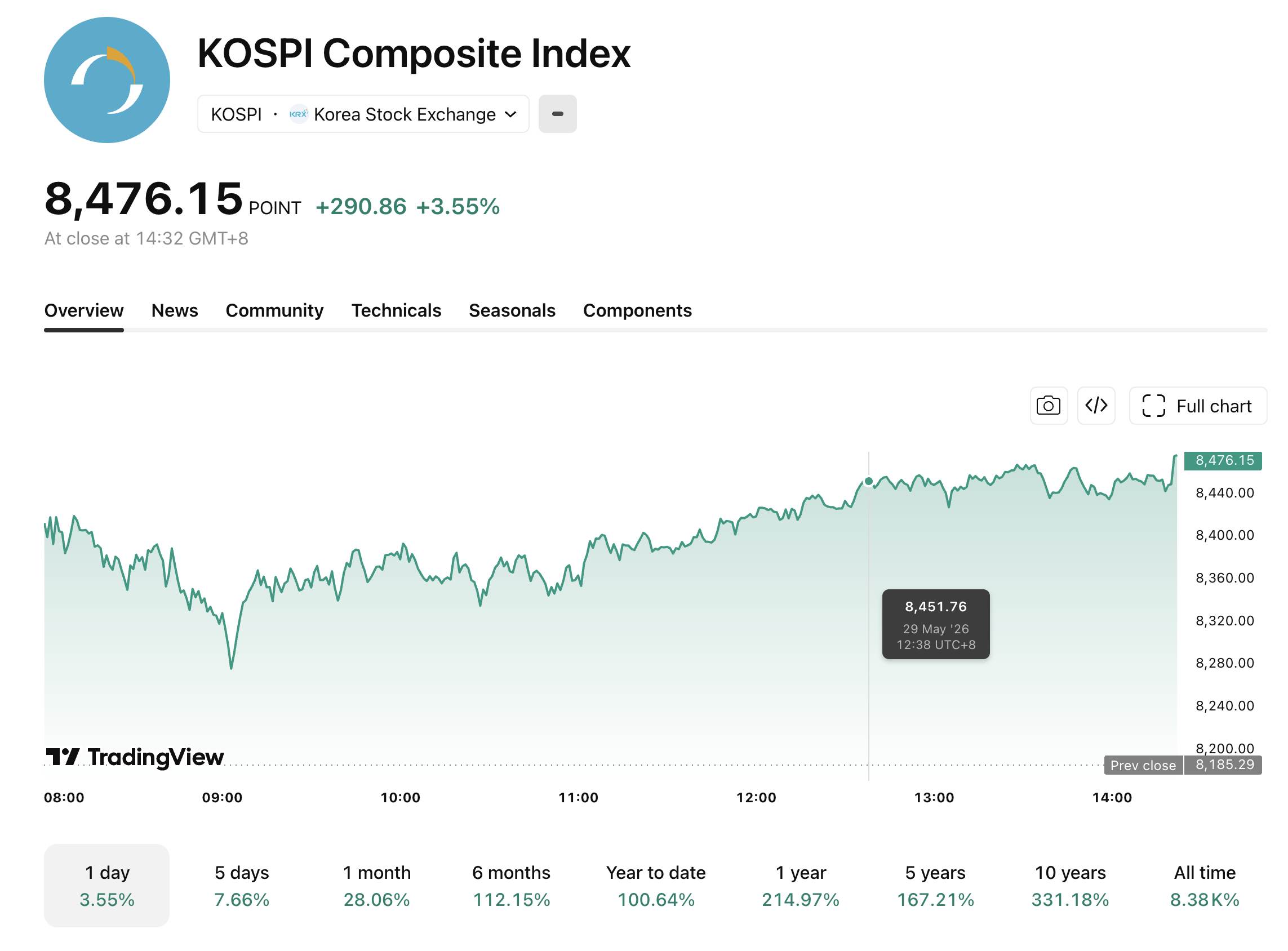
In South Korea, the KOSPI index closed up approximately 3.55%, breaking above the 8,400 level; however, the KOSDAQ small-cap index fell 2.68%. The divergence was caused by a massive rotation of capital out of small- and mid-cap stocks and into the two semiconductor giants.
[Source: TradingView]
Samsung Electronics rose 5.84% to close at 317,000 KRW; SK Hynix gained 1.92% to close at 2.333 million KRW. Samsung's rally had a clear catalyst: the company announced it had delivered its first batch of 12-layer HBM4E samples to global customers and revealed that capacity would double in the third quarter. While SK Hynix made no new announcements, markets expect the company to raise its capital expenditure guidance at next week's Investor Day.
In the short term, AI semiconductors remain the most definitive theme in the Japanese and South Korean markets, with order visibility for Japanese precision components and South Korean HBM memory chips extending at least through the end of 2026.
However, risks should not be overlooked: the South Korean market is overly concentrated in two chip giants; if passive funds continue to pare holdings due to exposure limits, the KOSPI could experience a distorted trend where the index rises while individual stocks fall. Meanwhile, valuations for Japanese electronic component stocks are at historical highs, and any failure to meet order expectations could trigger a correction.
This content was translated using AI and reviewed for clarity. It is for informational purposes only.
Recommended Articles










Comments (0)
Click the $ button, enter the symbol, and select to link a stock, ETF, or other ticker.