


Clarity Act Added to Senate Legislative Calendar, Can XRP Be the First to Regain Lost Ground?



AI Podcast


Bitcoin's sharp decline has impacted the broader crypto market, with total market capitalization falling to a three-month low. XRP has shown relative resilience, experiencing a smaller decline than other major cryptocurrencies. This strength is attributed to the "Clarity Act" being added to the Senate legislative calendar, which could establish a clear legal framework for utility tokens and encourage institutional adoption of Ripple's technology. Additionally, XRP spot ETFs have seen significant inflows, contrasting with outflows from Bitcoin spot ETFs. These factors suggest XRP is well-positioned for a comeback once market conditions stabilize.

TradingKey - Bitcoin's decline drags down Ripple, but XRP holds two trump cards and could stage a comeback against shorts at any time.
On June 3, the crypto market continued to experience a bloodbath, with a 4% plunge today. The total market capitalization fell to $2.27 trillion, hitting a new three-month low. Simultaneously, mainstream coins generally declined, with Bitcoin ( BTC) falling over 4%, while Ethereum ( ETH ), Binance Coin ( BNB) and Solana ( SOL) all dropped by more than 5%. In contrast, Ripple ( XRP) fell by less than 2%, the smallest decline among the top eight by market cap (excluding stablecoins). Why is this?
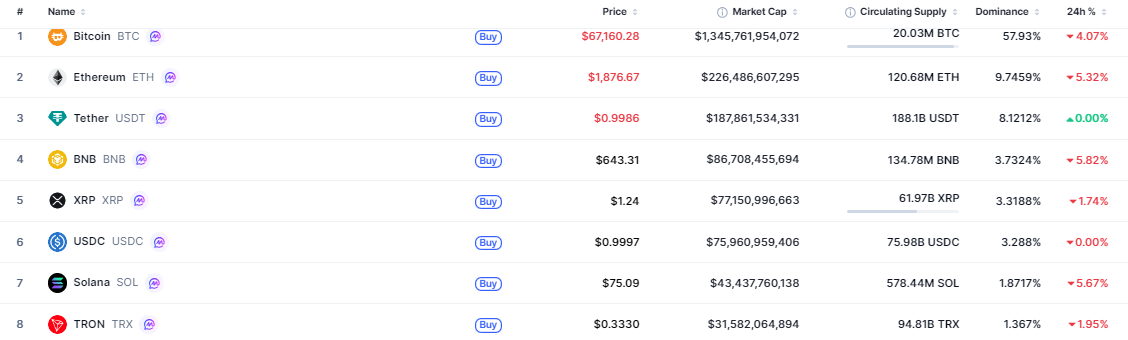 Price changes of the top eight cryptocurrencies by market capitalization, Source: CoinMarketCap
MicroStrategy recently sold Bitcoin, breaking its long-standing "buy and hold" strategy for the first time in years. Furthermore, with the U.S. set to release several economic data points this week, including ADP and non-farm payrolls, panic selling of Bitcoin has been triggered and has spread across the market. In this environment, the market has selectively ignored the positive news regarding the "Clarity Act," which is precisely why Ripple has shown resilience.
On June 1, the "Clarity Act" was officially added to the Senate legislative calendar. The next step is a full Senate vote, after which it will be sent to President Trump for signing. This legislation is significant for XRP for two main reasons: (1) It clarifies the jurisdictional boundaries between the SEC and the CFTC, providing a clear compliance path for utility and payment tokens; (2) Once a federal legal framework is established, mainstream Wall Street banks and cross-border payment giants currently on the sidelines will be able to formally adopt Ripple's technology network without legal risk.
Over the past month, Ripple has fallen 10% while Bitcoin has dropped 14%, indicating that XRP's performance has been more resilient. In addition, according to Coinglass data, U.S. Bitcoin spot ETFs have seen net outflows every trading day since May 19. Conversely, Ripple spot ETFs have not only avoided outflows but have seen significant inflows, indicating that the U.S. market is very bullish on XRP; the recent decline is merely a result of the broader market drag.
Under these conditions, as soon as the broader market shows signs of stabilizing, XRP—holding the dual trump cards of "spot ETF inflows" and "Senate legislative expectations"—is highly likely to become the leading dark horse to regain ground after this deleveraging storm. From a technical perspective, XRP is very close to the $1.10 support level established in February, and a rebound could occur at any time.
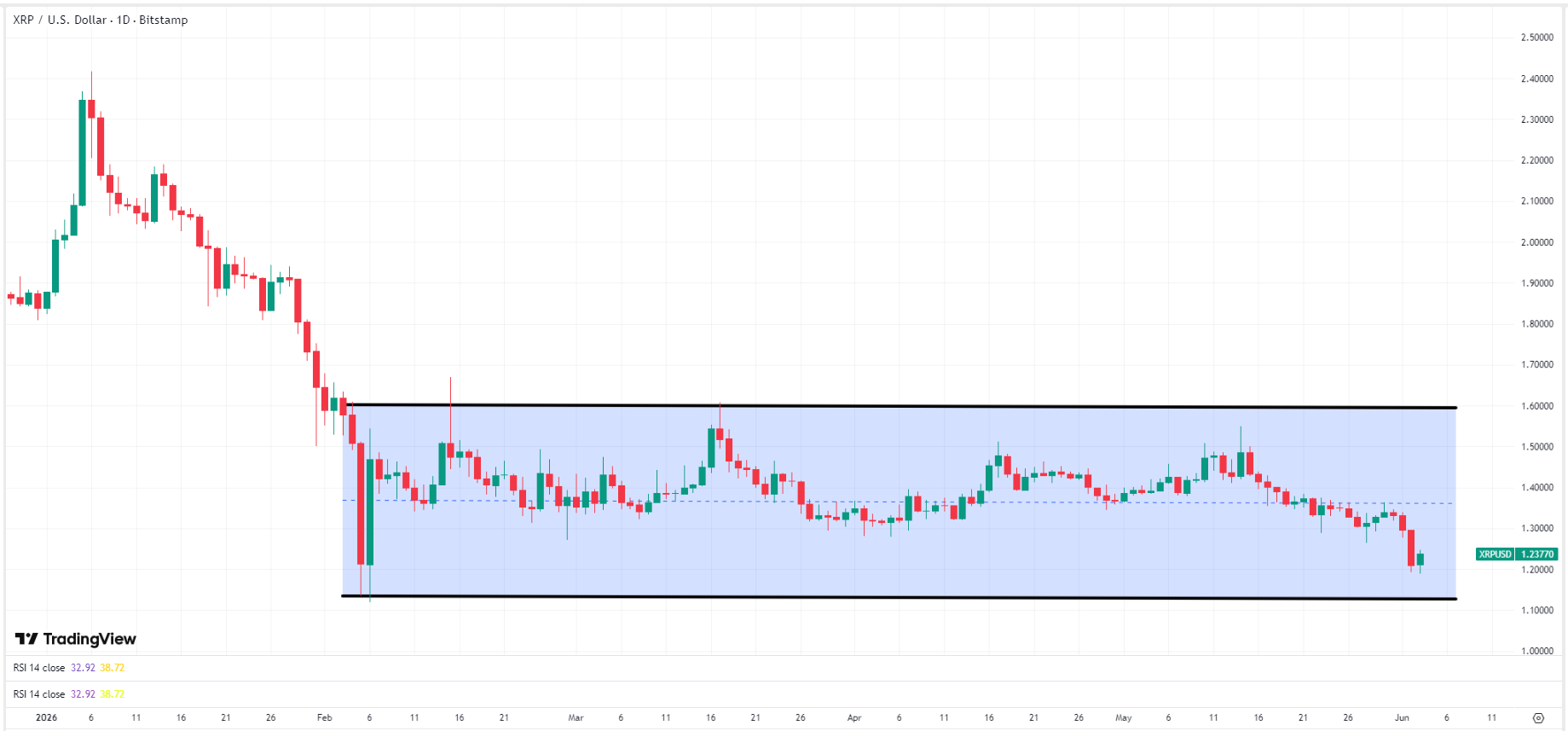 Ripple price chart, Source: TradingView
This content was translated using AI and reviewed for clarity. It is for informational purposes only.
Recommended Articles












Comments (0)
Click the $ button, enter the symbol, and select to link a stock, ETF, or other ticker.