


STRK Surges 40% Intraday to Lead Market as Starknet Plans Layer-1 Transition to Address Quantum Threat



AI Podcast


Starknet plans to transition from an Ethereum Layer-2 network to an independent Layer-1 blockchain by 2027 to achieve quantum resistance ahead of major networks. This strategic shift triggered a 40% single-day surge in its native token, STRK, reaching $0.071 on October 9. While breaking away from Ethereum's settlement layer allows Starknet to accelerate its security roadmap and enhance STRK’s utility as a native gas and staking asset, the move introduces market risks regarding independent network adoption, capital attraction, and the long-term decoupling from the broader Ethereum ecosystem.
TradingKey - Starknet plans to upgrade to an L1 mainnet to counter quantum threats, driving its token STRK to surge 40% in a single day and strongly lead the market.
On October 9, major cryptocurrencies such as Bitcoin and Ethereum collectively came under pressure, while Ethereum Layer-2 (L2) network Starknet (STRK) bucked the trend to surge by about 40%, rising to a high of $0.071 and touching its peak from January this year. The immediate catalyst for this STRK rally was market speculation surrounding post-quantum cryptography and anti-AI decryption concepts.
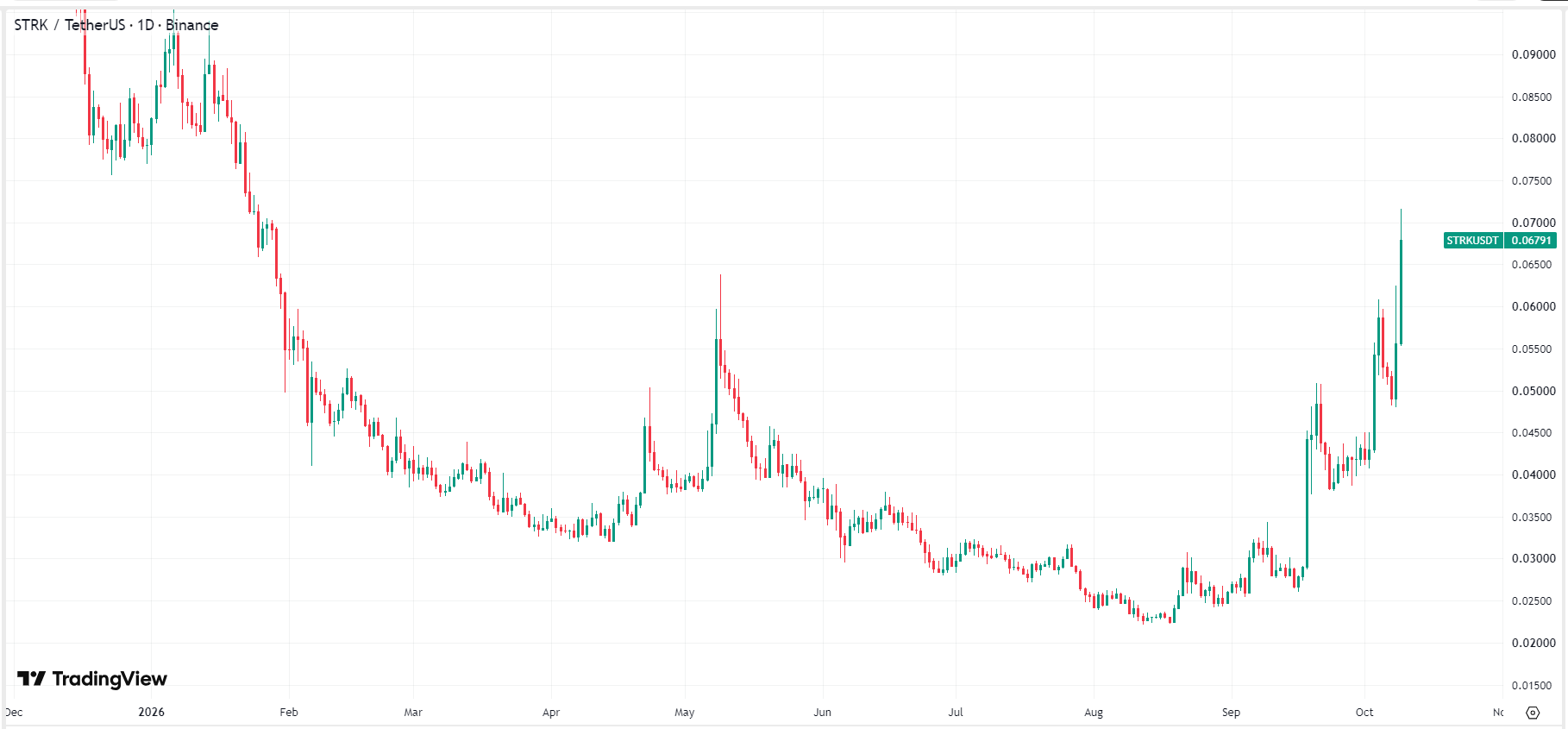
STRK price chart, Source: TradingView
At Token2049 held on October 7–8, StarkWare CEO Eli Ben-Sasson revealed that Starknet is evaluating a transition away from Ethereum's Layer-2 architecture to become an independent Layer-1 blockchain, aiming to become the first fully quantum-resistant L1 network by 2027. So, why does Starknet want to transition into an independent L1?
The quantum-resistant cryptography upgrade planned for the Ethereum mainnet is not expected to be completed until the end of 2029, while the Bitcoin mainnet still has no clear upgrade roadmap. If Starknet remains an Ethereum L2, the ceiling of its security upgrades is limited by Ethereum's settlement layer. After transitioning to an independent L1, the team can fully control the pace of security upgrades and achieve its quantum-resistance goal two years early (by 2027), potentially helping it leapfrog the competition by attracting developers and capital through security.
Previously, as an L2 token, part of STRK's network transaction fees and settlement value had to flow to Ethereum L1. If it transitions to an independent L1, STRK will be upgraded to a native gas fee token and staking asset on the chain, maximizing the token's value capture capability and demand.
This content was translated using AI and reviewed for clarity. It is for informational purposes only.
Recommended Articles






Comments (0)
Click the $ button, enter the symbol, and select to link a stock, ETF, or other ticker.