


TRON (TRX) Five-Year Price Forecast: Can It Reach $10 by 2030?



AI Podcast


Over the past five years, TRON (TRX) has demonstrated a distinct upward trend, outperforming major altcoins through robust resilience and independence from traditional boom-and-bust cycles. This performance is driven by high utility demand for TRC-20 USDT transfers, substantial fee revenue, and a continuous deflationary burn mechanism that locks up liquidity and reduces circulating supply. While a surge to $10 is unfeasible due to market capitalization constraints, TRX is projected to consolidate between $0.27 and $0.35 in the near term and potentially break above $1 during the 2028 Bitcoin halving bull market.
How Has TRON's Price Performed Over the Past Five Years?
TradingKey - Over the past five years, TRON (TRX) has demonstrated a price trajectory distinct from most major altcoins. Following its 2021 peak, TRX exhibited strong defensive qualities and a steady, continuous upward trend, breaking free from the cryptocurrency market's boom-and-bust cycle.
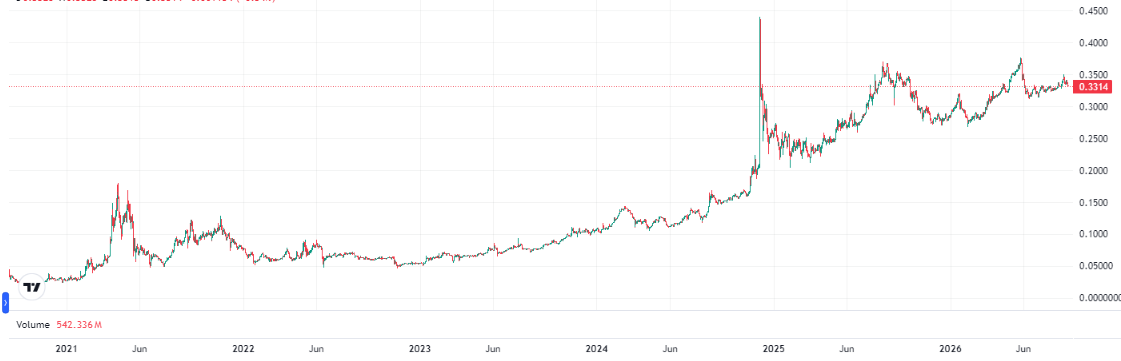 TRX price chart, source: TradingView
During the crypto bull market of 2021, the price of TRX rose from approximately $0.02 at the start of the year to hit an interim peak of around $0.18 between April and May 2021. Amid a major crypto market pullback, TRX plummeted over 70% a month later to a low of $0.05, subsequently rebounding above $0.1, and ultimately falling back to around $0.07 by year-end.
In 2022, as the entire market entered a bear market, TRX demonstrated remarkable resilience, largely trading sideways between $0.05 and $0.08 throughout the year without following other altcoins to extreme new lows. In 2023, TRX showed strong upward momentum, gradually climbing from around $0.05 at the beginning of the year to near $0.11 by year-end, mounting a step-like rally independent of the broader market.
In the second half of 2024, TRX broke through its 2018 peak of $0.3 in one move, surging to an all-time high of $0.43 by the end of the year. In 2025, while the price of TRX pulled back slightly, it generally maintained a high range of $0.28–$0.35, remaining far stronger than major cryptocurrencies such as Bitcoin (BTC) and Ethereum (ETH).
Why Is TRON Price Rising?
Unlike most cryptocurrencies that rely on narrative hype, TRON has its own public blockchain ecosystem, meaning there is genuine utility demand, while fee revenue provides price support. Although Ethereum's public blockchain ecosystem is more powerful than TRON's—with its TVL share typically above 50% compared to TRON's less than 10%—TRX is supported by a robust deflationary burn mechanism, detailed as follows:
Drivers | Specific Mechanisms and Catalysts | Impact Mechanism on TRX Price |
TRC-20 USDT Dominance | TRON is the public blockchain with the highest USDT circulating supply globally, offering fast transfers and low costs. | Network utilization remains high, with transactions consuming energy and bandwidth, directly driving TRX demand. |
On-Chain Protocol Revenue and Staking | TRON network fee revenue is extremely high, allowing users to stake TRX to earn yield or energy for transfers. | This locks up a large amount of TRX liquidity, reducing market selling pressure and boosting returns for long-term holders. |
Deflationary Burn Mechanism | A portion of network fee revenue is regularly burned, achieving net deflation for TRX. | Circulating supply continuously decreases, driving up token prices when demand remains stable or grows. |
Will TRON Price Keep Rising This Year?
The TRON network remains one of the world's largest public blockchains by USDT issuance and transfer volume, with fee revenue and network activity remaining strong. This strong utility demand provides underlying price support for TRX. In addition, transaction fees on the TRON chain periodically burn TRX, keeping TRX in a long-term deflationary state, where a reduced circulating supply helps drive up the unit price when demand is stable.
If the overall market maintains a bullish structure, TRX, backed by its highly deflationary mechanism and inelastic demand for stablecoin transfers, still possesses the foundation to retest its previous high or rise moderately by the end of the year, challenging $0.40 on the upside; however, if the broader market weakens or faces major regulatory news, it may shift into high-level consolidation in the second half of the year, with TRX testing $0.30 or even retesting this year's low of $0.27, though the likelihood of breaking below is relatively low.
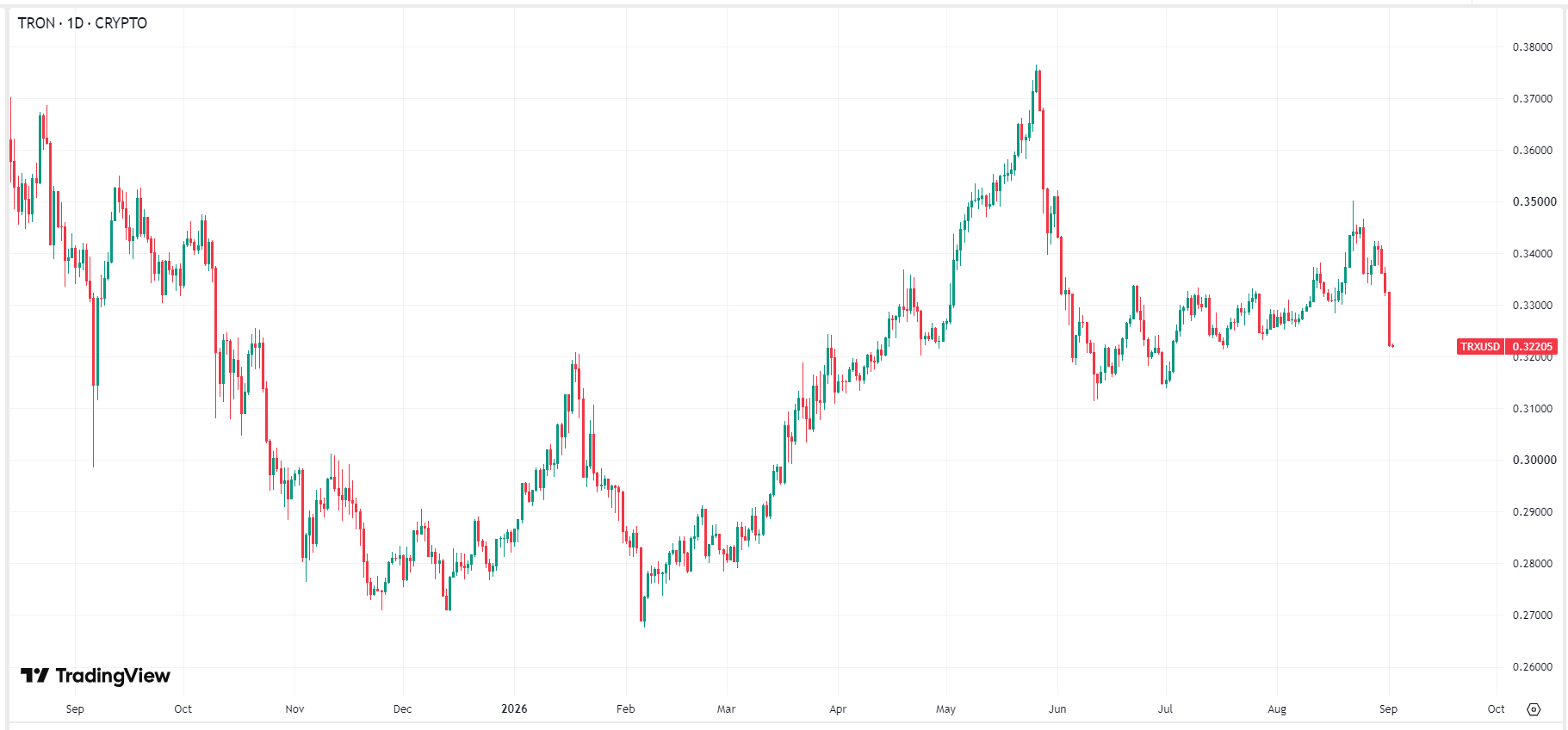
TRX price chart, Source: TradingView
TRON Price Prediction: Can It Rise to $10 in the Next Five Years?
TRX is currently priced at around $0.33, with a circulating supply of approximately 95 billion tokens and a current market capitalization of about $31 billion. If TRX were to reach $10, it would mean TRX needs to surge by about 30 times, pushing its market cap to $950 billion—nearly equivalent to the scale of top traditional giants such as JPMorgan Chase, Eli Lilly, and Micron Technology. Given the current cryptocurrency structure and pace of development, this is impossible, making growth of this magnitude virtually unattainable.
Judging from the current market environment and headwinds facing TRON itself, TRX is expected to fluctuate widely in the $0.27–$0.3 range from 2026 to 2027. In 2028, as Bitcoin undergoes a new halving cycle, the cryptocurrency market may enter a new bull run, and TRX is expected to break above its all-time high of $0.43. Between 2029 and 2030, it has the potential to double from that base to rise above $1.
Conclusion
TRON (TRX) has mounted a resilient, independent upward trend in recent years, hitting a new high of $0.43 at the end of 2024. Its core driver stems from the strong demand for TRC-20 USDT transfers and the deflationary mechanism brought by high transaction fee burns. However, constrained by its market capitalization, it is unlikely to rise to $10 over the next five years, but it is expected to break above $1 during the next Bitcoin halving bull market.
This content was translated using AI and reviewed for clarity. It is for informational purposes only.
Recommended Articles










Comments (0)
Click the $ button, enter the symbol, and select to link a stock, ETF, or other ticker.