


Ethereum by the Numbers: What Fee Revenue and Staking Yields Say ETH Should Trade At in 2030



AI Podcast


Ethereum’s long-term valuation increasingly relies on fundamental metrics like fee revenue and staking yields rather than pure speculation. VanEck projects a base-case price of $11,800 by 2030, driven by Layer-2 scaling and institutional adoption of smart contracts. Meanwhile, CoinShares outlines a $14,135 bull case by 2031, factoring in monetary premium and expanding tokenized real-world assets. Despite declining base fees post-Dencun upgrade, surging network volume and supply reduction via staking support these five-figure targets, positioning Ethereum as a yield-bearing, cash-producing institutional asset.

TradingKey - As the biggest altcoin, there are always a lot of predictions about Ethereum price. Cathie Wood has put up an Ethereum $180,000 valuation by 2030 forecast. And because most of these predictions are hype-based, they remain just that, predictions.
With the speculative days far behind Ethereum, predictions need to be based on facts and numbers, not just hype alone. Let’s explore what two critical numbers, fee revenue and staking yields, say the Ethereum price could be by the end of this decade.
The VanEck Thesis: Why $11,800 Isn’t Just Hopium
VanEck’s Matthew Sigel has given one of the most notable predictions. According to VanEck’s analyst, Ethereum will be priced at $11,800 by 2030. And this prediction isn’t just a five-figure guess.
The firm’s $11.8k base case projection relies heavily on Ethereum cementing its status as the dominant global settlement network. VanEck gives this prediction with one condition. The network must scale.
VanEck’s model anticipates Ethereum capturing a massive chunk of traditional finance applications, alongside an explosion in smart contract utility. According to VanEck’s detailed report, this isn’t just about base layer transactions anymore.
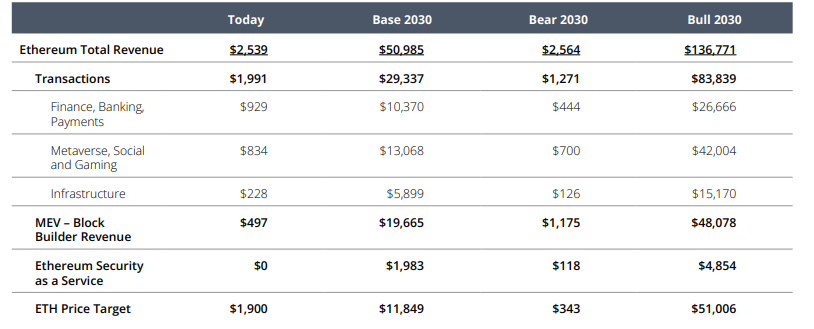 ETH Price Projection Based on Utility - Source: VanEck
It is about a sprawling ecosystem of Layer-2s funneling value back to the mainnet. When you zoom out, the math actually starts to look conservative. Yahoo Finance highlights how institutional capital is increasingly viewing ETH through the lens of a cash-producing asset.
If smart contracts eat even a fraction of global financial services, the velocity of money moving through Ethereum will justify an $11,800 price tag based purely on the cash flow generated by network usage.
Fee Revenues as the Ultimate Valuation Litmus Test
Things changed a lot on the Ethereum network after the Dencun upgrade. Execution activity shifted violently away from the base layer and toward Layer-2 networks. User costs plummeted. Throughput skyrocketed.
The ultrasound money narrative had fallen apart, however, because of the collapse of fee revenue. Once a weekly bill that would regularly break the $200 million mark, it suddenly dropped to about $10 million early in 2024.
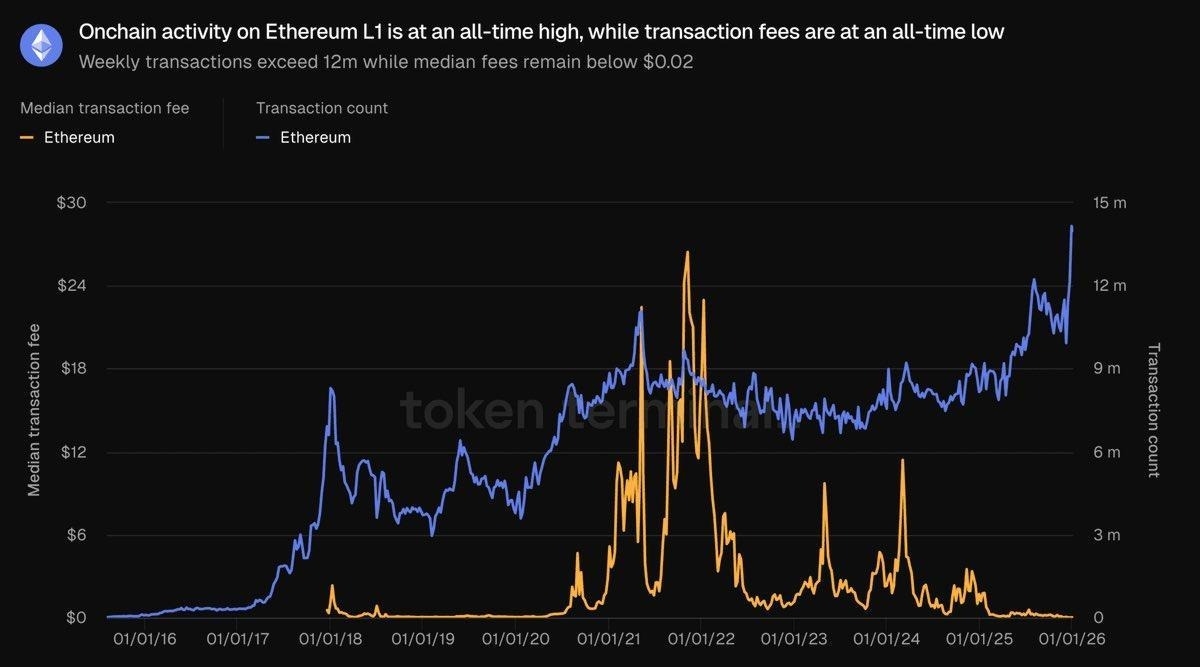 ETH On-Chain Activity + Fee Revenue Chart - Source: Token Terminal
Base fees have decreased, but on-chain figures and the number of monthly active users have increased significantly. The network keeps growing rapidly. CoinShares models that under a high-growth scenario, Ethereum’s fee revenue could still reach a monstrous $5.7 billion by 2031.
How? By assuming decentralized exchange (DEX) volumes grow at a 25% compound annual growth rate (CAGR), and stablecoin supply balloons to $2.8 trillion.
Volume compensates for cheaper individual transactions. If you are valuing ETH based on discounted cash flows, this fee explosion is the exact engine required to push the price deep into the five-figure range.
Staking Yields: The Risk-Free Rate of Web3
You can’t discuss Ethereum’s future without addressing staking. It fundamentally rewrites the asset’s investment profile. Staking is more than just another Ethereum technical term, it’s an important feature for the economics of ETH.
Ethereum staking involves validators locking up their ETH to secure the network. In return, they earn newly minted tokens alongside unburnt transaction fees. It’s pure passive income.
Think of it as the internet’s native bond. When institutional investors look at Ethereum today, they don’t just see a speculative token. They see a yield-bearing instrument.
Reward rates vary wildly based on total network participation and transaction volume. Yet the core principle remains: locking up supply actively reduces selling pressure.
If millions of ETH leave the open market to earn a 3% to 5% APY, the available liquid supply shrinks drastically. Combine a shrinking supply with skyrocketing demand from Layer-2 usage, and the resulting price mechanics become highly combustible.
The $14,135 CoinShares Bull Case
Based on Ethereum’s fee revenue and staking yields, there are other, more bullish predictions. CoinShares published a framework that looks beyond traditional cash flow. They analyze Ethereum as money.
Luke Nolan, their senior research associate, split the valuation into parts. Yes, fee revenue matters. But the monetary premium is the main thing to focus on. If ETH becomes the dominant collateral across DeFi, layer-2 reserves, and corporate treasuries, its overall value cleanly decouples from mere transaction fees.
In their bull case, which they admit requires an "everything works out perfectly" scenario, Ethereum price hits $14,135 by 2031. That specific model assumes Ethereum doesn’t just survive; it has to thrive.
It anticipates expanding Layer-1 market share to 35% and securing a jaw-dropping $420 billion in tokenized real-world assets. When an asset acts as consumable gas, yield-bearing capital, and pristine collateral simultaneously, standard models break. They underestimate network effects.
The Final Verdict: The 2030 Price Tag
So, where exactly does ETH trade at the end of the decade? While bears are screaming about regulatory friction and alternative layer-1s eating market share, the numbers tell a whole different story. If VanEck’s cash flow models and CoinShares’ theories hold water, an $11,800 to $14,135 range is mathematically sound.
Staking yields will inevitably continue locking up the float. Fee revenues will stabilize and scale through sheer unadulterated volume on Layer-2s. Ethereum is quietly building the financial rails of the future. By 2030, the market will finally price it accordingly.
Recommended Articles










Comments (0)
Click the $ button, enter the symbol, and select to link a stock, ETF, or other ticker.