


US Treasury Opens Iran 60-Day Oil Sales Authorization, Oil Market Supply Expectations Ease Again, WTI Crude Futures Fall Over 3%



AI Podcast


US-Iran peace talks regarding nuclear inspections and Strait of Hormuz access have eased geopolitical tensions, triggering a decline in WTI and Brent crude futures. The US Treasury has issued a 60-day temporary license for Iranian oil exports, though significant trust deficits and regional instability remain. While markets have priced in near-term easing, medium-term support persists via strategic restocking and peak-season demand. Huatai Securities projects a price floor near $60/barrel due to evolving OPEC structures and revised its 2026 Brent forecast to $82/barrel, anticipating an accelerated long-term inflection point for global oil consumption.

TradingKey - The US-Iran peace talks in Switzerland are still making progress. US Vice President Vance revealed that the negotiations are going well, causing the two major crude oil futures to return to recent lows, nearing pre-war price levels.
US Vice President Vance disclosed that Iran has formally agreed to allow International Atomic Energy Agency (IAEA) inspectors to re-enter the country to conduct their work. He characterized this resolution as a key milestone in the process: "This is an important milestone for the American people and the first step toward achieving the permanent denuclearization of Iran or permanently ending Iran's nuclear weapons program."
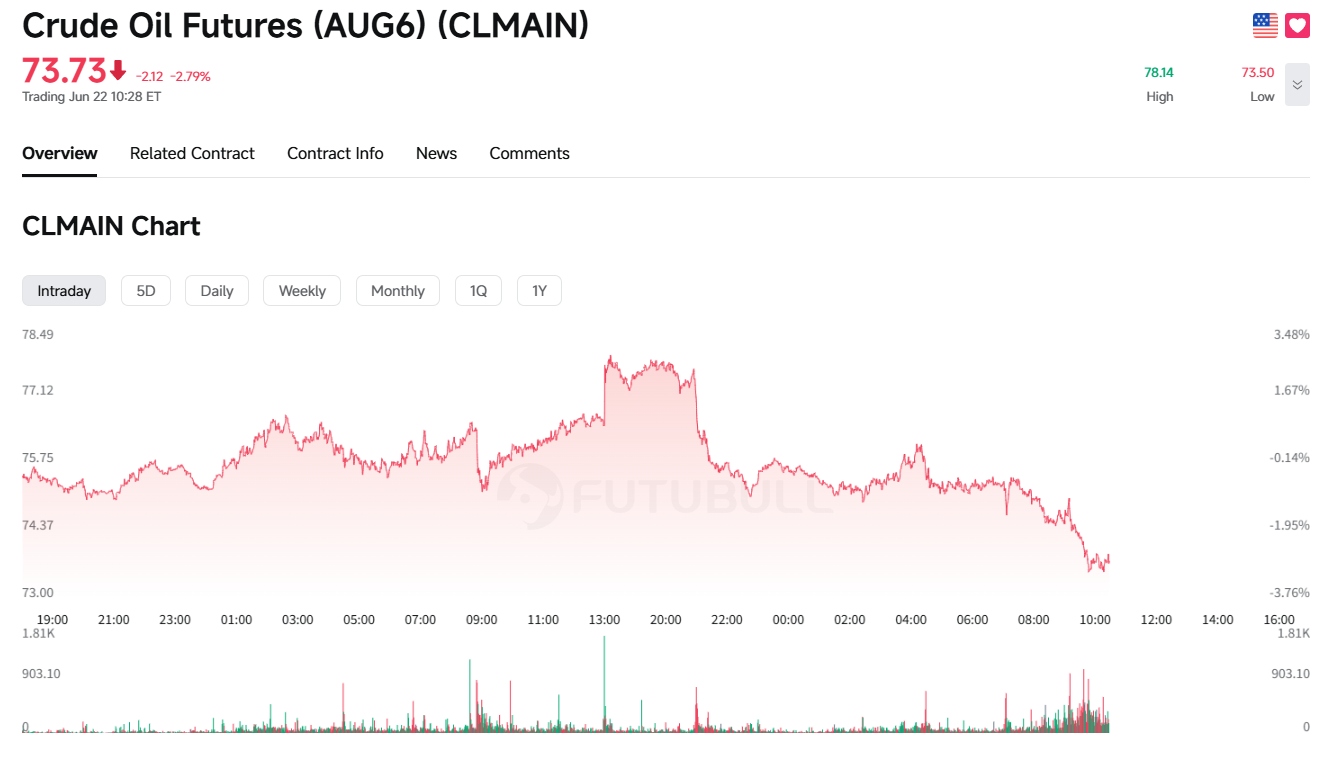
Influenced by the positive progress in the peace talks, the two major crude oil futures weakened. As of press time, WTI crude futures fell 2.79% to $73.73, while Brent crude futures dropped 2.15% to $78.12.
[Source: FutuBull]
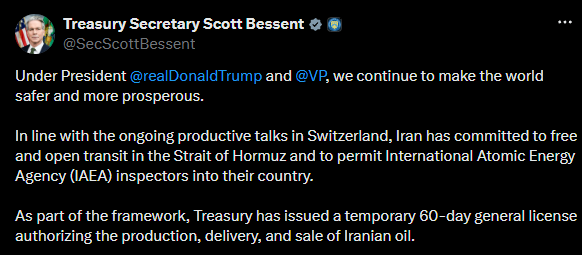
Following the productive negotiations, the US Department of the Treasury also promptly followed up with corresponding policies. US Treasury Secretary Scott Bessent stated on social media that the ongoing negotiations between the US and Iran in Switzerland have made positive progress. Iran has formally committed to guaranteeing free and open navigation through the Strait of Hormuz and accepting the entry of IAEA inspectors to carry out their work.
As a supporting measure under this agreement framework, the US Treasury Department has issued a 60-day temporary general license to temporarily lift restrictions on the production, transportation, and sale of Iranian oil, paving the way for negotiations on a final agreement.
[Source: X]
Looking ahead, two core uncertainties remain in the US-Iran negotiations.
First, the foundation of bilateral trust is weak. The US insists on an execution sequence of "completing inspections before unfreezing assets," while Iran demands that the US fulfill its commitments first.
Second, whether Israel's military operations in Lebanon can achieve a substantial ceasefire will directly affect the overall atmosphere of the subsequent US-Iran negotiations. At present, the core conflict in the standoff still centers on the transit status of commercial vessels in the Strait of Hormuz. According to statistics, about 55 small vessels transited on the 20th, after which Iran once again announced a blockade of the strait.
Overall, the crude oil market has already priced in expectations of geopolitical easing. As subsequent news flow brings repeated fluctuations, oil prices have room for a technical recovery, with potential to halt their decline and rebound.
Huatai Securities stated that international oil prices fell significantly in June, driven by rising expectations of the strait's reopening. IEA data shows that demand destruction is spreading faster, but short-term strategic restocking and peak-season consumption will provide floor support for medium-term oil prices. The institution indicated that as the third quarter enters the global peak oil consumption season, combined with future global strategic restocking, crude prices will remain supported over the next one to two years. It lowered its 2026 Brent crude futures average price forecast to $82/barrel (down from the previous forecast of $90/barrel) and expects the average price in 2027 to be $70/barrel.
In the medium to long term, the inflection point for global oil consumption is accelerating. The UAE's exit from OPEC is speeding up the collapse of the monopolistic supply structure for crude oil, with oil producers' marginal costs supporting a price floor at around $60/barrel.
This content was translated using AI and reviewed for clarity. It is for informational purposes only.
Recommended Articles








Comments (0)
Click the $ button, enter the symbol, and select to link a stock, ETF, or other ticker.