


Gold Price Forecast: Ahead of Warsh's Jackson Hole Speech, Is Gold's Next Target $4,500 or $4,700?



AI Podcast


Gold prices edged lower toward $4,580 during the Asian session on August 28, retreating from near $4,700 as sticky U.S. inflation and hawkish Fed signals prompted long liquidation ahead of Chair Kevin Warsh’s Jackson Hole speech at 10:00 a.m. Eastern Time on August 28. July headline PCE rose 3.7% year-over-year, keeping September rate hike risks alive. Technically, despite the pullback, moving averages maintain a bullish alignment. Key resistance stands at $4,700, while crucial support is located near $4,530. Warsh’s remarks will dictate whether gold tests lower supports or resumes its upward trajectory.

TradingKey - As of the Asian session on August 28, gold prices (XAUUSD) traded around $4,580, edging lower. Gold prices had earlier approached $4,700, but with U.S. inflation remaining high and several Federal Reserve officials releasing hawkish signals at the Jackson Hole symposium, the market trimmed long gold positions ahead of Fed Chair Kevin Warsh's speech, causing gold prices to retreat from their highs.
Markets Await Warsh's Jackson Hole Speech as Gold Awaits Fed Rate Signals
From a fundamental perspective, the primary variable affecting gold's trajectory today is Federal Reserve Chair Warsh's upcoming speech at the Jackson Hole symposium.
According to the Fed's official schedule, Warsh will deliver a keynote address at 10:00 a.m. Eastern Time on August 28. This marks Warsh's first major speech at Jackson Hole since becoming Fed Chair. As the Fed is currently in a phase of clear policy division, the market will likely search for further clues regarding September rate policy and the Fed's future policy framework.
The latest US PCE data for July showed that headline PCE rose 3.7% year-over-year, exceeding market expectations of 3.6%, while core PCE remained around 3.3%. With inflation persistently above the Fed's 2% target, markets cannot entirely rule out a further rate hike in September. Following the PCE release, the US dollar and US Treasury yields temporarily surged, applying pressure on gold.
Meanwhile, several Fed officials who have arrived in Jackson Hole continued to emphasize inflation risks. Kansas City Fed President Jeffrey Schmid stated that inflation remains "sticky" and that the Fed must continue working to bring it back to the 2% target. Other officials similarly warned that recent price pressures in energy, housing, and goods mean the Fed cannot prematurely declare victory over inflation.
If Warsh emphasizes in his speech that PCE remains too high and signals that the Fed needs to take further action to ensure inflation returns to 2%, the market could rapidly scale up expectations for a September rate hike. In that scenario, US Treasury yields and the US dollar could rise in tandem, putting notable pressure on non-yielding gold and potentially pushing gold prices below key recent support levels.
Another possibility, however, is that Warsh maintains a cautious stance. Compared to previous Fed Chairs, Warsh has noticeably reduced direct guidance regarding the future policy path since taking office. He previously expressed a reluctance to influence markets through frequent forward guidance, preferring instead to let the bond market play a larger role in shaping financial conditions. If Warsh does not further bolster rate-hike expectations today, hawkish bets previously built up by the market could partially unwind, while weaker Treasury yields and a softening US dollar would favor a gold rebound.
Gold Price Technical Analysis
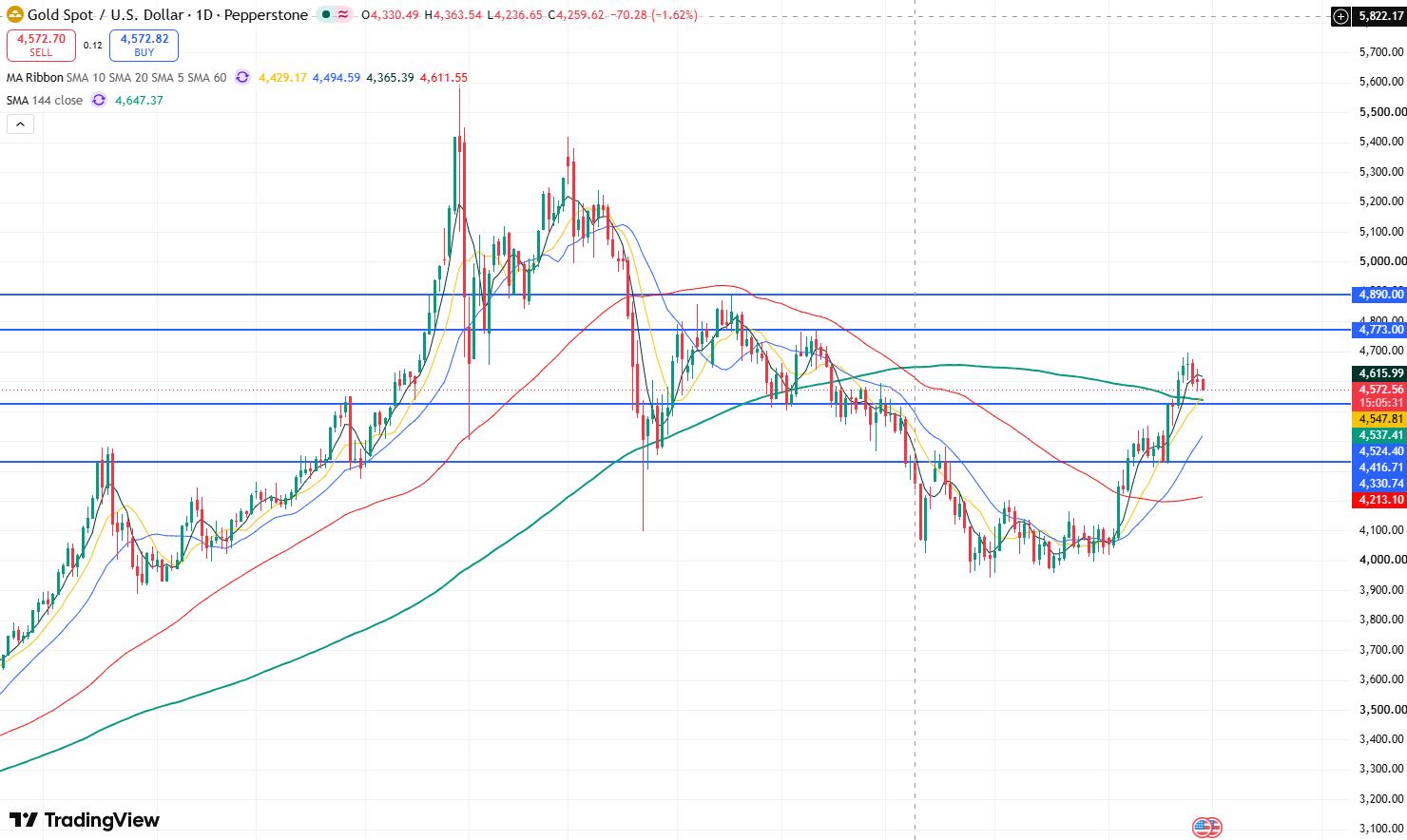
Gold Price Daily Chart, Source: TradingView
Looking at the daily chart of gold prices, the recent movement of candlesticks shows a clear pattern of higher highs and higher lows, indicating that the near-term trend for gold prices is distinctly bullish. Meanwhile, as the 5-day and 10-day moving averages cross above the 144-day moving average, forming a golden cross, market bullish momentum has been further strengthened.
Currently, gold prices are pulling back under pressure below $2,700, but the 10-day and 20-day moving averages remain in a bullish alignment, indicating that the short-term trend remains bullish.
On the upside, the primary resistance level to watch is $4,700. If gold prices can break out and hold above this level, it will open up upside room toward $4,800 or even $4,900.
On the downside, the primary support level to watch is $4,530, which is also located near the 10-day moving average, potentially forming a confluence of support. If this level is lost, gold prices may pull back further to test the support level near $4,450.
This content was translated using AI and reviewed for clarity. It is for informational purposes only.
Recommended Articles








Comments (0)
Click the $ button, enter the symbol, and select to link a stock, ETF, or other ticker.