


Morgan Stanley’s Latest Assessment: Three Variables for Gold’s Rise to $5,200 — Hawkish Fed, ETF Flows, and Middle East Turmoil



AI Podcast


Morgan Stanley has lowered its late 2026 gold price target to $5,200 per ounce, citing hawkish Federal Reserve policies and elevated real yields. While global central bank buying establishes a structural floor, analysts emphasize that sustained price appreciation depends on a resurgence in ETF inflows, which remain pressured by high interest rates and a strong U.S. dollar. Despite geopolitical volatility, gold’s recent performance is tied more to inflation and energy prices than safe-haven demand. Reaching the $5,200 target remains difficult without a shift in investor sentiment and monetary policy trends.

TradingKey - Morgan Stanley ( MS )'s latest precious metals research report shows that while continuous gold purchases by global central banks have provided a solid floor of support, gold ( XAUUSD )'s march toward a new historic high of $5,200 per ounce is facing strong resistance from the Federal Reserve's hawkish policy.
Between late April and May of this year, the Wall Street investment bank sharply lowered its gold target price for the second half of 2026 from the previous $5,700 to $5,200, reflecting its assessment of weakening short-term upward momentum for the precious metal.
Although the bank still maintains its long-term upward forecast for gold prices, analysts warn that without a resurgence in exchange-traded fund (ETF) buying, achieving this target will become increasingly difficult.
Morgan Stanley commodity strategists Amy Gower and Martijn Rats pointed out that the key variable in the current gold market is ETF demand, which heavily depends on the Fed's policy path, the trajectory of real yields, and the strength of the US dollar.
"While central bank gold purchases can put a floor under the market, ETFs are the core driver for pushing prices further upward," the analysts said. "If ETF capital does not flow back, gold prices may maintain a relatively strong pattern, but the path to $5,200 will become much narrower."
Fed Hawkishness Looms Large, ETF Flows Key to Breaking the Deadlock
The Federal Reserve's hawkish stance is becoming the biggest obstacle to gold's push toward the $5,200 mark.
The hawkish signals sent by the Federal Open Market Committee (FOMC) last week not only pushed up market expectations for rate hikes but also further raised the opportunity cost of holding non-yielding gold.
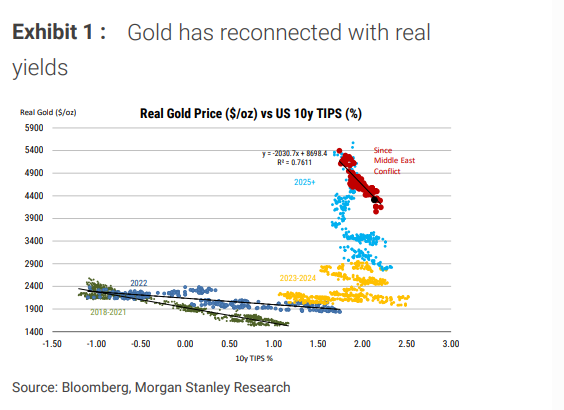
Morgan Stanley economists noted that the Fed seems determined to keep interest rates elevated through the end of 2026. This stance has directly driven the U.S. 10-year Treasury real yield to its highest level this year, while also triggering persistent net outflows from gold ETFs.
However, historical data shows that rate hikes do not necessarily lead to a decline in gold prices. Research by Morgan Stanley found that in the month following a 25-basis-point rate hike by the Fed, gold prices actually rose by an average of 0.84%.
The key behind this is that the market's true focus is not the rate hike itself, but the subsequent trajectory of the U.S. dollar, changes in real yields, and shifts in risk appetite.
Looking back at previous cycles, rate hikes in June 2006, December 2018, and March 2023 all triggered market concerns over economic growth, serving instead as catalysts for gold to rally against the trend.
Breaking through the key $5,200 level depends on the return of gold ETF buying. Morgan Stanley commodity strategists Amy Gower and Martijn Rats emphasized that the core variable in the current gold market is ETF demand, which is highly dependent on the Fed's policy path.
While continuous gold purchases by global central banks have provided a solid floor for gold prices, ETF flows are highly sensitive to real yields and the trajectory of the U.S. dollar.
Data show that the R-squared value between gold prices and the U.S. 10-year TIPS real yield has reached 0.7611. The Fed's recent stance of keeping interest rates unchanged has already led to noticeable outflows from ETFs.
Easing of Middle East tensions opens up upside potential for gold
The easing of tensions in the Middle East is providing unexpected support to the gold market—a tailwind driven not by traditional safe-haven demand, but by the relief of inflationary pressures transmitted through falling oil prices.
Looking back at recent market performance, it is clear that gold failed to exhibit its traditional safe-haven attributes during this geopolitical conflict. The primary reason is that conflict-induced supply shocks drove up energy prices, which heightened inflation expectations. This, in turn, forced the central banks of some oil-importing nations to liquidate gold reserves to stabilize their fiscal positions, ultimately putting additional pressure on gold prices.
Now, as geopolitical tensions subside, expectations of declining energy prices are materializing. This will not only free up monetary policy space for central banks but also directly alleviate the pressure on them to sell gold.
A Morgan Stanley report noted that while retail and ETF interest in gold has cooled, sustained heavy buying by global central banks continues to establish a firm structural floor for gold prices.
This content was translated using AI and reviewed for clarity. It is for informational purposes only.
Recommended Articles











Comments (0)
Click the $ button, enter the symbol, and select to link a stock, ETF, or other ticker.