Solana and Robinhood Chain launchpads lead as crypto fees explode in September



Crypto economic activity, reflected by app fees, continued rising in 2026. The most active apps expanded their fee production, becoming one of the viable use cases for on-chain activity.
Crypto economic activity reached a new peak as Q3 closed, a total of $3.3B in fees generated for the period. In September alone, revenue-generating apps produced $1.44B in fees.
The fee-sharing model caused a revival of Web3 activity after a long period of slower on-chain usage.
During previous periods, Web3 fees were mostly generated by airdrop farming. In the past year, new revenue-sharing models appeared, and in Q3, reflection tokens linked to tokenized assets boosted on-chain fees.
The fee generation depends on real app usage, and the size of fees or on-chain tax varies for each app and for some specific tokens. The model also includes crypto influencers, who try to bring back the fee-sharing model for token holders, especially for reflection meme tokens.
Robinhood boosted crypto economic activity
Crypto economic activity depends on the appeal of chains, the presence of retail traders, and the available liquidity. Robinhood emerged as one of the leaders for on-chain token launches and trading.
Based on Cryptorank data, Robinhood’s chain generated $368M in fees in September, ranking among the top fee-producing chains for the past month. The recent fee boom came from the initial round of meme token launches.
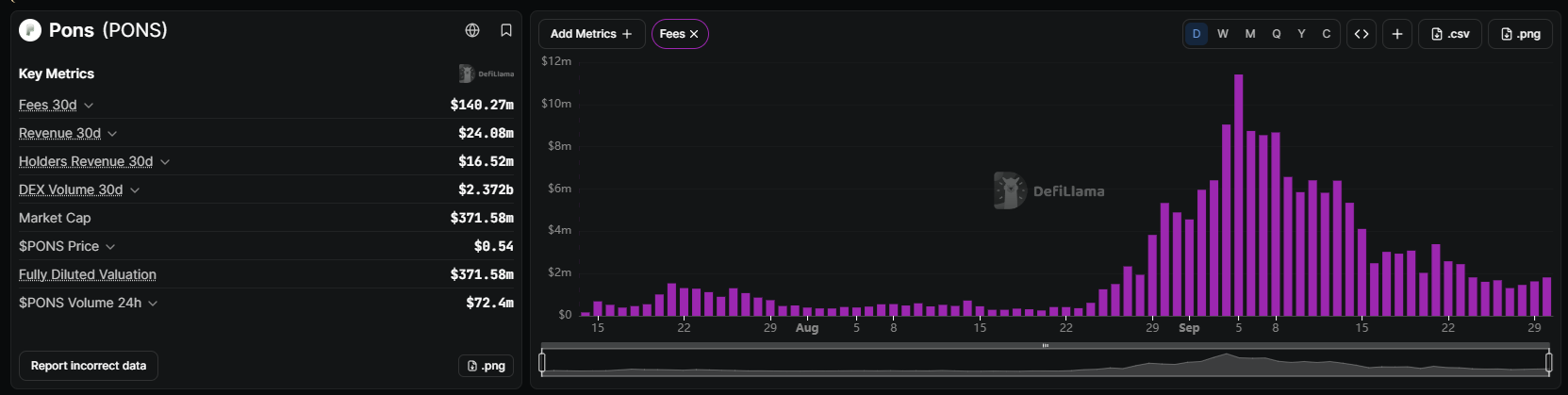
Later, the Pons launchpad became the major fee producer for Robinhood, based on reflection tokens tied to tokenized equities, cryptos, or precious metals. Pons peaked on September 5, with $11.42M in daily fees. At the end of the month, Pons produced around $2M in daily fees.
Fee sharing also turned into a mechanism to invite ‘trenches’ traders and holders. Crypto influencers also received unsolicited fee sharing on social media, with the invitation to boost exposure for specific meme tokens.
Despite this, on-chain data shows that only a handful of memes offer meaningful fee-sharing revenues. On-chain data also shows some of the recent meme launches were rug pulls, often linked to the same launch teams.
Decentralized trading also boosted crypto fees
Launchpads were only a part of the general fee production for leading chains. Decentralized trading and prediction markets still held strong. Some of the leading fee-producing apps still include Uniswap, which turned into the leading DEX. Uniswap benefited from its version on Robinhood, as well as a generally improved sentiment for altcoins and tokens.
Hyperliquid and Polymarket retained their top 10 positions as fee producers. Hyperliquid made over $73M in fees for September, while Polymarket reached over $87M. As Cryptopolitan reported earlier, prediction markets broke above $20B in weekly trading for the first time.
Solana’s apps also remain among the top fee producers, with strong performance on the 24-hour time frame. PumpFun is still one of the key venues for launches, after adding its own version of reflection tokens.
StonkFun, the recently launched venue for reflection tokens, as well as the Fomo copy-trading app added their new models to Solana. The recent quarterly fee results reflect those new types of apps, which quickly spread throughout the crypto space.
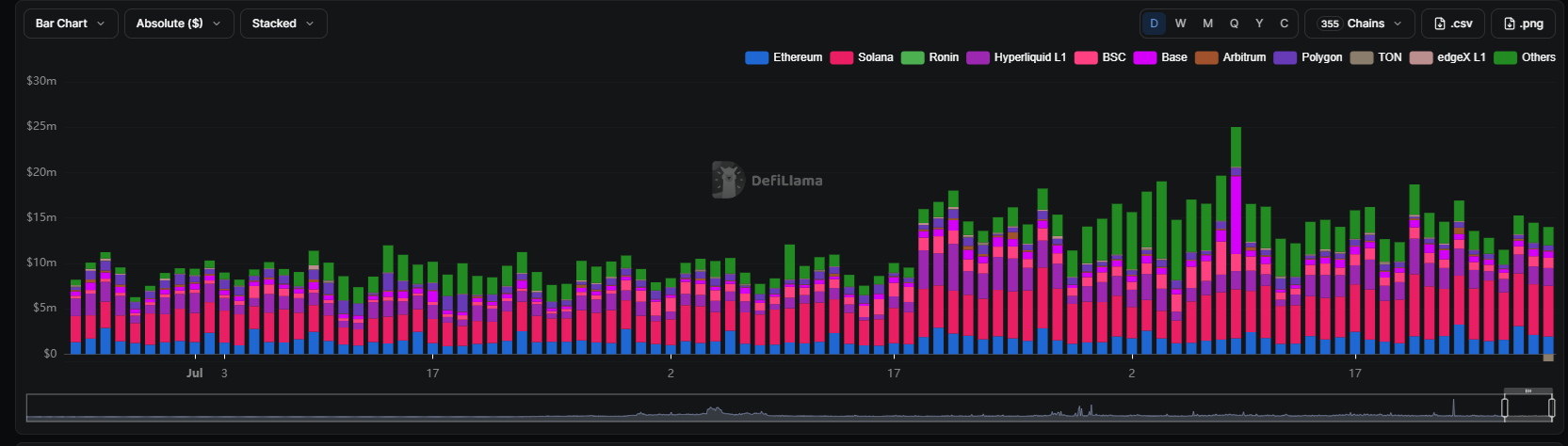
As a result, Solana was still the leading chain by app revenue in September, with a total of $145.75M. Robinhood, despite its significant fees for September, only achieved app revenues of $86.8M.
In September, almost all chains saw a boost in total app revenues. Even legacy chains with minimal activity found models that attracted new traders, whales, and influencers.
For now, the new apps and models are yet to prove their viability and risk profile, though they show Web3 technology can be revived with additional use cases to attract new liquidity.
Don’t just read crypto news. Understand it. Subscribe to our newsletter. It's free.