


COHR: Rev. growth and profit, still full-throttle in optics?


$Coherent Corp.(COHR.US) released FY1Q27 results after the U.S. close on Nov 4 ET (early Nov 5 Beijing time). Overall read is solid, with steady execution and a higher long-term GPM guide lifting confidence, sending shares up 8% after-hours.
That said, its mkt cap has shed over 50% from the recent peak within six months. Can this print win buyers back when set against the fundamentals?
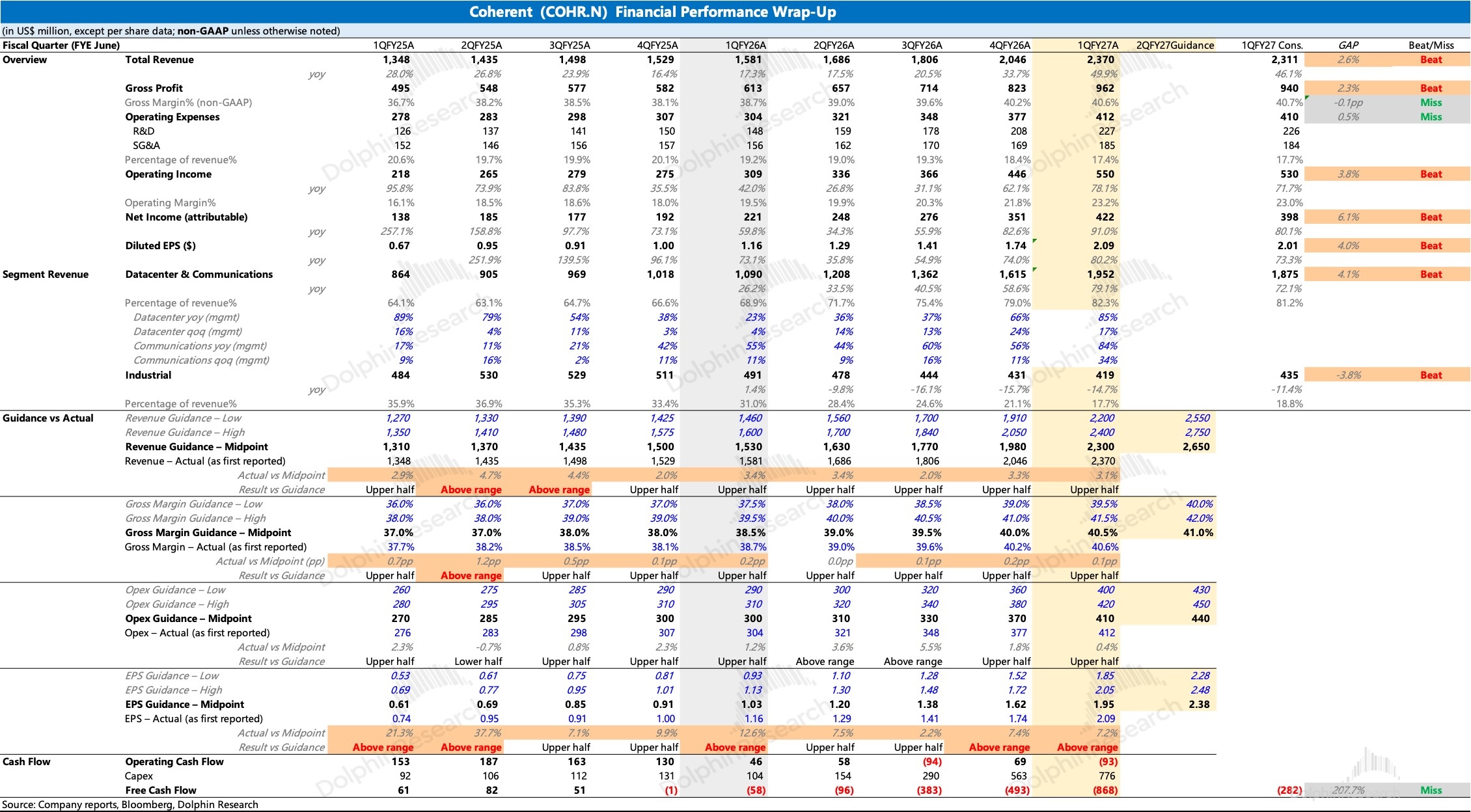
1. Revenue: Solid, in line
Total revenue was $2.37bn, up nearly 50% YoY and about 16% QoQ. It landed in the upper half of guidance, 3.1% above the midpoint, with mix tilting faster toward data center and communications.
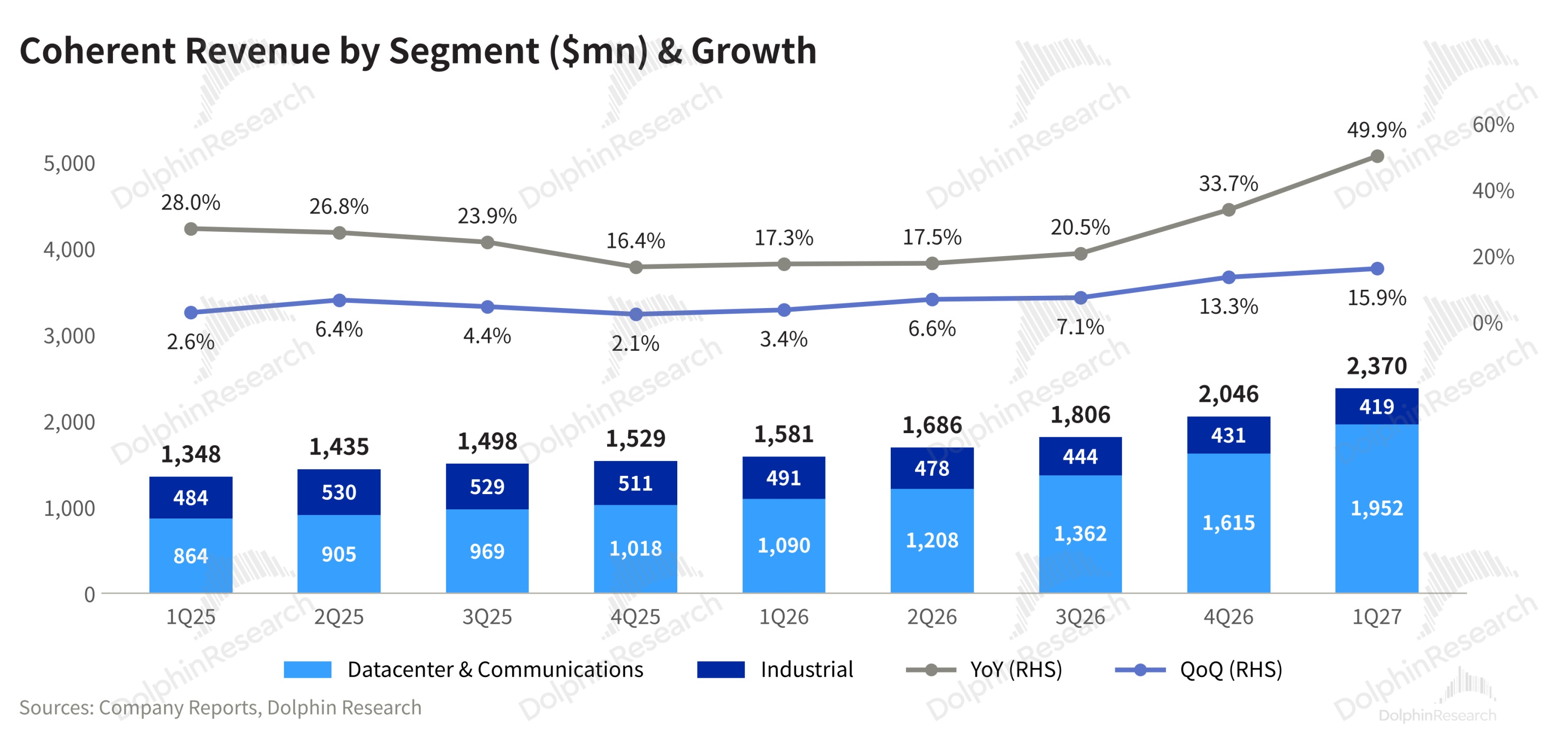
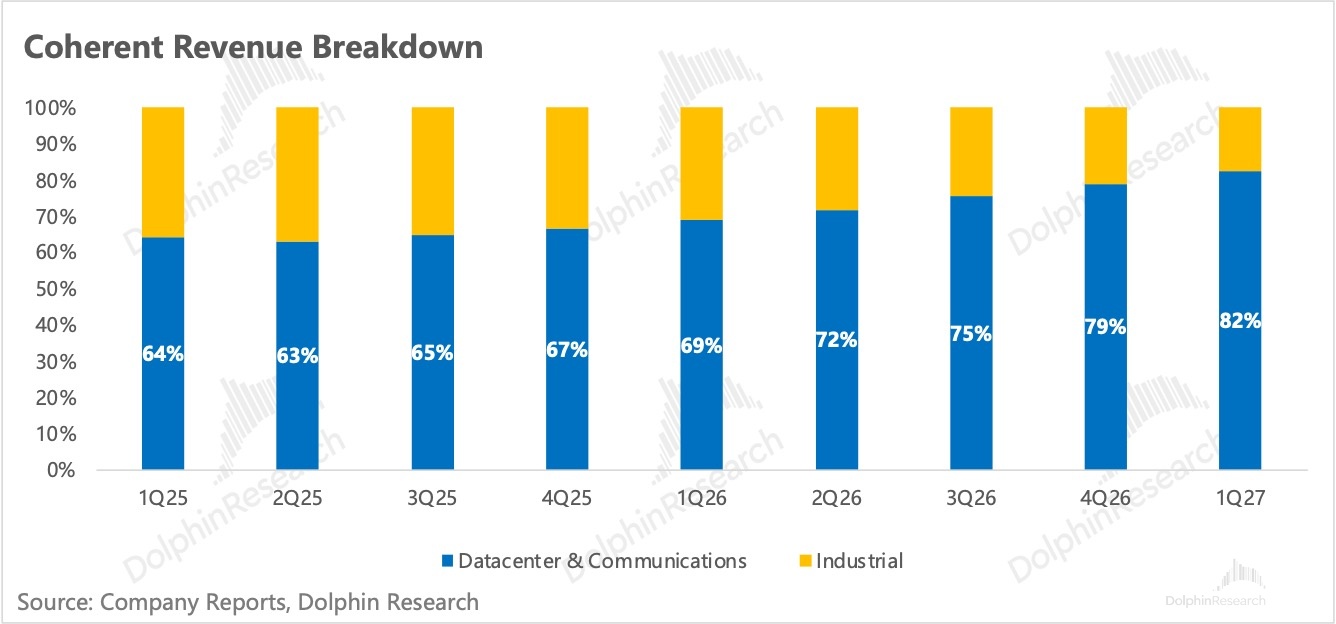
Data Center & Communications revenue reached $1.95bn, +79% YoY and 4.1% above consensus. The segment accounted for 82% of total, up from 79% last quarter.
- Data center growth delivered at +85% YoY, meeting management’s prior goal of 80%+. 1.6T optical modules have ramped across multiple customers, and 1.6T together with 800G will jointly drive strong module growth next quarter.
- Communications was up 84% YoY, driven by DCI/Scale-Across while legacy telco also grew. Scale-Across/DCI revenue topped $200mn this quarter, roughly 4x YoY, or about $1bn annualized. The company expects by end-CY27 that quarterly revenue will double vs. Q1, implying Avg. ~15% QoQ over the next five quarters.
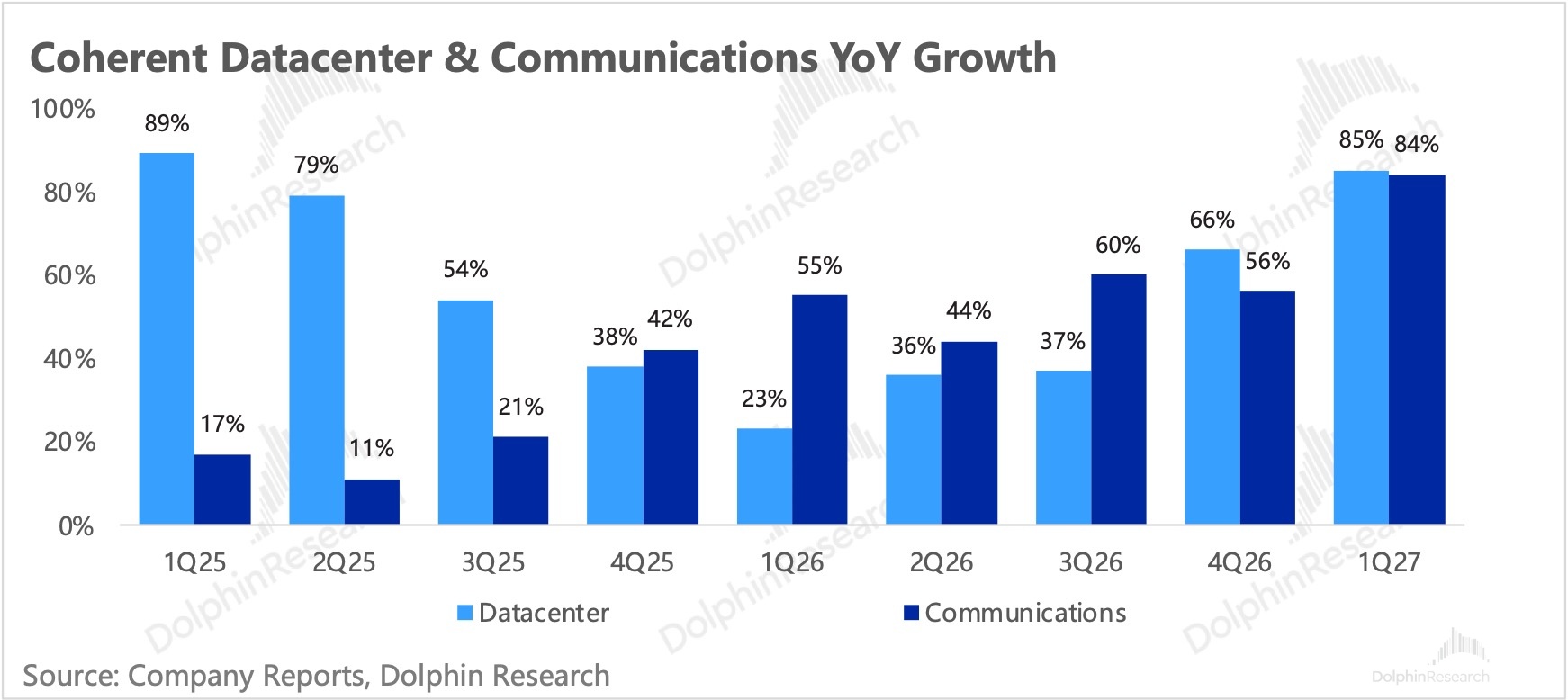
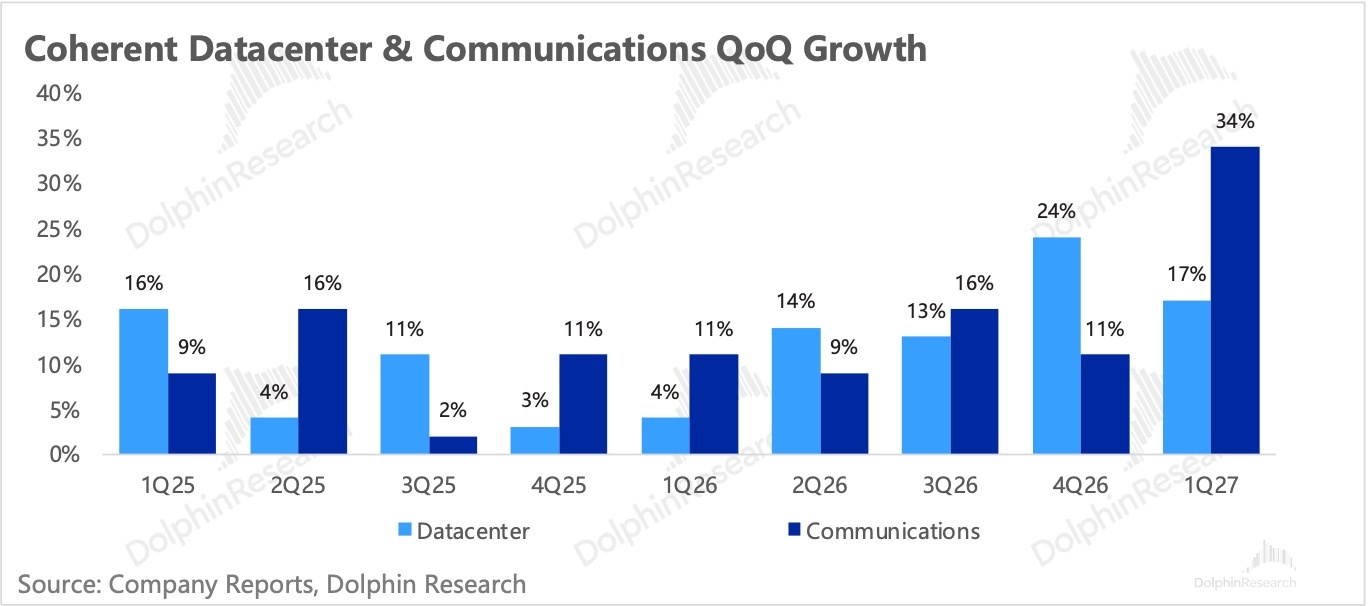
The guide implies demand remains strong, with both data center and communications set to continue robust growth YoY and QoQ in Q2. Momentum looks intact across both sub-segments.
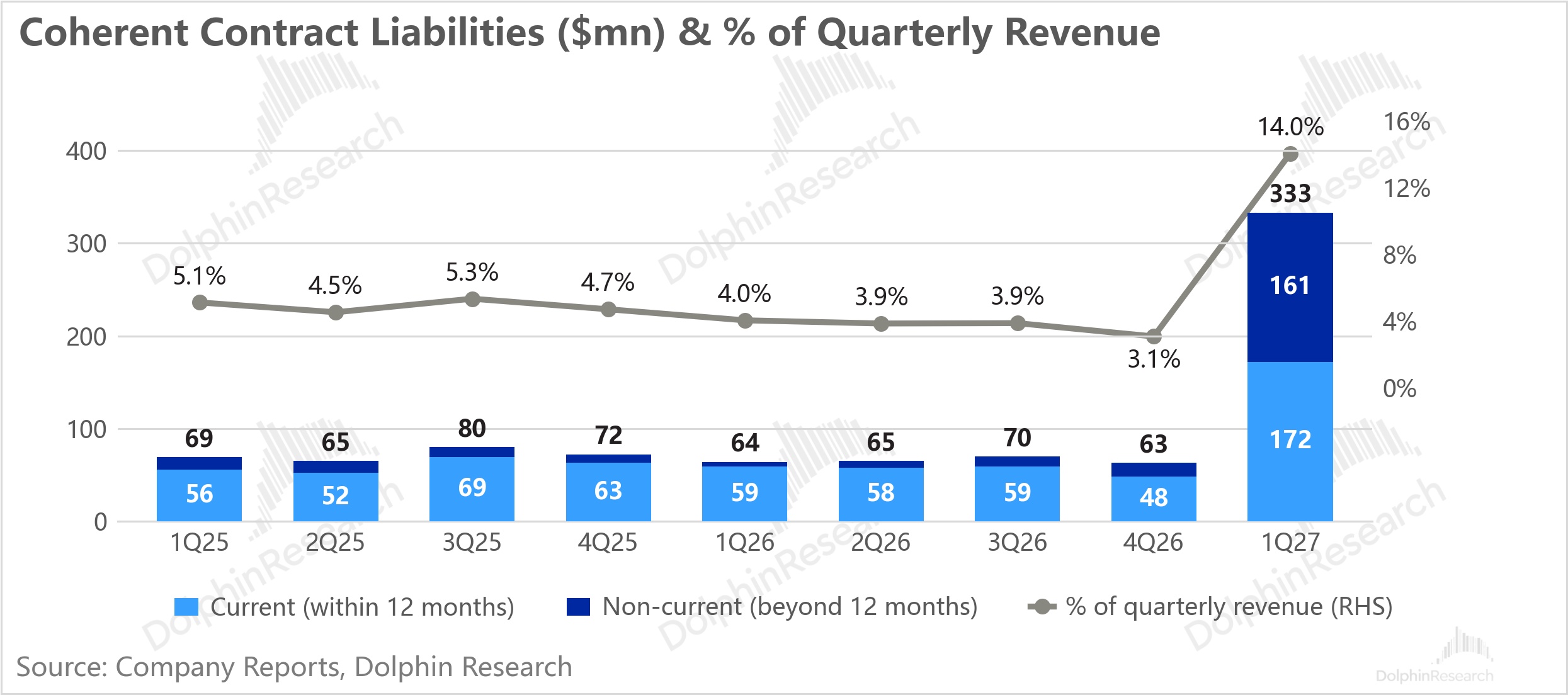
Visibility on sustainability also looks high: CY27 is well covered by orders, with backlog extending into CY28 and LTAs generally running to around 2030. As evidence, contract liabilities rose to 5.3x last quarter’s level, with the portion recognized beyond one year up from $15mn to $161mn.
Longer-cycle visibility comes from the PhotonLink platform: this quarter the company signed a new five-year LTA of roughly $20bn with a second anchor customer besides NVIDIA (a leading AI company). Revenue contribution is slated to begin in early CY28.
2. Gross margin: The strongest print
GPM reached 40.6%, up 180bps YoY and 40bps QoQ. The long-term target was raised from 42% to 45%, to be achieved on a quarterly basis by end-2028.
With orders already packed, we focus more on delivery quality—namely the pace of margin uplift during the revenue ramp. On this, GPM is the part that truly stands out.
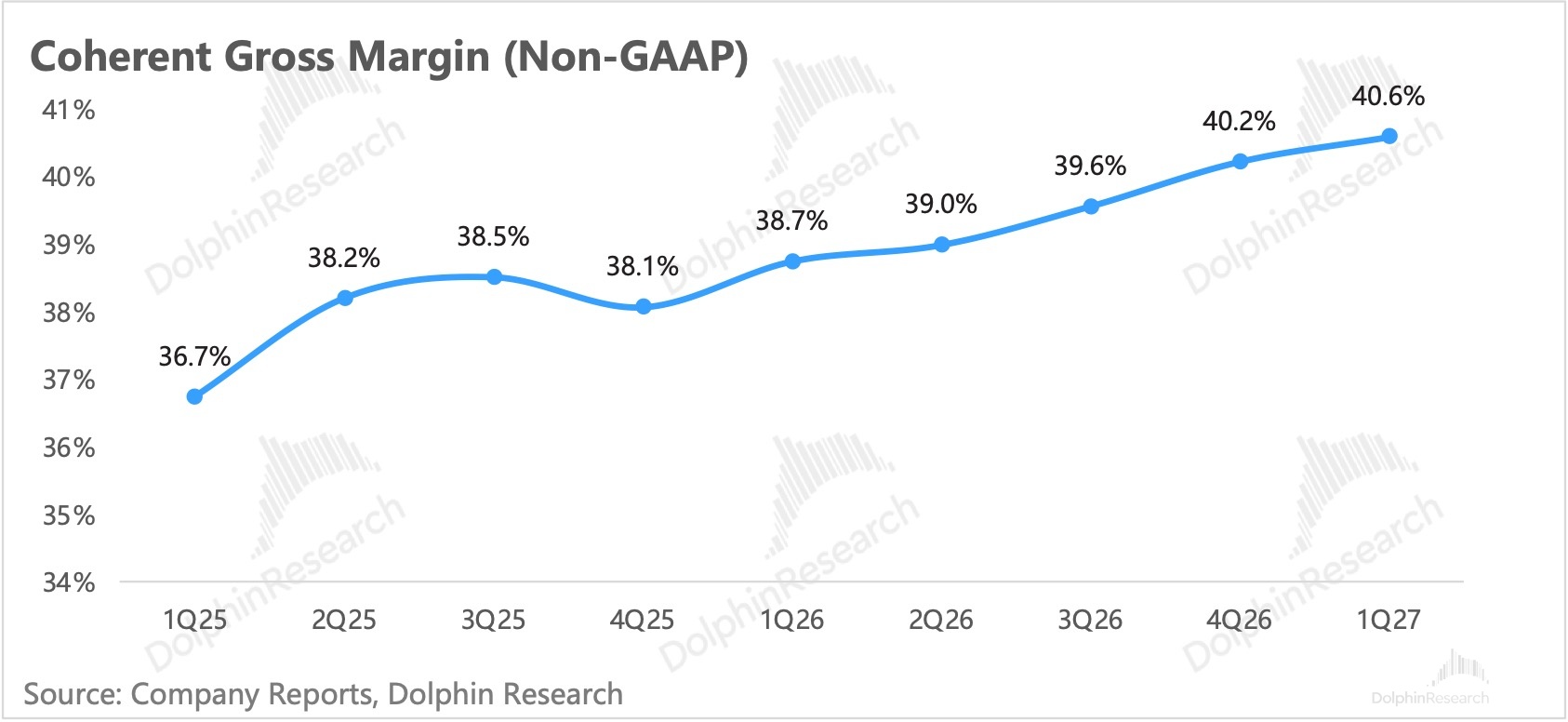
The YoY and QoQ GPM gains were mainly driven by pricing, lower product input costs, and manufacturing yield improvement. Pricing was concentrated in Data Center & Communications.
This is especially critical during the 1.6T ramp. The new-product transition did not drag margins, easing prior concerns around mix-upgrade pressure.
The company also lifted the LT GPM target to 45% (by end-2028 on a quarterly basis). Management’s roadmap, by contribution, is led by high-margin new products scaling and 6-inch InP full utilization, followed by pricing and cost-down.
The 6-inch capacity dividends have yet to be realized. The mix of in-house vs. outsourced InP devices is roughly unchanged vs. a year ago, and while in-house capacity has doubled, the module ramp absorbed it all.
As capacity more than doubles again by end-CY27, the company will gradually shift toward in-house over the coming quarters. The 6-inch line already has higher yields than 3-inch, and each epi reactor run outputs 2.5x vs. 3-inch, giving in-house lasers a cost advantage over time.
3. Opex & profitability
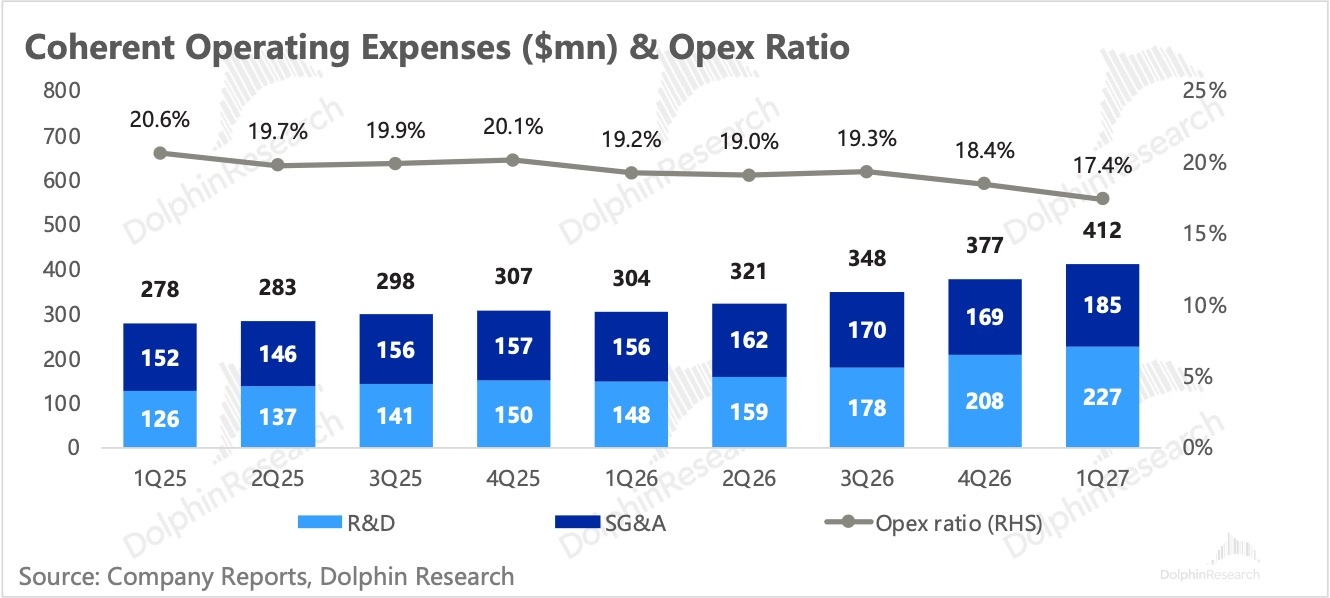
Non-GAAP opex was $412mn, roughly in line with consensus. The opex ratio was 17.4%, down close to 200bps YoY and already below the LT target of 18%. Incremental R&D spend went to modules, PhotonLink (merchant device platform), OCS, and the multi-rail transmission platform.
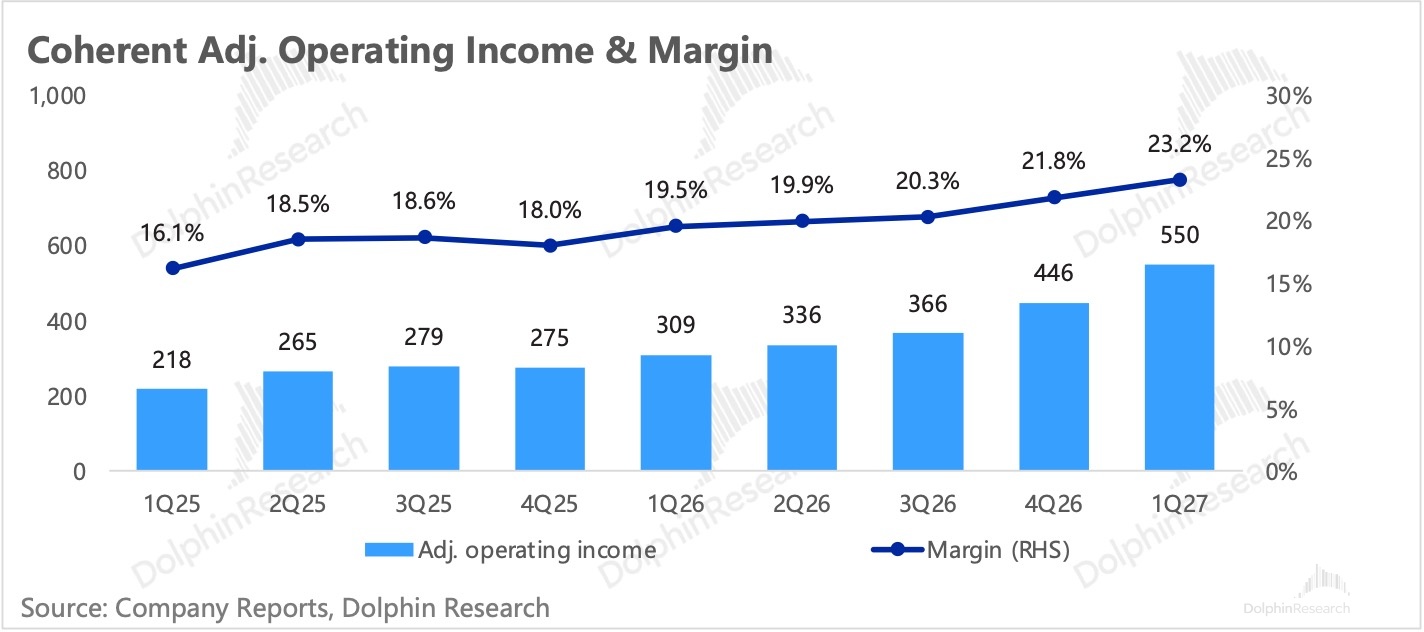
OPM came in at 23.2%. That was 30bps above consensus.
4. Cash flow: Cash goes to inventory; negative CF is not an issue
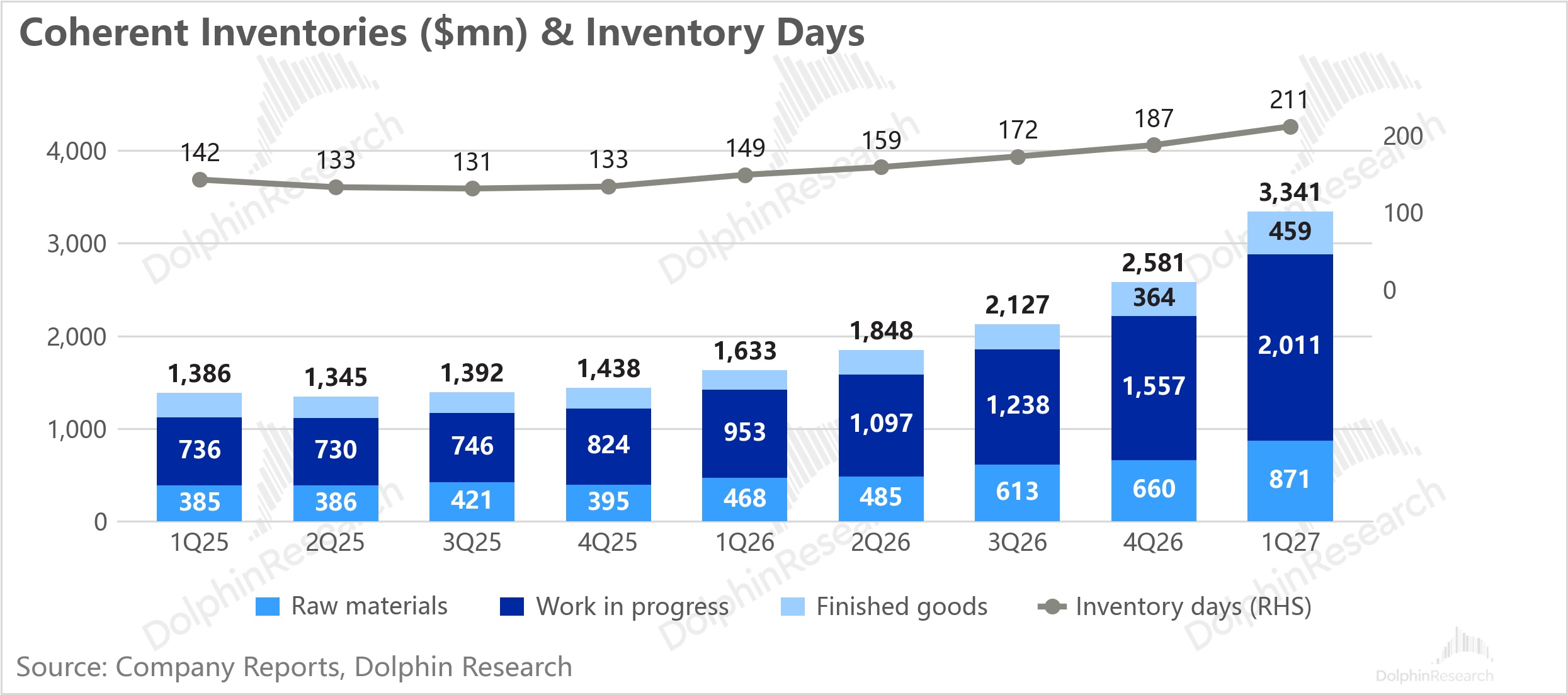
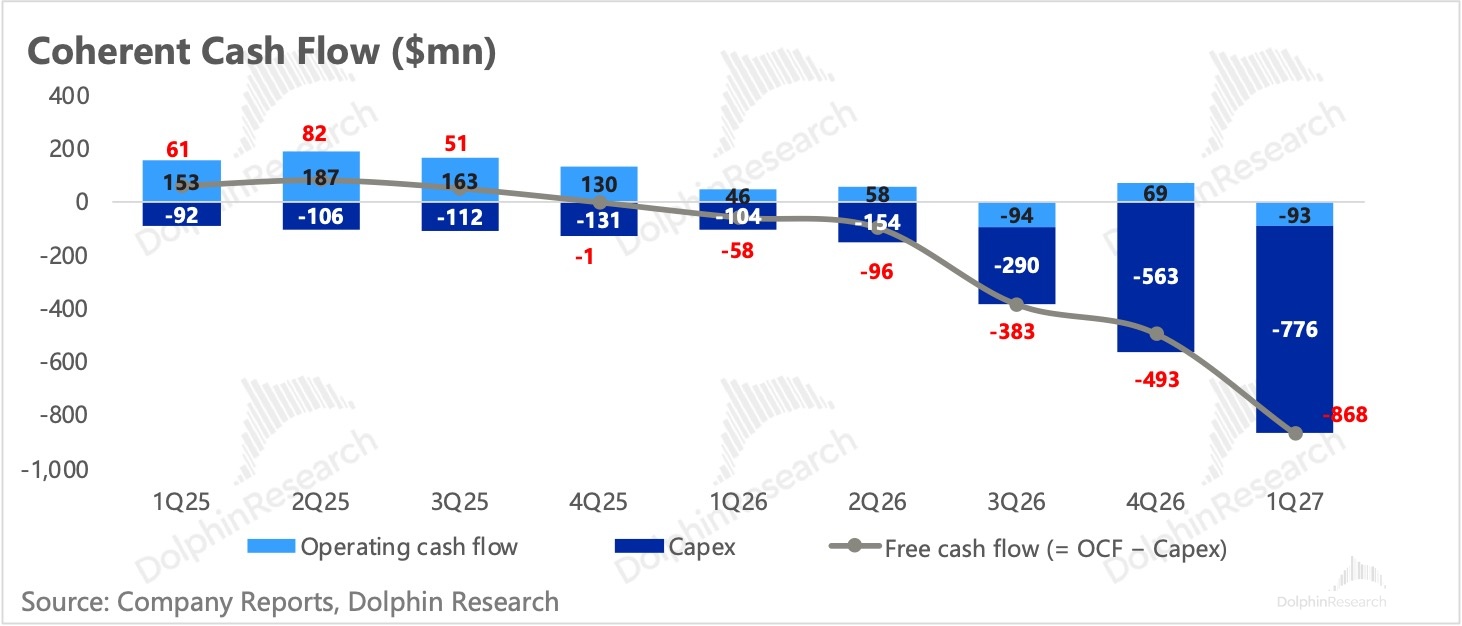
Operating CF was -$93mn (vs. +$46mn a year ago), mainly to support growth via inventory build. Inventory rose $760mn QoQ to $3.34bn, including a $450mn increase in WIP, implying continued growth ahead.
Capex was $776mn during the expansion cycle, vs. $556mn last quarter. Management said Q2 will be up QoQ as expansion continues, making capex unlikely to come down near term.
FCF was -$868mn. The print reflects heavy capex and working-capital build.
5. For more on this quarter, seeTrans. Refer to the link for details.
6. Performance overview follows
Dolphin Research view:
1. The higher GPM guide is the most direct positive this quarter. From 40.6% to above 45% by end-2028 on a quarterly basis implies ~50bps per quarter over the next ~9 quarters. That aligns with this quarter’s +40bps QoQ cadence.
Such guidance signals strong confidence in navigating a tight InP cycle. Given the 6-inch ramp and vertical integration, hitting the target looks achievable.
2. The key debate remains the InP supply-demand inflection, which the market is split on. On one hand, there is concern that InP tightness could cap module shipments and revenue. On the other, expansion—especially by Chinese laser vendors—could create EML oversupply and trigger price wars. The company’s responses are as follows:
- In-house InP laser output doubled YoY, one quarter ahead of plan, and will more than double again by end-CY27, with substrates secured (over five suppliers).
- In-house InP is fully used internally for modules and still does not meet internal needs, so lasers are not sold externally.
- No visible risk of EML oversupply before CY28.
- For 400mW ultra-high-power CW lasers used in CPO, the company sees only one competitor (Lumentum), and no Chinese vendors.
Amid tight supply, the company relies on full-stack capabilities from epi, chips, devices, modules to systems to secure deliveries. InP capacity is expanding in Sherman, Texas and Sweden, and the 6-inch line in Zurich is slated for 1H CY27.
This underpins the growth narrative. It remains a core pillar of the story.
3. Key risks to watch:
a. Pricing hinges on InP supply-demand, the core risk. Demand strength is consensus, but industry-wide InP capacity views diverge, making the turning point hard to call. Several forces are easing light-source tightness:
- Significant InP capacity expansion;
- CW silicon photonics allowing one laser to feed multiple channels, lowering InP per module;
- VCSEL and other non-InP approaches diverting some demand;
- Domestic EML/CW laser ramp from Source Photonics China peers such as Source Photonics (CN), Accelink and others. Once the market loosens, module and optical chip profitability will retreat visibly.
b. Module-level moats are limited. Assembly/manufacturing barriers are modest, with bargaining power driven by upstream/downstream. Under CPO, the core step (optical coupling) shifts to OSATs, and once they master it, they can compete on capacity. Meanwhile, CPO design largely returns to switch-chip vendors, who are also key buyers of pluggables. A Fabrinet-style pure-EMS model may also find opportunities.
c. DSP capacity constraints. DSPs are limited by TSMC’s advanced-node capacity. This adds another supply-side uncertainty.
d. Sustained heavy capex is another variable to validate. Line expansions and tool upgrades are worsening near-term cash flow, with no sign of slowing near term. Despite firm POs and multi-year LTAs, whether the company can complete a fast, capex-intensive ramp without sacrificing margins, straining working capital, or facing customer-cert delays still needs to be proven by future prints.
4. How to value Coherent?
In our view, in the shift from legacy telecom to AI optical, Coherent’s most valuable asset vs. traditional module peers is its laser chips and InP capacity, a point validated by Marvell’s premium bid for Lumentum. This asset is further amplified in NPO/CPO. Amid rapid shifts in the external environment, technology, and demand, the light source is the most certain asset, and as the No.2 source vendor Coherent likely deserves a premium.
On historical P/E, since AI took off in 2023 the multiple has traded roughly 15-30x. The current multiple is near the low end of that band.
On Dolphin’s base case, we assign 20x FY28E Adj. net income (Lumentum at 20-25x). This implies a mkt cap of about $53bn, ~39% upside vs. today.
We view the base-case top-line valuation as relatively cautious. In a bear case, we assume 28E GPM at 41%, implying earlier-than-expected easing of InP tightness and intensified competition driving price erosion, vertical-integration capex keeps FCF under pressure without margin gains, and product-mix upgrade plus yield ramp miss expectations.
We assign 13x P/E, slightly above the ~12x trough since 2023, with AI exposure providing some support. That implies a ~$31bn mkt cap and ~20% downside.
The multiple uplift from this print is limited. The higher margin guide is the key positive, but execution depends on industry beta; consider scaling in when valuation nears the bear case to retain a margin of safety.
Notes:
A quick look at product/biz definitions. Similar to Lumentum, Coherent grew into today’s communications leader via M&A, and in FY2026 reorganized segments into: a) Data Center & Communications; b) Industrial.
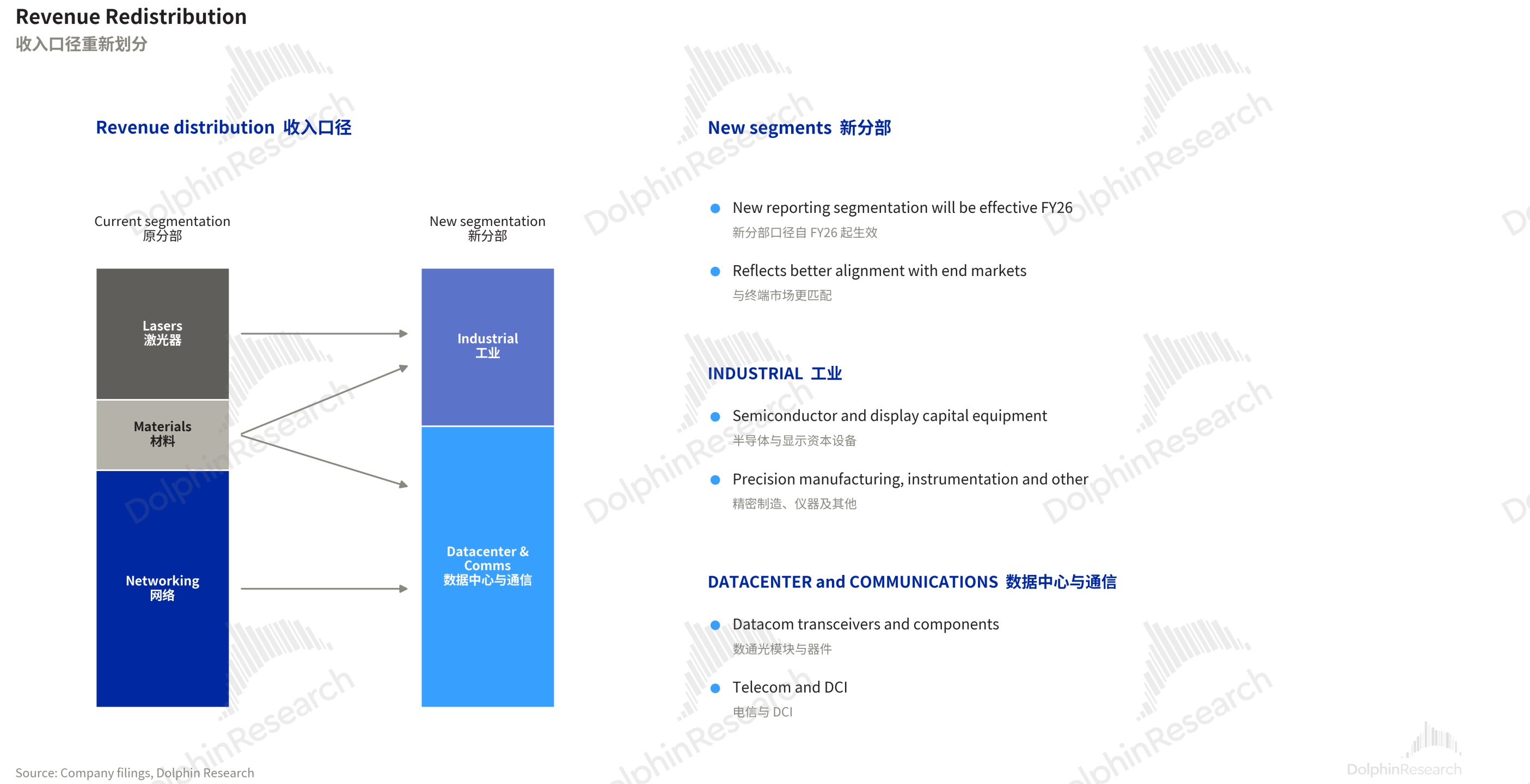
Under the new perimeter, Data Center & Communications is the primary revenue driver, at about 82% in FY27 Q1. By Dolphin’s estimates (non-company disclosure), the key product revenue mix from high to low is: optical modules; comms/DCI (ROADM/WSS/tunable, etc.); OCS switches; and CPO (for CPO, cf. tech primer, value chain).
On Industrial, the company is divesting low-ROI assets. The mix should trend down and is not a focus.
Risk disclosure and statements: Dolphin Research disclaimer and general disclosures
Recommended Articles







Comments (0)
Click the $ button, enter the symbol, and select to link a stock, ETF, or other ticker.