


MELI: Broad Slowdown; Is Lending Getting Riskier?


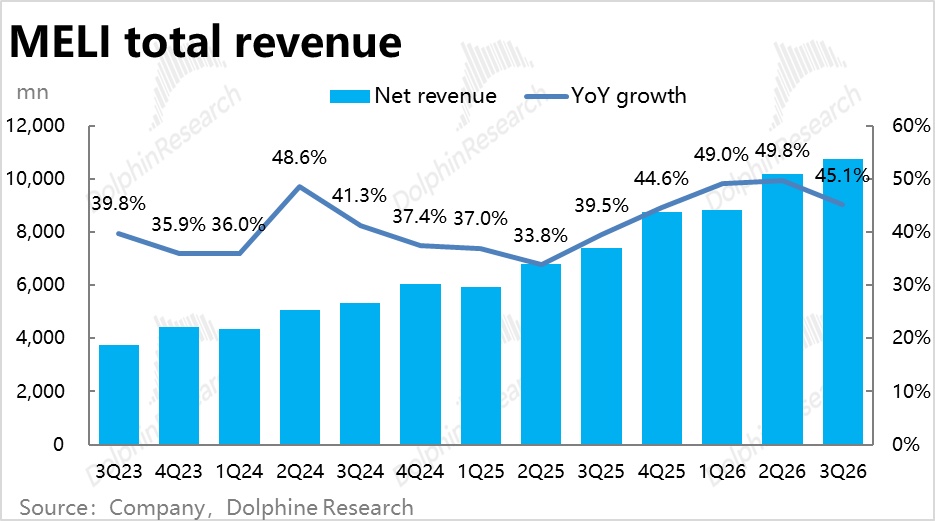
LatAm 'Alibaba' — $Mercadolibre(MELI.US) (hereafter MELI) released Q3 results after the close on Nov 4 ET. Overall, revenue growth continued to decelerate off a high base but broadly met expectations. Profit missed again by about 7%, sending the stock down ~6.5% after hours.
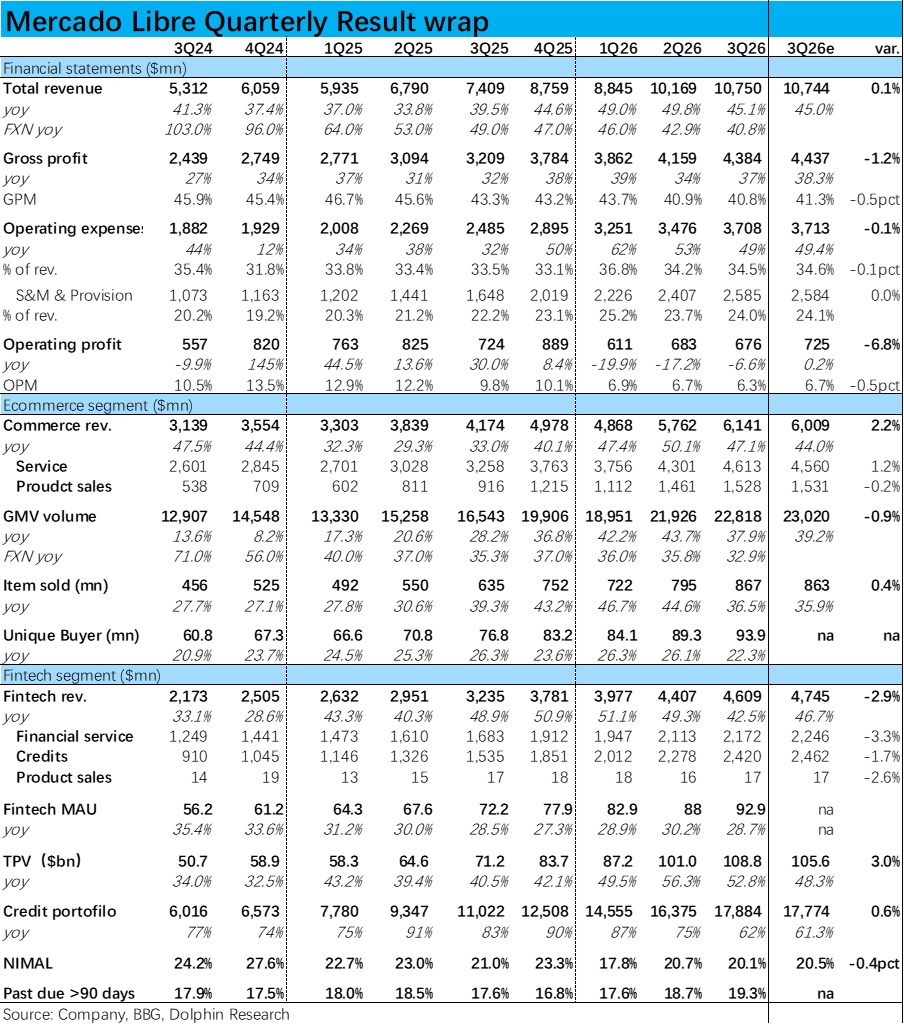
1) Headline results (revenue and profit): Total revenue was $10.75bn (+45% YoY; +41% FX-neutral), slowing by ~5ppt and ~2ppt vs. last quarter, respectively, and roughly in line with consensus. E-com revenue beat by ~2%, while financial revenue missed by ~3%.
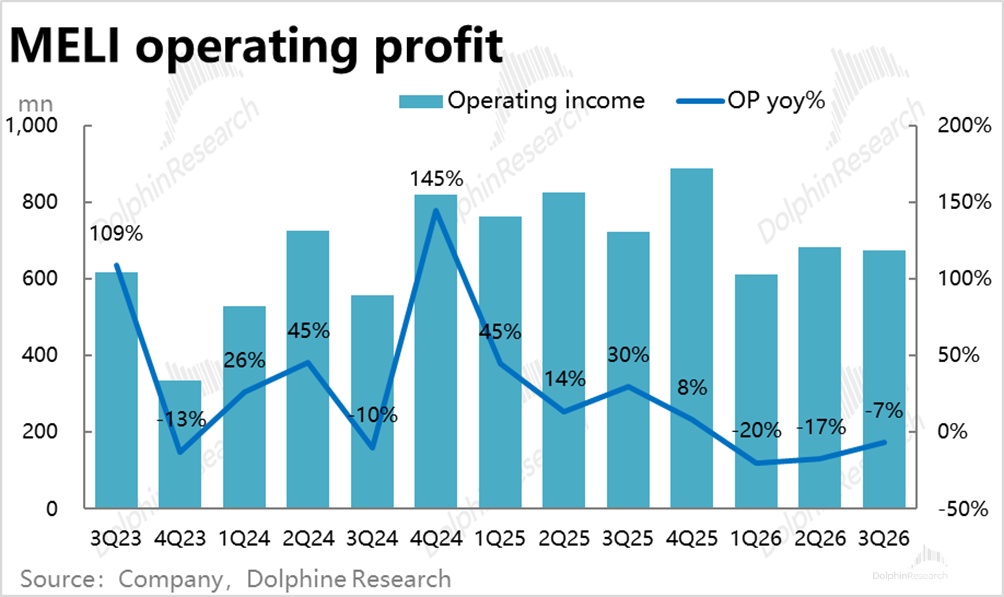
The main shortfall remained profit: OP was $680mn, about 7% below estimates, with OPM narrowing 3.5ppt YoY. The key drag was a GPM about 50bps below expectations, while opex ratio rose QoQ but was roughly as expected.
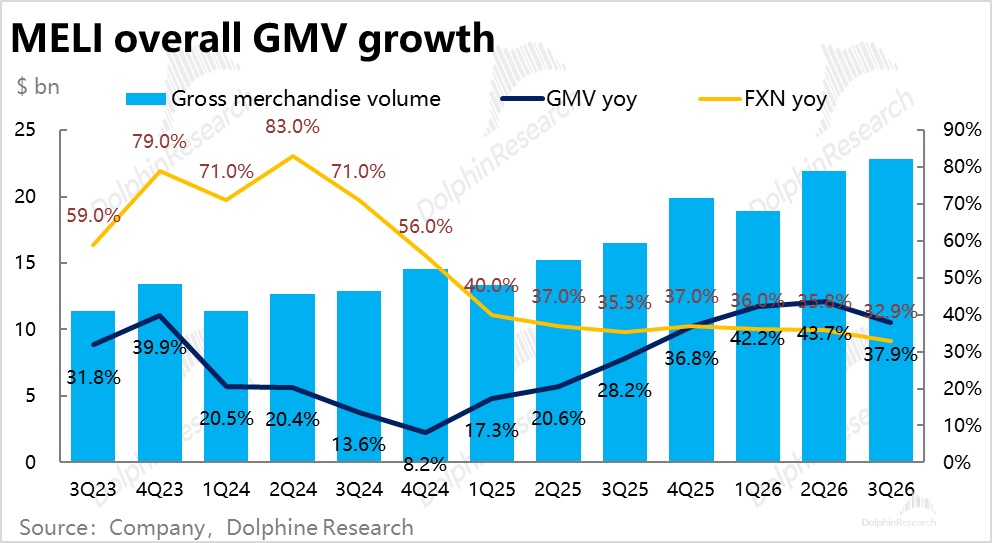
2) Broad-based slowdown in e-com volume growth, with items decelerating the most: GMV grew 38% YoY (+33% FX-neutral), slowing by ~6ppt and ~3ppt vs. last quarter, slightly below consensus. Part of the slowdown reflects fading FX tailwinds.
By price vs. volume, items grew 36% YoY, slowing ~8ppt, the steepest decel among key metrics. Unique buyers rose 22%, slowing ~4ppt.
The larger slowdown in items vs. GMV reflects a narrowing drag on AOV from low-price goods, with FX-neutral AOV decline improving to about -3%. Growth still leans on low-ticket products.
Beyond tougher comps, several factors weighed on e-com growth. Brazil has lapped last year's lower free-shipping threshold that boosted growth, with items growth easing from 56% to 45%. Mexico saw pressure from early-year tax reform and softer consumption, taking FX-neutral GMV growth down to 21%.
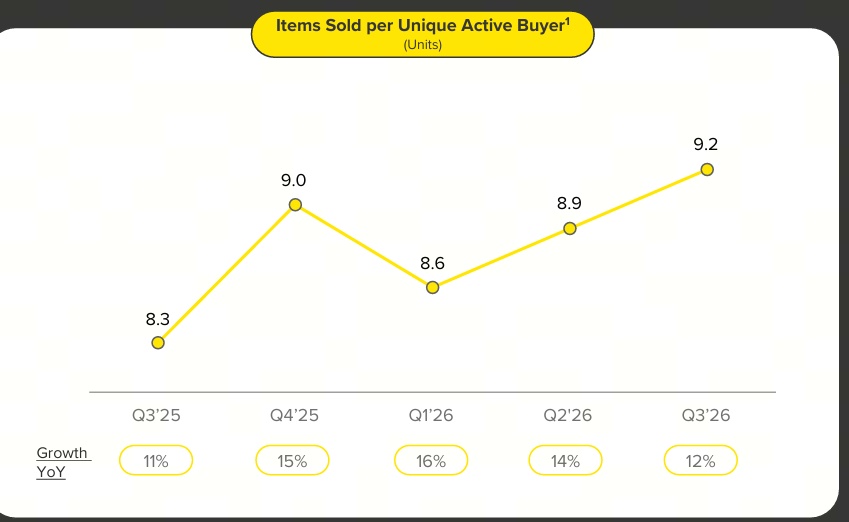
That said, despite slower active buyer growth, user stickiness is rising. Items per recent active buyer kept climbing and hit a record high this quarter.
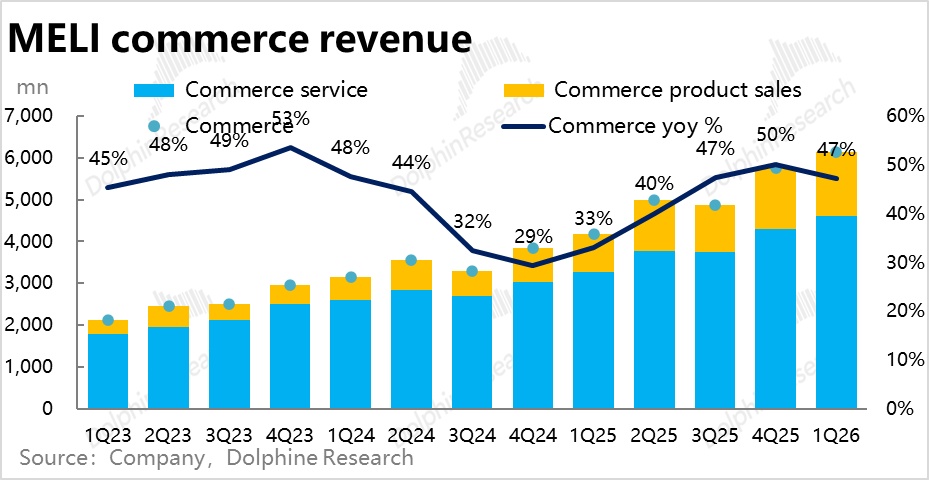
3) E-com revenue beat, monetization rebounded: E-com revenue grew 47% YoY, decelerating just ~3ppt QoQ, while FX-neutral growth slightly accelerated to 41%, about 2% above consensus. 1P revenue rose 67% and 3P services revenue rose 42%. The beat came entirely from 3P services.
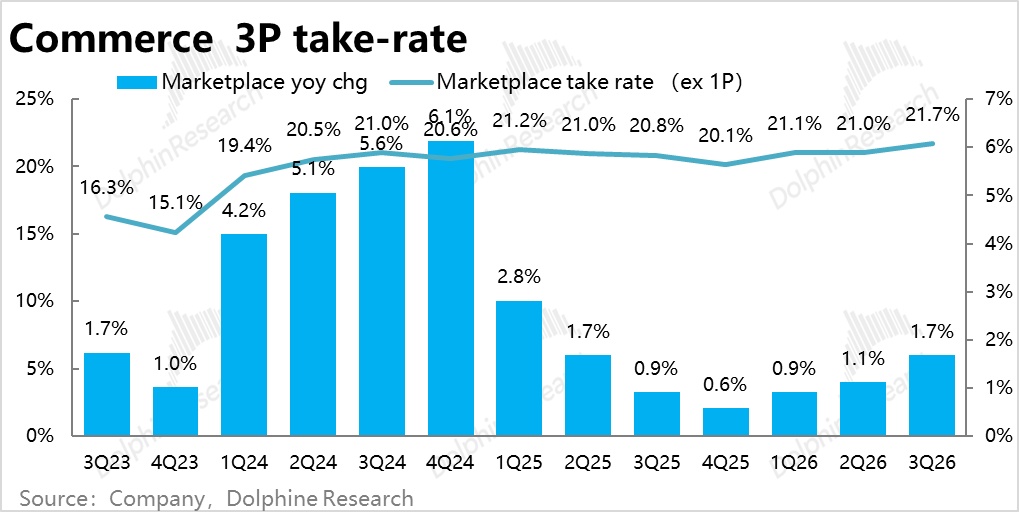
By Dolphin Research estimates, 3P take rate was 21.7%, up ~0.8ppt YoY and at a near two-year high. Ad revenue was close to 3% of GMV, up 58% YoY, contributing about half of the YoY take-rate uplift. Management noted AI improved ad matching efficiency, and ad slots moved from fixed to quality-based dynamic allocation.
The other half of the take-rate uplift, and the source of the beat, came from shipping fee adjustments. No further detail was provided.
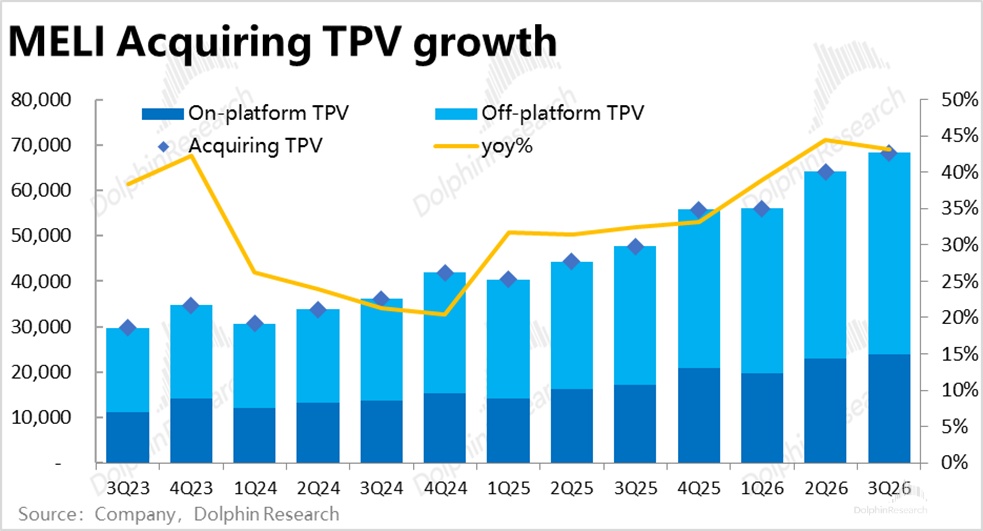
4) Payments still growing fast, but monetization is falling: TPV was $108.8bn, up 53% YoY and ahead of expectations. Acquiring TPV, the main revenue contributor, grew 43% YoY, only ~1ppt slower than last quarter. Growth remains strong.
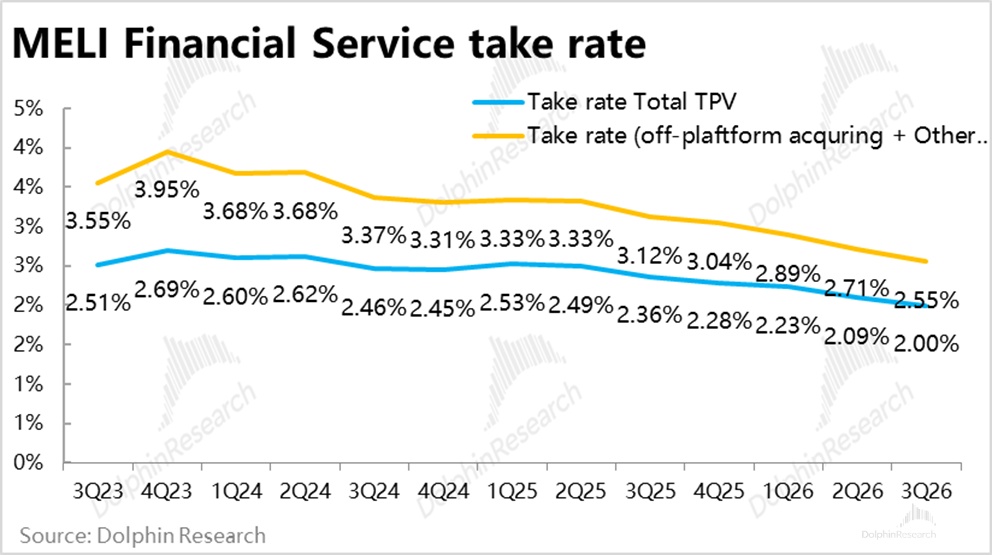
The engine remains off-platform processing, up about 46% this quarter, outpacing on-platform at about 38%. However, financial services revenue, largely fees on payments, rose just 29% and missed consensus by ~3%. Financial services revenue/TPV fell from 2.4% a year ago to 2.0%, indicating continued take-rate pressure.
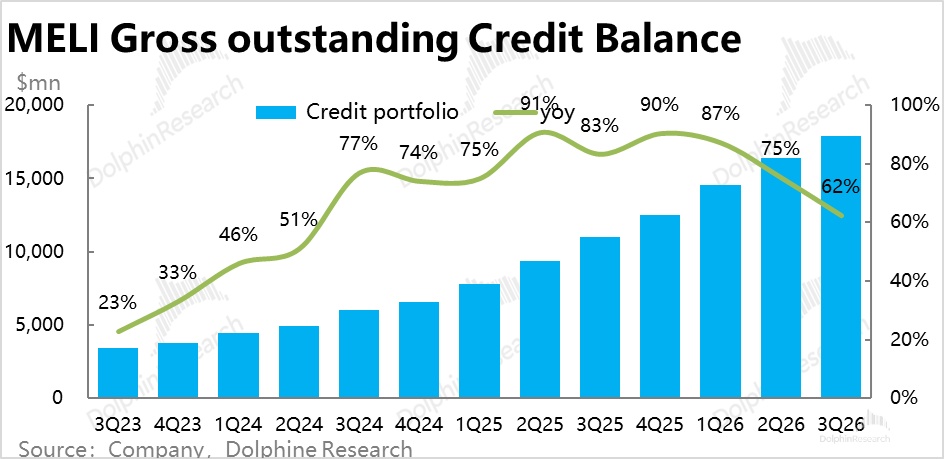
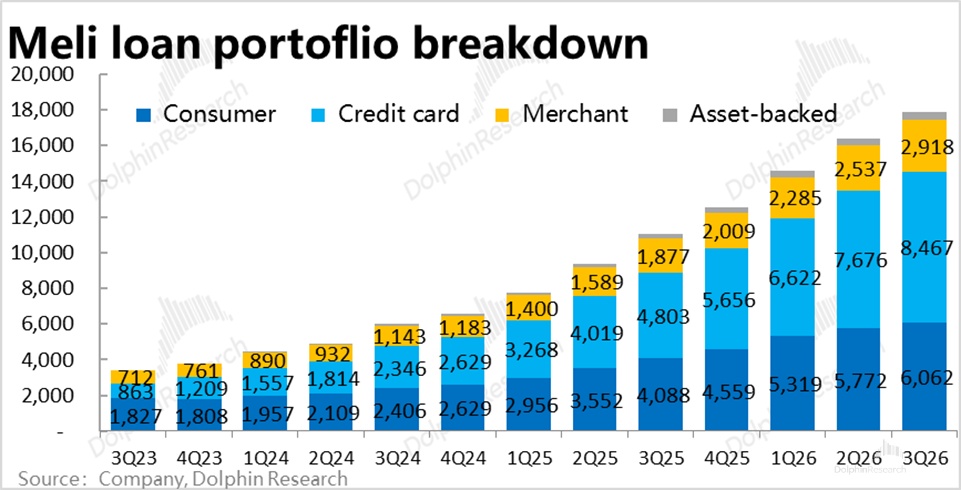
5) Credit balance growth slowed, revenue missed: Ending credit balance reached $17.9bn, up 62% YoY, slowing from 75% last quarter and slightly above consensus. All loan types are slowing, but credit cards remain the fastest-growing at +76%, lifting their share to 47%.
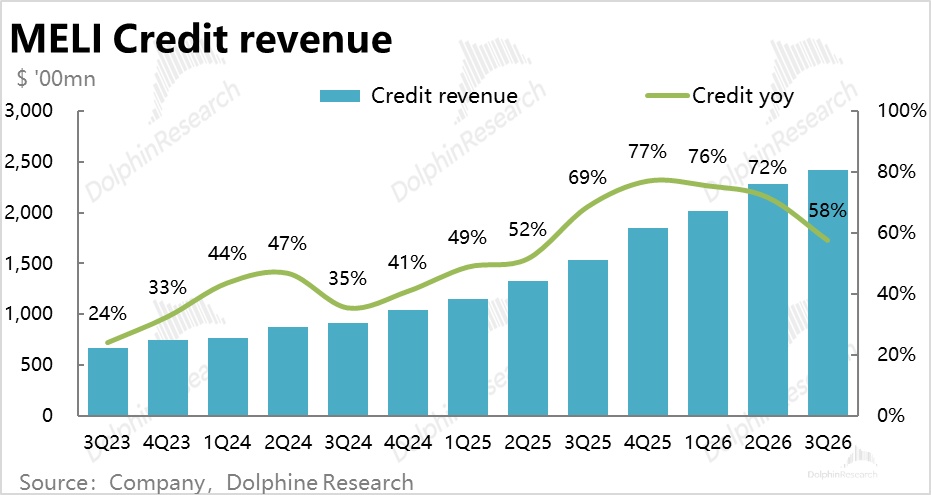
Credit income decelerated faster than balances, up 58% YoY, a sharp 14ppt slowdown vs. last quarter and ~2% below consensus. This implies a lower gross yield on loans (revenue/loan balance). A straightforward reason is the rising share of credit cards, which carry a lower blended rate.
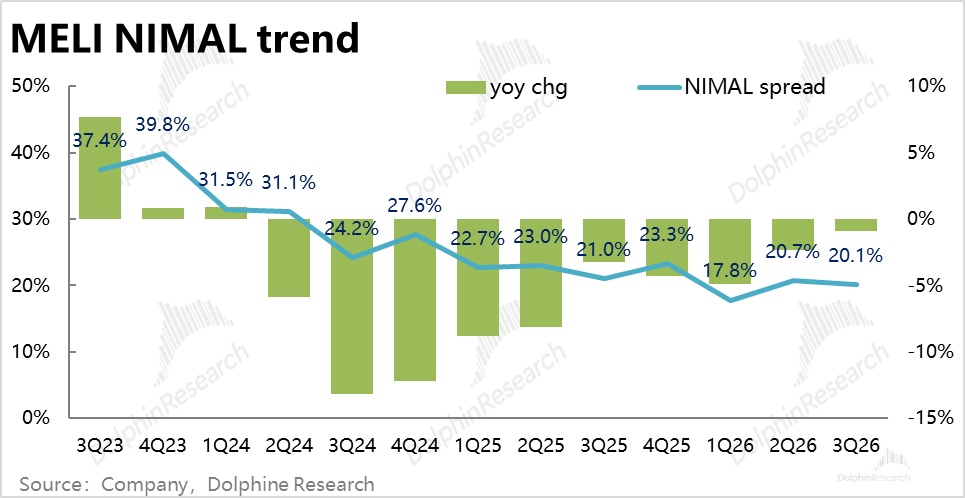
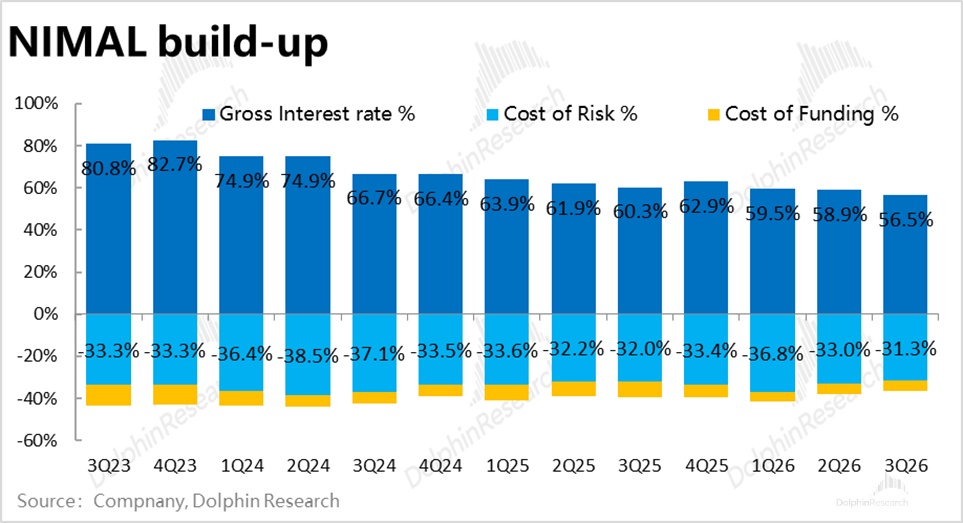
6) NIMAL continued lower, past-due ratio up: After tightening risk controls last quarter, NIMAL had recovered to 20.7%, but slipped to 20.1% this quarter, down 0.9ppt YoY and below the 20.5% consensus. By Dolphin Research estimates, the annualized risk cost ratio (provisions/loan balance) fell from 32.0% to 31.3% YoY. The most direct drag was the credit yield, dropping from 60.3% to 56.5%.
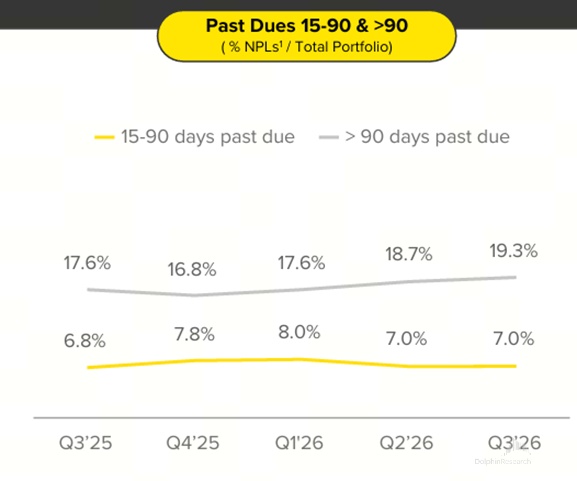
Management attributed this to a higher share of credit cards, which earn no interest when cardholders neither roll nor revolve. Meanwhile, NPLs have been trending up, with 90+ DPD rising for two consecutive quarters to 19.3%. Risks are building.
7) Margin kept sliding, logistics and marketing were the main drivers
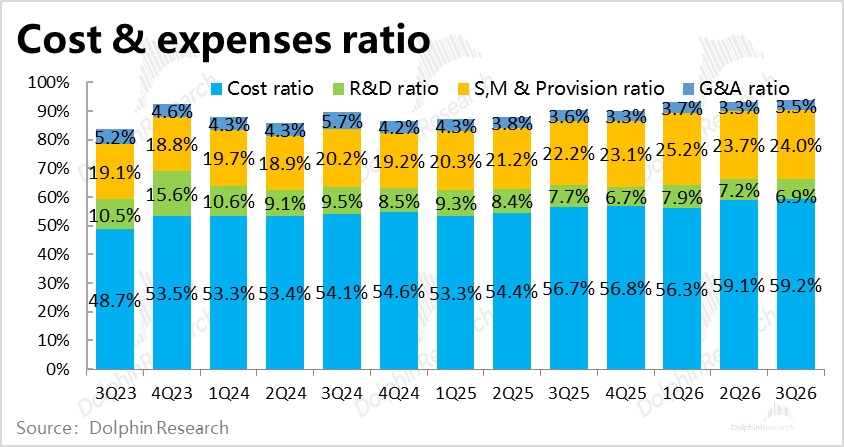
As noted, profit missed mainly due to GP pressure, while opex ratio also moved higher. Management cited two key reasons: logistics investment and marketing spend.
They said logistics net dragged OPM by 0.6ppt QoQ, of which 40bps hit GP and 20bps reflected G&A from hiring. While logistics revenue mix rose by 60bps (helped by shipping fee adjustments mentioned earlier), higher fuel prices and pre-peak warehousing spend pushed logistics costs up by 100bps QoQ.
The company also stepped up affiliate marketing in Brazil, taking S&M ratio to 11.6%. YoY, broader free shipping and lower commissions in Brazil, plus PIX discounts, weighed on GPM. Credit expansion drove higher provisions, lifting opex ratio as well.
By region, Brazil's direct margin fell from 11.8% to 8.0% YoY, while Mexico dropped from 18.5% to 14.2%. Pressure is concentrated in these two core markets.
8) Key highlights at a glance; for call transcript, seelink
Dolphin Research take:
1) Core messages and signals this quarter
(i) Diminishing ROI on 'investment-for-growth'. As the Brazil free-shipping threshold cut rolled off, user, items, and GMV growth all slowed, with Mexico also weighed by tax reform and softer consumption. Margins have declined QoQ for three straight quarters, and management gave no bottoming timeline.
From this lens, incremental growth per dollar invested has fallen, which is not a great look. Management emphasized, however, that investment has improved user stickiness, supporting medium- to long-term visibility.
(ii) Customer acquisition is shifting toward social. Higher S&M ratio was driven by increased affiliate marketing in Brazil. Management acknowledged social media is becoming a new product discovery entry point, a shift 'beyond the company's control', and positioned affiliates as a strategic, ongoing investment channel.
Competition is intensifying on logistics speed and social channels. Shopee Brazil DCs rose from 16 to 30 within a year; Amazon added same-day DCs; TikTok Shop registered its own logistics entity in Brazil.
On policy, Brazil in Sep removed import tax on cross-border parcels below $50, with small parcels up 82% YoY in Sep, a tailwind for platforms like Shopee and Shein. Competition in South America will only get tougher.
(iii) E-com monetization rebound is a rare positive. Despite cutting some commissions to attract sellers, strong ad growth and shipping fee adjustments lifted the 3P take rate (per Dolphin Research) back to near two-year highs. Unit logistics cost in Brazil is also declining.
(iv) The financial profit engine is weakening. Scale growth remains fast, but revenue missed: payments take rate fell as large-merchant mix rose, while credit yields declined and 90+ DPD increased. Credit contributes the bulk of OP, underpinning the e-com 'war chest'. This is a key risk this quarter.
(v) For AI shopping agents, the company chose a 'closed' path. Management stated on the call it will not open the product catalog to external AI agents for now, prioritizing an in-house agent already rolled out to a small user cohort across the three core markets. They believe trust is built in the latter stages of the purchase flow via assortment, pricing, logistics, finance, and membership, helping preserve a high share of direct traffic.
2) Outlook
E-com growth: likely to keep slowing near term; Argentina is the swing factor. Brazil has lapped the free-shipping base effect, and Q4 comps are tough YoY, while FX tailwinds are fading, so GMV growth may keep easing. Management highlighted that Brazil's 2-year CAGR is accelerating and items per capita remain in double digits, suggesting habits are deepening.
Three potential catalysts could re-accelerate growth. First, Argentina cut MELI+ free-shipping thresholds in Sep, with free shipping penetration near Brazil levels and purchase frequency at a record in Sep, which could speed up items growth. Second, instant retail pilots in Brazil could boost margins soon.
Third, affiliates and social channels are adding incremental orders, with affiliate orders up 240% YoY this quarter. Ads grew 58% YoY, and the company is pushing offsite 'commerce media', with CTV integrations like Netflix slated for early 2027.
Financials: credit balance growth to keep slowing; revenue growth to lag balances. Management noted weaker credit conditions in Brazil and Argentina, prompting marginal tightening on higher-risk cohorts, while continuing to ramp credit cards. We expect balance growth to ease from high levels.
With a rising share of lower-yield credit cards, credit income growth should trail balances, as seen this quarter. On payments, expanding into large merchants will dilute take rate, but margins remain healthy.
Margins: no guidance; inflection still unclear. Per the call, the margin drag from capacity expansion should partly fade as utilization ramps in Q4. However, energy costs and affiliate marketing will persist, and fulfillment capacity continues to add each quarter.
Offsets include ongoing declines in unit logistics cost, scale leverage in R&D and G&A, and older credit-card vintages turning profitable over time (Brazil 2025 vintage near breakeven). Management also indicated no new large capex initiatives in the near term.
Consensus implies OPM rising by ~50bps from 2024 to 2027. Delivering on that depends on utilization gains and a favorable mix shift between new and old card vintages.
Credit losses: near-term risk skewed to the upside. Management said metrics look fine: 15–90 DPD stable, Argentina delinquencies across products near historical lows, and NIMAL down due to mix. But credit conditions in Brazil and Argentina are softening, with 90+ DPD rising for two straight quarters. Combined with record card issuance and upfront provisioning on new vintages, provision/revenue may be tough to lower in the near term. Asset quality will be a focal point over coming quarters.
3) Valuation view and investment stance
At an after-hours price of about $1,630, market cap is ~$83bn. That is ~21x implied 2027 OP of ~$4bn and ~15x 2028 OP. Given 30–40% OP growth potential from 2027 to 2028, the valuation bar is not high.
However, this assumes margin recovery next year, while this quarter's OP missed by ~7%. Margin repair could trail expectations, putting consensus at risk of downward revisions. With markets favoring near-term visibility, shares lack catalysts until margin and credit quality inflect.
Political risk from Brazil's election also needs to be priced. In the Oct 25 runoff, Lula won, and the next day BRL fell over 8% vs. USD and the equity market sold off sharply, with MELI down ~8%. Markets also raised Brazil rate expectations for 2026–27, which could lift funding costs and strain household debt service, echoing the credit risks noted above.
Overall, Dolphin Research maintains a wait-and-see near term, looking for signs of OPM stabilization and asset quality improvement. The company's mid- to long-term growth story remains appealing. If price and valuation correct meaningfully, buying the dip could be considered.
Risk disclosure and statement:Dolphin Research disclaimer and general disclosure
Dolphin Research archive on [MELI]:
Earnings reviews:
2026.2.25 Review:LatAm 'Alibaba' with split personality: revenue giant, profit dwarf
2026.2.25 Call Trans:Mercado (Trans): building an in-house e-com agent
2025.10.30 Review:MELI: profit miss? perhaps just growing pains before victory
2025.10.30 Call Trans:Mercado (Trans): prioritizing long-term value over short-term profit
2025.8.5 Call Trans:Mercado (Trans): uncertain about lowering free-shipping thresholds elsewhere
2025.8.5 Review:Growth or profit? MELI's choice
Deep dives:
2025.7.10:Mercado: LatAm 'Alibaba' on a patient path to $100bn market cap
2025.9.16:LatAm 'Alibaba' MELI: faux e-com, real lending?
2025.10.17:LatAm 'Alibaba' Mercado: Alibaba's face, Amazon's guts?
Recommended Articles







Comments (0)
Click the $ button, enter the symbol, and select to link a stock, ETF, or other ticker.