


AAPL: Storage backlash is here. Is the non-AI 'safe haven' still safe?


Apple (AAPL) released Q4 FY2026 results (to Sep 2026) before U.S. market open on Nov 3 Beijing time. Key takeaways below.
1) Headline: revenue of $114.48bn (+11.7% YoY), beating consensus ($113.5bn) and above the high end of company guidance (+9–11% YoY). Guidance and consensus were both cleared, underscoring solid top-line execution.
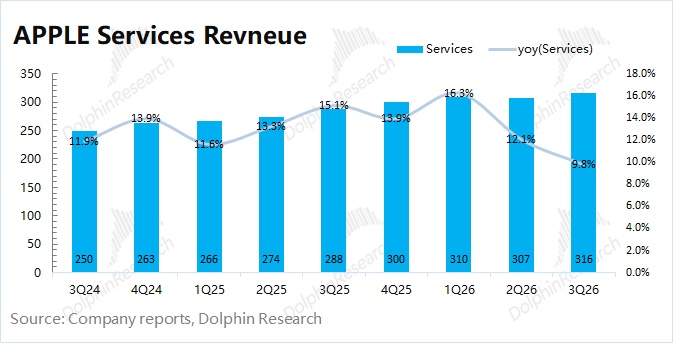
$Apple(AAPL.US) Growth was led by iPhone and Mac, with the iPhone 18 Pro line shipping late in the quarter and contributing from mid-Sep. Software services rose 9.8% YoY, roughly in line with market expectations.
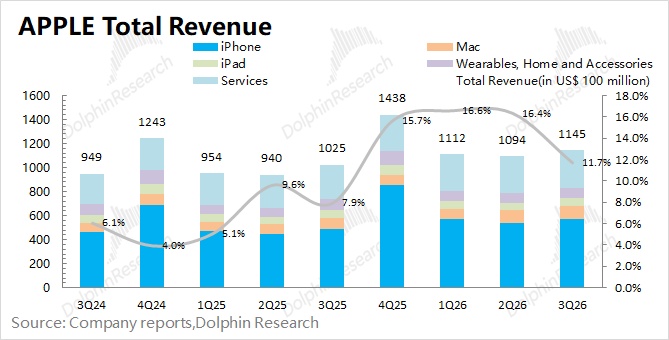
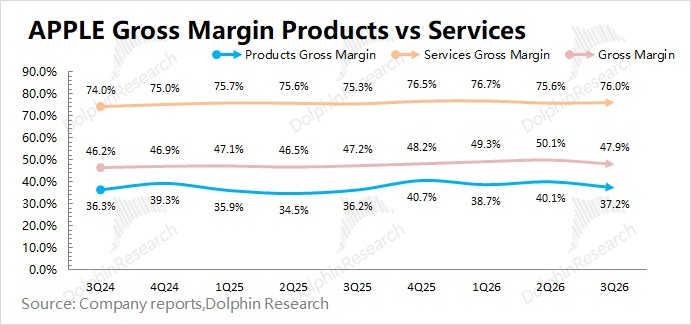
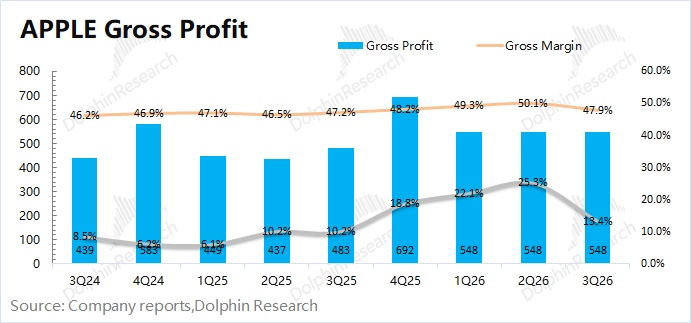
Gross margin (GPM) was 47.9%, down 220bps QoQ, slightly ahead of the 47.6% consensus. This still includes roughly a 100bps benefit from tariff refunds; ex-refund, GPM was about 46.9%.
Services GPM was 76.0%, up 40bps QoQ. Hardware GPM was 37.2%, or ~36% ex tariff refunds, down about 100bps QoQ, mainly on memory price increases.
Per management, excluding tariff refunds in the Jun and Sep quarters, total and hardware GPM each fell ~100bps QoQ, almost entirely due to memory. The underlying hit from memory was larger, partially offset by drawdown of low-cost inventory, cost-downs on non-memory components, and product pricing. Most tariff refunds have been received by quarter-end, so there will be no further tailwind ahead.
2) iPhone: revenue of $57.58bn (+17.5% YoY), above consensus ($56.5bn). Despite supply constraints and FX headwinds, growth was driven by higher ASPs following price hikes on the iPhone 18 Pro line and carryover demand for the iPhone 17 series; the U.S. and Greater China both delivered strong double-digit growth.
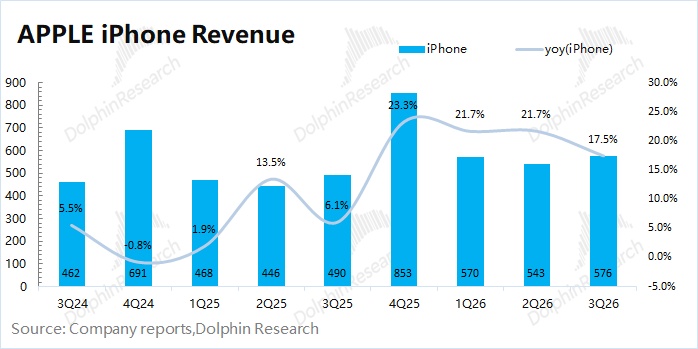
From a volume vs. price lens, iPhone growth this quarter was primarily ASP-led. The mix-benefit outweighed modest unit pressure.
1) iPhone units: IDC estimates global smartphone shipments at ~255mn in Q3 2026, down 21% YoY. Apple shipped ~57.3mn units, down 2% YoY, with share rising to 22.4% from 18.2% a year ago. Unit performance materially outpaced the broader market.
Memory inflation forced Android brands to raise prices, and Apple also lifted Pro-series prices by $100. Lead times indicate steady demand post price hikes, with iPhone 18 Pro/Pro Max delivery times by late Oct in line with last year.
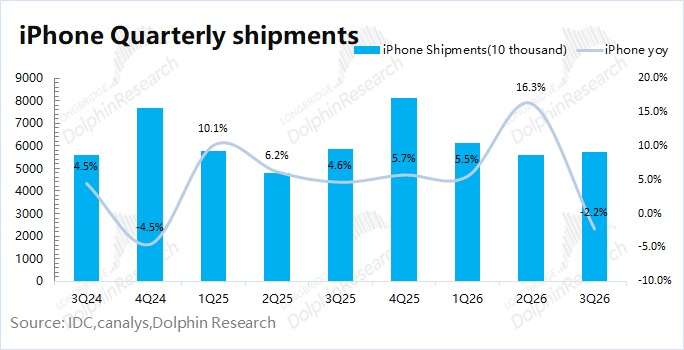
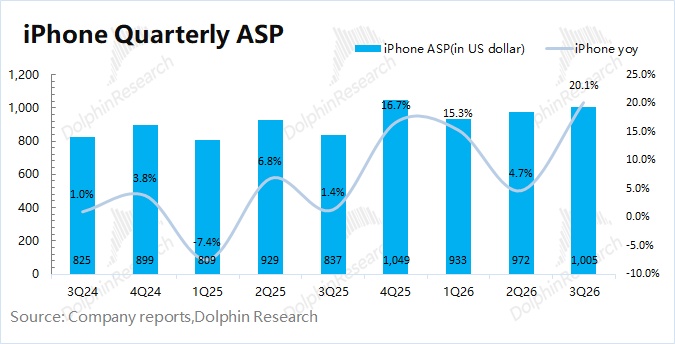
2) iPhone ASP: triangulating revenue with shipments, ASP was about $1,005 this quarter, up ~20% YoY. That compares with roughly $837 a year ago.
Apple’s pricing move centered on $100 higher starting prices for 18 Pro/Pro Max and $100 higher pricing for the prior 17 line, with no base model launched this fall. The product mix skewed toward Pro.
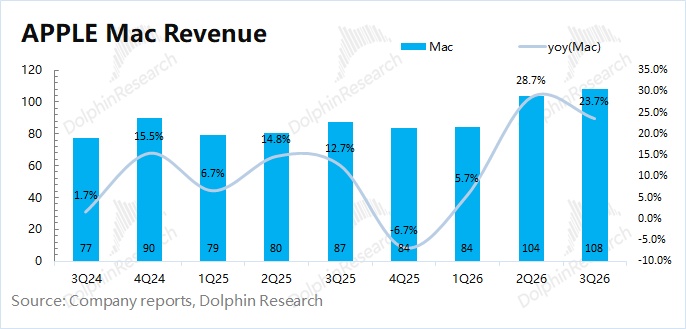
3) Non-iPhone hardware: Mac revenue was $10.79bn (+23.7% YoY), well above the $9.7bn consensus. Mac continued to benefit from strong MacBook Neo and MacBook Pro demand and grew over 20% despite supply constraints (units -13% YoY; price +42% YoY).
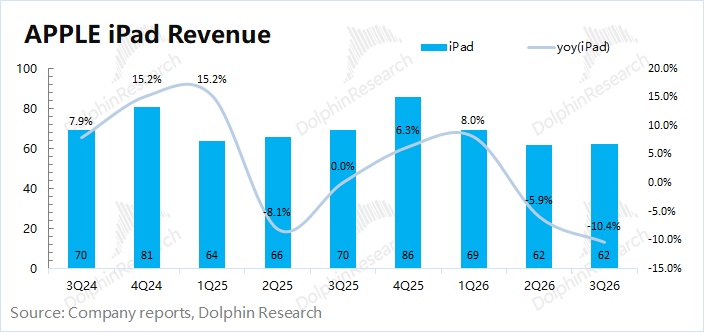
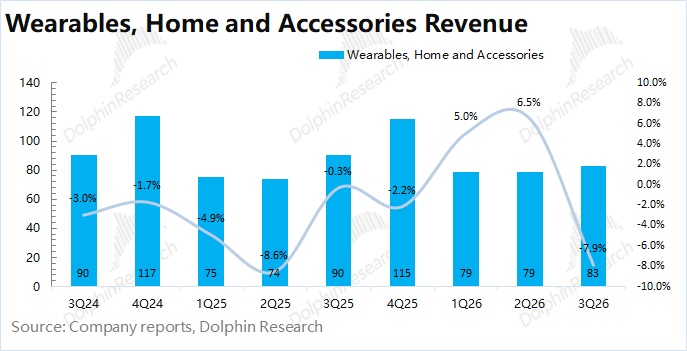
iPad revenue was $6.23bn (-10.4% YoY). Wearables and other hardware revenue was $8.3bn (-7.9% YoY). Both missed market expectations ($6.8bn and $9.0bn respectively).
iPad was constrained by supply and a tough base. Wearables faced a high base from last year’s Watch SE3 and AirPods Pro 3 launches; the new Watch S12/Ultra 4 and AirPods 5 only started shipping in mid-Sep, contributing little to the quarter.
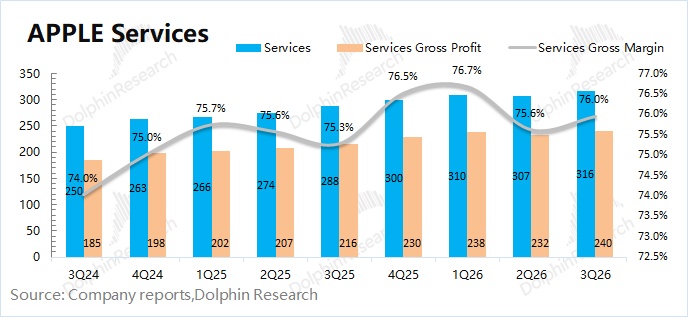
4) Services: revenue reached $31.57bn, in line with the $31.6bn consensus, up 9.8% YoY. With a 76.0% GPM, services contributed 27.6% of revenue but generated 43.7% of group GP.
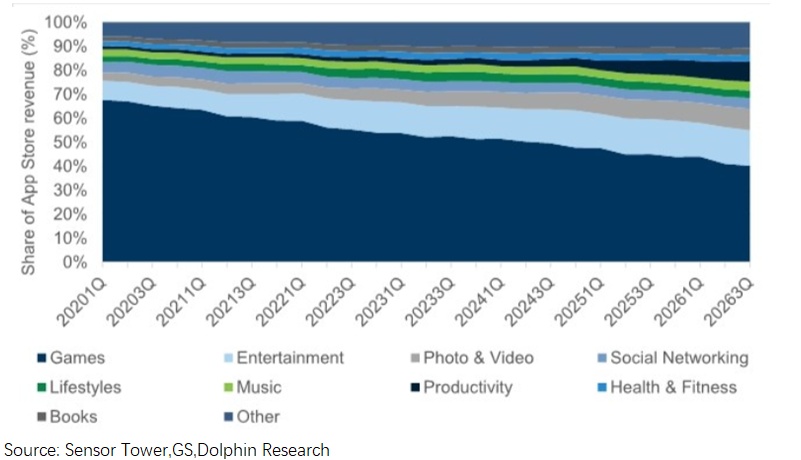
By sub-segment, video, cloud, payments, and ads hit record highs, while music set a Sep-quarter record; App Store was roughly flat YoY, with games still a drag. FX was the main driver of slower services growth: from the Mar to Sep quarter, about 400bps of the deceleration came from FX, with the EU App Store fee cut (30% to 26%) effective Oct 1, impacting the next quarter.
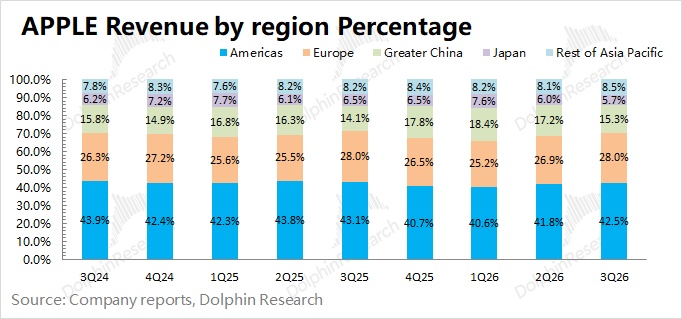
5) Revenue by region: Americas remained the core, at $48.68bn (42.5% mix, +10.2% YoY), and Europe was $32.01bn (+11.5% YoY). Greater China was $17.54bn (+21.0% YoY), the fastest-growing region; Japan fell 1.4% YoY, and Rest of APAC rose 15.0% YoY.
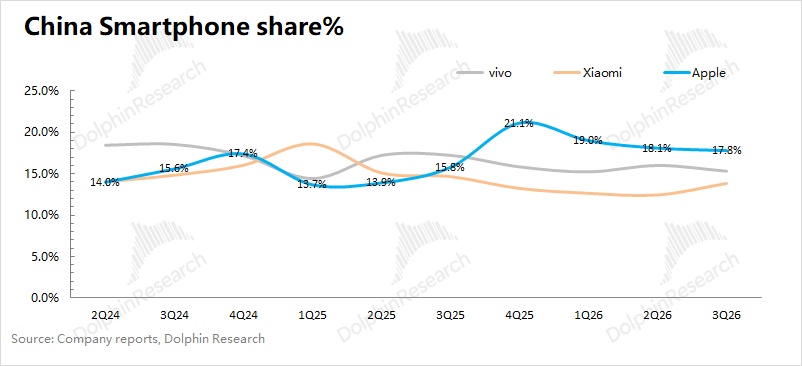
iPhone shipments in China were about 10.33mn this quarter (-4% YoY), while the overall China smartphone market fell 15% YoY. Memory inflation pressured low-end Android, lifting iPhone share by about 200bps YoY.
For the Trans, please click. See details via the link.
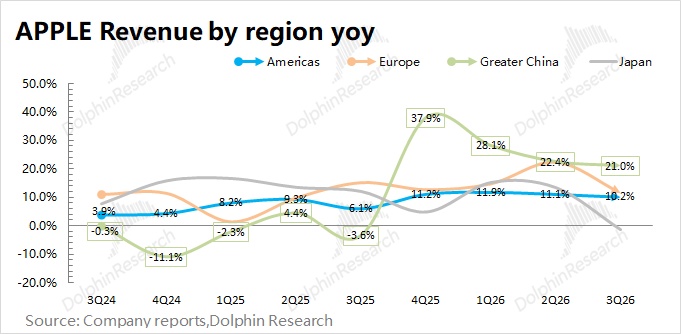
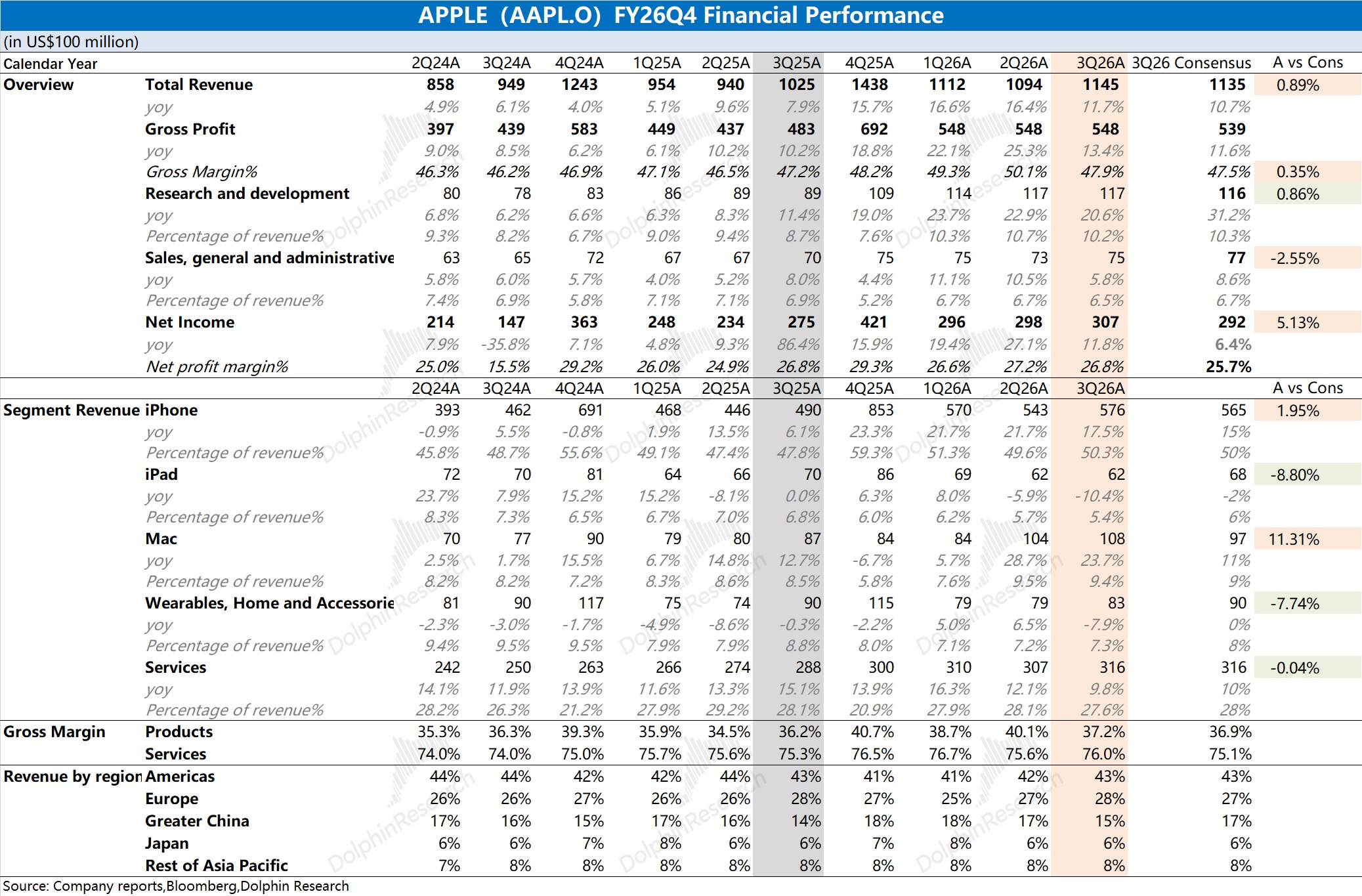
Dolphin Research view: revenue cleared the bar, profits got eaten by memory
Apple delivered a solid print, with revenue above its own top-end guidance. But GPM still benefited from tariff refunds, and ex that, memory inflation is already showing through.
Top-line growth was largely price-driven by iPhone and Mac, not units, with volumes slightly down. The Pro line took outright price hikes, and there was no base model this fall, skewing sell-through to higher-end SKUs.
Profit is the tougher side. Memory costs surged, and most of the new Pro Max cost delta was memory-driven, with management calling the increases unprecedented. They offset with low-cost inventory and pricing this quarter, but inventory will run down while purchase prices keep rising. The good news: Apple’s higher-end positioning and earlier price hikes make it more resilient vs. peers.
Beyond the quarter, management guided next quarter revenue to grow 7–10% YoY to about $153.8–158.1bn, slightly above consensus ($152.6bn). Services are guided to grow 8–9% YoY (~$32.4–32.7bn), below the +12% market view, dragged by softer third-party licensing (primarily Google default search fees) QoQ and FX headwinds.
Services growth is moving into high single digits; third-party licensing is mainly the default search slot rent from Google and others. A slowdown in Google’s core search could also weigh on Apple’s revenue share.
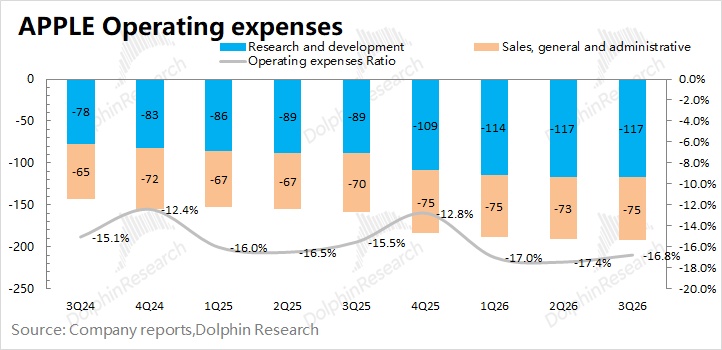
Company GPM guidance for next quarter is 45–46%, below the 46.7% consensus, with the midpoint about 140bps below this quarter’s ex-refund 46.9%, reflecting higher memory costs and cloud costs tied to Siri AI.
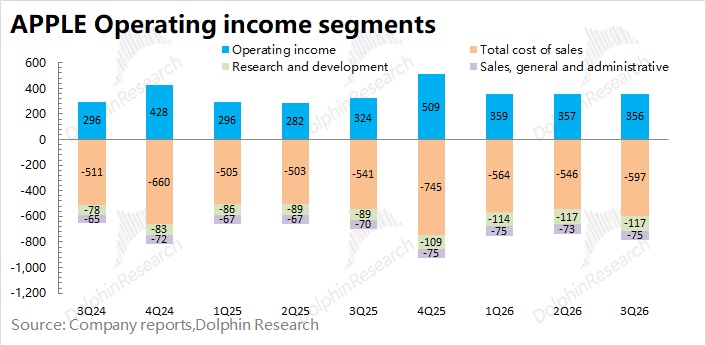
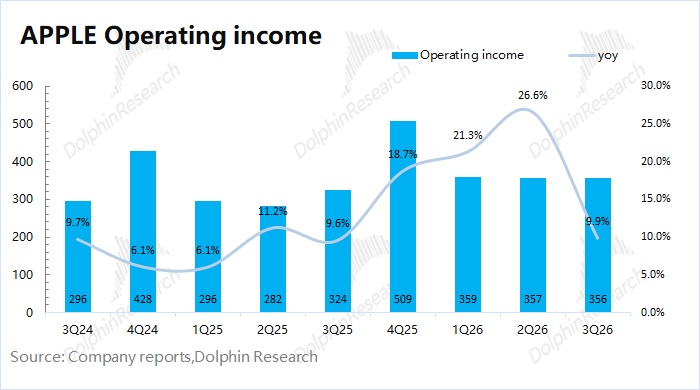
On this guide, Dec-quarter OP is about $50bn and could even be below last year’s $50.9bn. In other words, revenue grows high single digits while profits decline, as memory costs absorb most of the incremental revenue.
Management noted Sep-quarter supply constraints mainly stemmed from advanced nodes and are easing as more products move to 2nm. In the Dec quarter, the primary bottleneck shifts to memory.
To shore up supply, purchase commitments rose by $33bn from Jun to Sep, and inventory increased to $14.5bn from $11.1bn last quarter-end (vs. $5.7bn a year ago). The intent to pre-lock materials is clear.
Beyond the print, the market is focused on the following:
a) China: share defended, total market down Greater China revenue rose 21% YoY, led by iPhone and Mac. On units, China felt the memory-price shock acutely: China smartphone shipments were ~58.06mn in Q3 2026 (-15% YoY); iPhone shipped ~10.33mn (-4% YoY), with ~18% share and outperformance vs. the market.
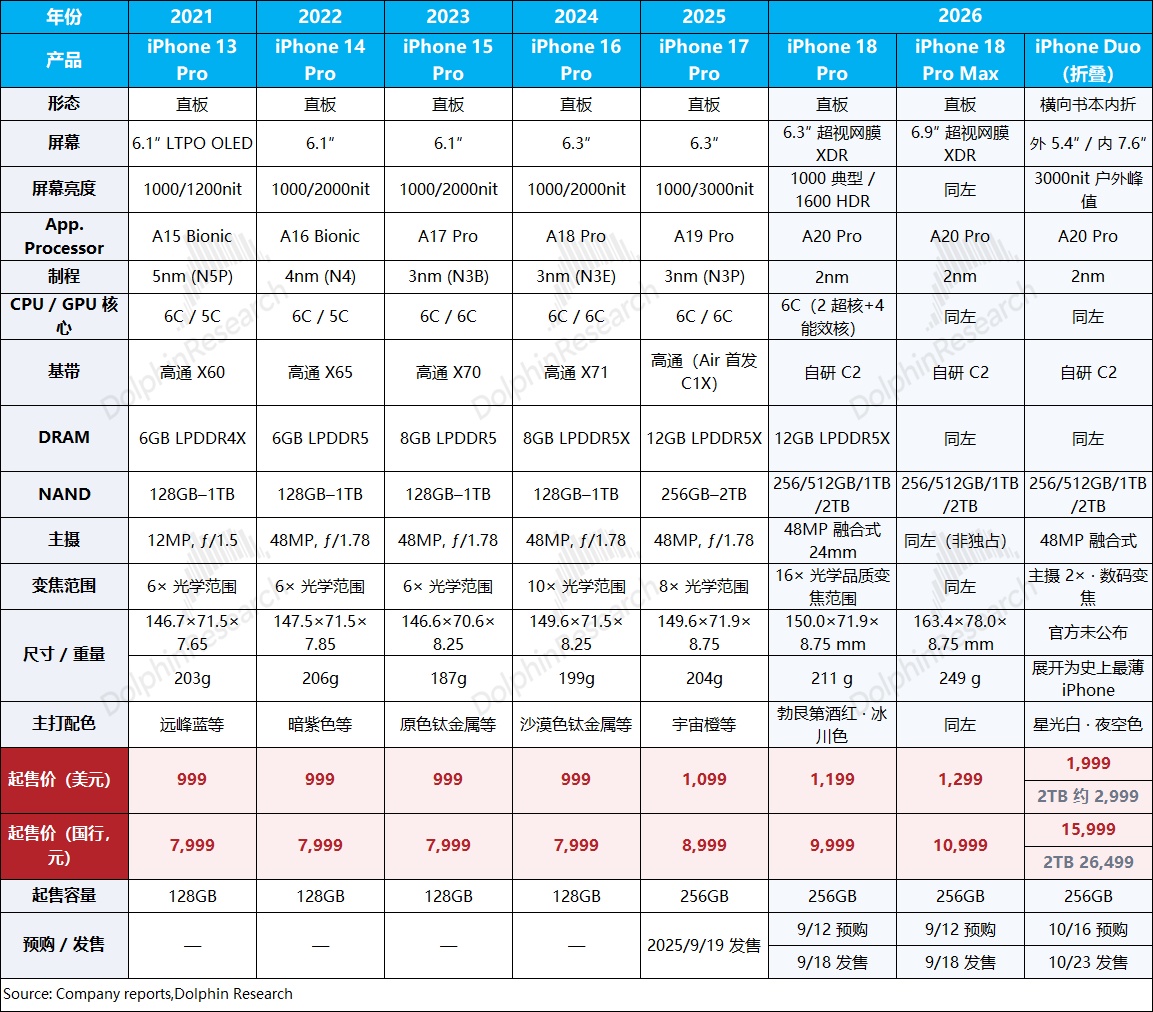
b) iPhone 18 cycle: demand resilience post price hikes At the Sep 9 launch, Apple introduced iPhone 18 Pro/Pro Max (from $1,199/$1,299, each +$100), the first foldable iPhone Duo (from $1,999), the in-house A20 Pro and C2 modem, with the base model pushed to spring. High-frequency reads suggest demand is fine but not strong: global Pro/Pro Max lead times in week 7 were 7/21 days, exactly matching last year; Duo lead times were ~94 days with no pickup-in-store anywhere, indicating a clear supply shortfall.
There were also negative headlines (Nikkei): Oct Pro component cuts, with Largan noting 15–20% order reductions shortly after launch. On the call, management said it is too early to assess price elasticity; they did not directly address the lack of a base model this fall, noting the iPhone 17, iPhone Air, and iPhone 17e will sit alongside 18 Pro for the holiday lineup.
c) AI strategy: Siri upgrade lands, but not in the EU or China The WWDC-promised Siri AI rolled out in beta in Sep for U.S. English users and expanded in Oct to French, Japanese, Korean, Portuguese, and Spanish, but did not launch initially in the EU or China.
Server-side model features (e.g., Siri AI, smart photo editing) will have usage caps, with paid expansions for higher limits, opening a path to monetize via iCloud+ and other subscriptions. Management disclosed more than 2.5bn daily Siri requests, still mostly request-based interactions, with a scalable orchestration backbone enabling later agent-like capabilities.

In China, ‘Apple Intelligence’ obtained generative AI filing in Jul, and the company partners with Alibaba for local models. On costs, management for the first time clarified the financial impact: cloud costs for server-side inference are booked in services COGS, and bundled Siri AI in hardware will defer a portion of revenue, both diluting GPM, contributing to the softer Dec-quarter GPM guide.
Capex remains disciplined at about $2.2bn this quarter (-31% YoY), a stark contrast to peers’ tens of billions per quarter.
Apple’s current market cap is about $4.94tn, implying ~36x PE on FY2027 net profit (revenue 2-yr CAGR 13%, GPM 46.5%, tax rate 17%). History suggests a 25x–40x PE range, with the current share price near the upper bound.
Last quarter was a small beat with soft guidance, as the Sep-quarter revenue guide (+9–11%) lagged the +12% consensus and services missed twice, sending shares down 7.5% the next day.
Subsequently, the Sep 9 iPhone 18 launch pricing had limited impact, lead times matched last year, and the stock recovered to near new highs around $348 in late Oct. More recently, talk of supply-chain cuts, shorter lead times, and softer carrier upgrades has stoked concerns for the Dec quarter.
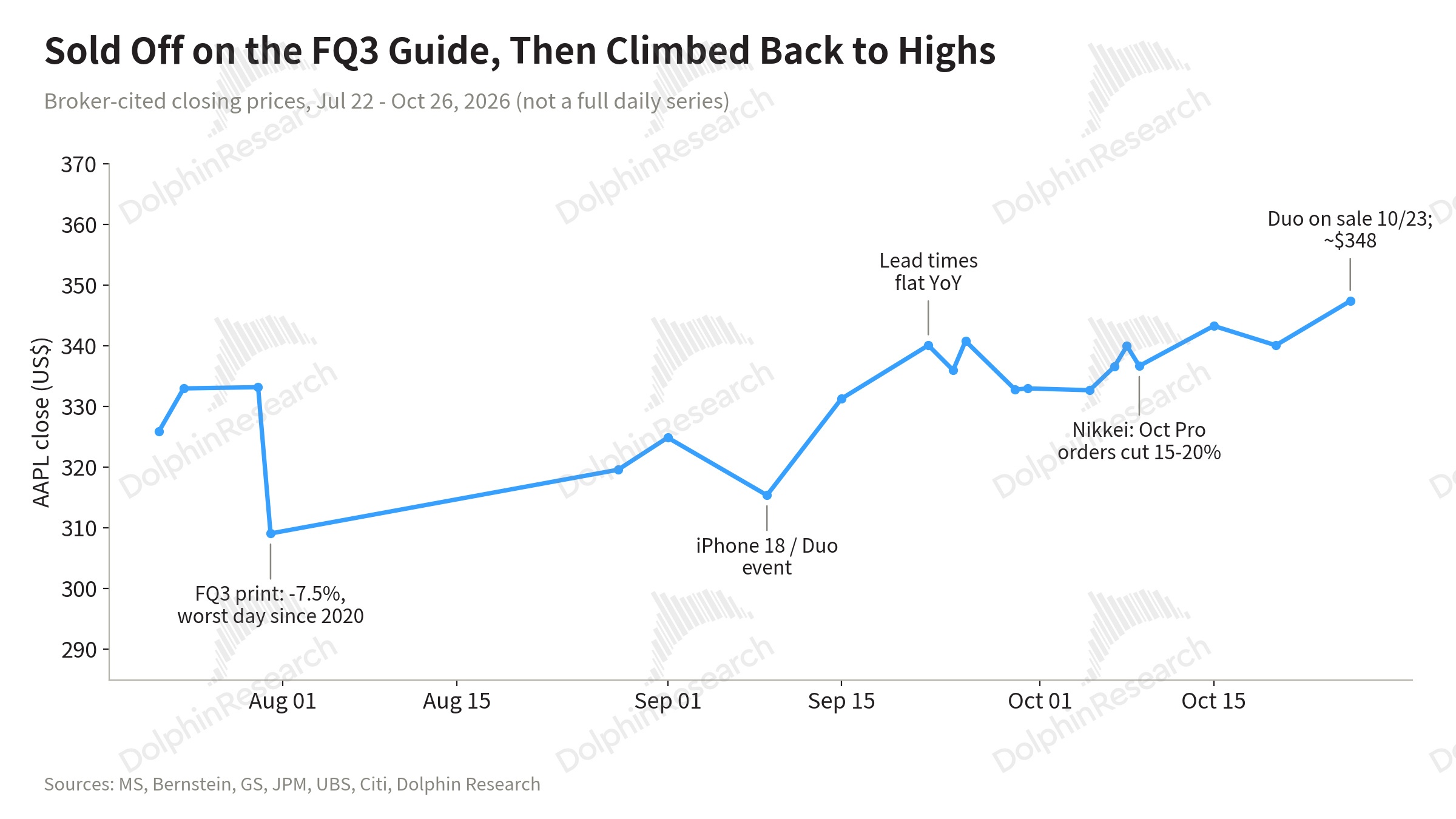
As noted last quarter, Apple has become a safe harbor amid the AI correction, with PE expanding from ~29x to above ~35x. Even as growth is seen slowing (memory pressure and demand worries), the multiple has risen over the past three months.
We think this quarter and the next-quarter revenue guide are clean and slightly above expectations, validating the price-for-growth logic on the top line. The issue is profit: the 45–46% GPM guide is below consensus, with memory inflation plus Siri AI cloud costs eroding the incremental margin from price hikes; services growth guidance at 8–9% is also below the Street.
At ~36x PE on FY2027, the market is paying a certainty premium, while the guide says revenue is fine but profit is uncertain. Key watch items: 1) hardware GPM once low-cost inventory is consumed; 2) iPhone Duo ramp cadence; 3) Siri AI monetization and whether it stabilizes services growth.
Our view: this print is unlikely to drive another leg of multiple expansion; shares may enter a digestion phase with limited upside catalysts. But it is not enough to change Apple’s role as a hedge on the other side of AI trades, given that among mega-caps, only Apple and Nvidia still generate strong positive FCF.
Detailed data and charts from Apple’s results via Dolphin Research:
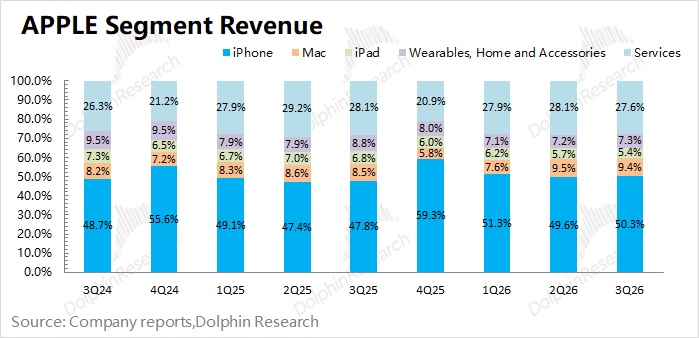
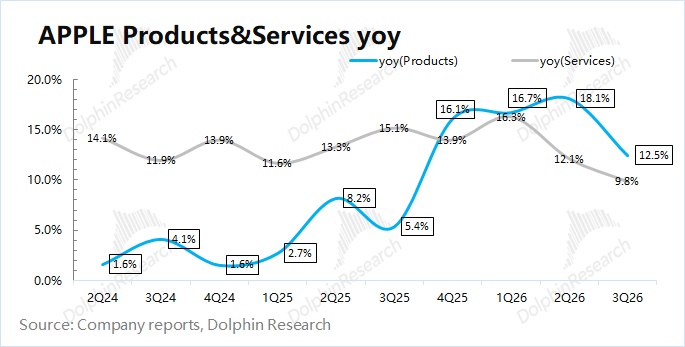
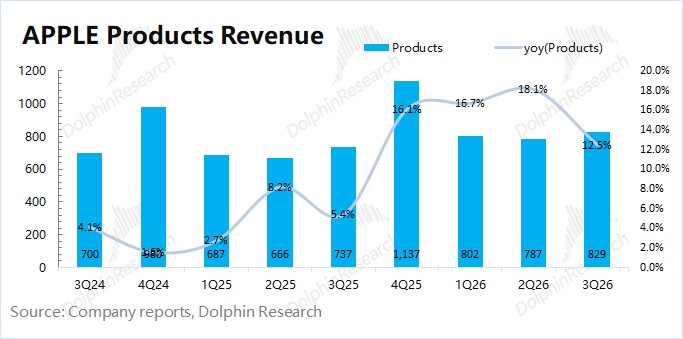
Dolphin Research Apple coverage history:
Sep 10, 2026 Fall Event Apple: Memory surge forces price hikes; can the foldable save the day?
Jul 31, 2026 Trans Apple (Trans): Selling too well is a headache? Sep-quarter guide constrained by FX and supply
Jul 31, 2026 Earnings take Apple: Pushing through price hikes — how long can hardware’s leader hold?
May 1, 2026 Trans Apple (Trans): No longer insisting on net cash neutral; the new Siri will launch this year
May 1, 2026 Earnings take Apple: Missing AI, memory costs up — still delivering steady results?
Jan 30, 2026 Trans Apple (Trans): New Siri to partner with Google, while keeping internal R&D alive
Jan 30, 2026 Earnings take iPhone blows out; Gemini assists — is Apple’s AI era here?
Oct 31, 2025 Trans Apple (Trans): Stepping up AI spend, new Siri coming next year
Oct 31, 2025 Earnings take Apple: iPhone holds the crown — when will AI show up?
Sep 10, 2025 Event take Apple: A modest iPhone refresh to hold the stage, with AI still in the wings?
Aug 1, 2025 Trans Apple (Trans): Capex increase mainly from AI-related investments
Aug 1, 2025 Earnings take Apple: AI delays — still leaning on iPhone to carry the load
Risk disclosure and statement: Dolphin Research disclaimer and general disclosures
Recommended Articles







Comments (0)
Click the $ button, enter the symbol, and select to link a stock, ETF, or other ticker.