


Prolonged Middle East Conflict 'Could Trigger Stagflation' in NZ



Credit ratings agency S&P Global Ratings has floated the dreaded "stagflation" word in the context of the New Zealand economy.
Speaking in a webinar about war in the Middle East, Nico DeLange, S&P Director & Lead Analyst of Pacific Financial Institutions Ratings, said NZ banks face more risk than their Aussie counterparts of secondary effects from the conflict. That's because of NZ's small economy and greater reliance on imported refined fuel.
Following the closure of the Marsden Point refinery, NZ has no domestic oil refinery. Australia has two, albeit there was a major fire at one of them on Thursday. The Marsden Point refinery closed in 2022, meaning all NZ's fuel comes from fuels refined overseas. Marsden Point had supplied 70% of domestic fuel demand.
Secondary shocks could include higher interest rates and lower house prices, which could hurt bank balance sheets. Additionally, persistent high energy prices could lead to higher inflation.
"Similar to Australia, a prolonged or worse conflict outside our base case is likely to drive New Zealand inflation higher, which could become embedded in pricing behaviour and jeorpadise the economic recovery," DeLange said.
"New Zealand's small fuel dependent economy also faces potential higher secondary risk than Australia."
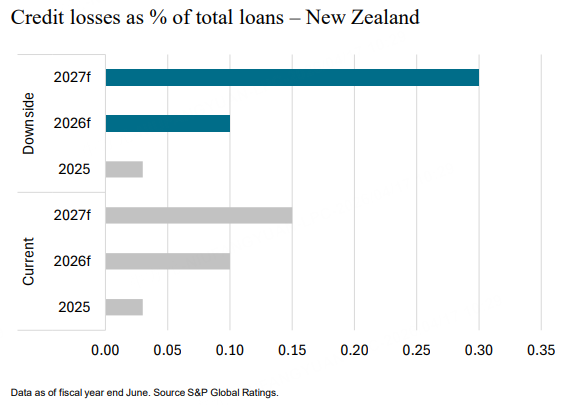
"A prolonged conflict could drive inflation higher and trigger stagflation, and this scenario would likely stall the country's economic recovery and weaken bank asset quality," said DeLange.
Stagflation is when economic growth is stagnating and there's high inflation, which can also mean rising unemployment.
S&P said Aussie banks, including the parents of NZ's big four banks, have negligible direct exposure to Middle East credit or funding.
"However, their heavy concentration in residential mortgages remains a key vulnerability. We think a prolonged war could trigger secondary shocks to interest rates and house prices, hurting bank balance sheets. Further, persistent high energy prices could push up inflation."
"The New Zealand economy faces broadly similar limited direct impacts on banks under our current base case. There is potentially a greater risk of secondary effects on banks compared to Australia, however, due to its small economy and greater reliance on imported oil," S&P said.
Recommended Articles










Comments (0)
Click the $ button, enter the symbol, and select to link a stock, ETF, or other ticker.