


Goldman Sachs Says the Market's Going to Stink for 10 Years. Here's How to Beat It.



Bad news for investors who are expecting the stock market to maintain its incredible growth streak -- it's not gonna happen. That's the word from Goldman Sachs, anyway. In its most recent long-term outlook, the investment bank said the performance of the S&P 500 (SNPINDEX: ^GSPC) during the next 10 years should seriously pale in comparison to the past 10. And the argument it made in support of that prediction isn't entirely unreasonable.
But if Goldman Sachs is right about the market's broad trend for the next decade, what should you do about it?
Turns out, there are some bigger-picture actions you can take now that could help your portfolio outperform the overall market during this upcoming lethargic period.
Here comes the headwind
To put some more specific numbers on this prognostication, after averaging an annual return of 13% for the past 10 years, the S&P 500 is set for an average yearly gain of only 3% for the next 10, Goldman's Chief U.S. Equity Strategist David Kostin predicts. Why? Mostly because the index is overweighted with a small number of (very) high-growth technology companies in an economic environment where it's "extremely difficult for any firm to maintain high levels of sales growth and profit margins over sustained periods of time."
The stocks in question are, of course, recent mega-winners like Nvidia, Microsoft, and other members of the so-called Magnificent Seven.
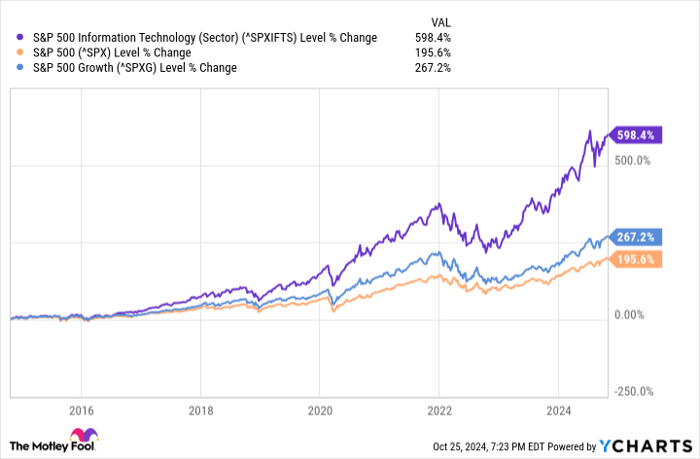
And Kostin's concern is a valid one. Right now, the S&P 500's 10 biggest components -- a group that includes Berkshire Hathaway (NYSE: BRK.A) (NYSE: BRK.B) -- account for roughly 30% of the index's value. Because the S&P 500 is a market-cap-weighted index -- each company's position in it is proportional to that company's market value compared to the total -- if those gigantic companies' growth hits a wall, the index's growth will as well. This risk is heightened by the fact that the S&P 500's forward price-to-earnings ratio now stands at a frothy 24.
Although Goldman Sachs' expectation is grim, it's not alone in its pessimism. Based on similar concerns, JPMorgan Chase's expectation for the coming decade is for an only slightly better annualized gain of 6%.
You can do better than either of these outlooks though.
Priority holdings for the coming decade
These warnings touch on an important but often-overlooked aspect of investing: Although the S&P 500 is supposed to represent a well-balanced and diversified cross-section of the U.S. economy, there are times when it makes sense to approach "the market" differently.
Goldman Sachs even says as much. As part of its analysis, the bank also predicts that the S&P 500 equal-weight benchmark index will outperform during the coming decade since it's not dominated by the stocks of huge companies that are due for a slowdown. In an equal-weight fund, all the positions are rebalanced back to equal sizes several times a year. Investing in the Invesco S&P 500 Equal Weight ETF (NYSEMKT: RSP) is an easy way to execute this strategy.
There's perhaps a more effective way of achieving market-beating results without abandoning the idea of indexing though. That's owning something like the Vanguard S&P 500 Value ETF (NYSEMKT: VOOV), or a conglomerate like Berkshire Hathaway. While this might mean you miss out on the benefits of a few select growth stories, those investments certainly won't be held back by the predicted stagnation of the recently popular growth stocks.
In this vein, another factor that supports this argument is that the era of ultra-low interest rates that made growth stocks so much more attractive than value stocks has officially come to a close. Yields on investment-grade corporate bonds are near 10-year highs, and there's no sign that they will come down significantly anytime soon. We could easily see value stocks catch up with their growth counterparts in the coming years.
Finally, while Goldman Sachs argues that large-cap and mega-cap stocks are overvalued, the same can't be said of small caps, or even mid caps. These groups have conspicuously trailed the large-cap herd largely because so many investors would rather plug into story stocks than hunt for compelling small-cap picks. The iShares S&P 600 Small-Cap ETF (NYSEMKT: IJR) is trading at a trailing price-to-earnings ratio of less than 17, while the iShares S&P 400 Mid-Cap ETF (NYSEMKT: IJH) is similarly cheap at just over 19 times trailing earnings. Both could be great ways to outperform the S&P 500 now that the stage is set for a sweeping reversal of these market cap groupings' leadership.

Just keep it in perspective
Admittedly, this is philosophical stuff... far from the hot-trade kind of approach that even many in the buy-and-hold crowd have been utilizing of late.
Yes, that has worked well enough so far. Yet if the winds of change are really blowing, true long-term investors will be well advised to ease back into better stock-picking habits. They'll want to think bigger picture, which is certainly where exchange-traded funds deliver their best value.
With all of that said, take Goldman Sachs' forecast with a grain of salt. Nobody can predict the future, and the likely future is changing anyway. While the Magnificent Seven may be headed into a period of so-so gains, who's to say a handful of other stocks won't take their place and lead the S&P 500 higher for the next 10 years? The best way to ensure those stocks are in your portfolio is to have at least a small stake in an S&P 500 index fund.
The bottom line is that diversification is still a good idea. You'll just want to consider forms of diversification beyond a basic S&P 500 fund.
Don’t miss this second chance at a potentially lucrative opportunity
Ever feel like you missed the boat in buying the most successful stocks? Then you’ll want to hear this.
On rare occasions, our expert team of analysts issues a “Double Down” stock recommendation for companies that they think are about to pop. If you’re worried you’ve already missed your chance to invest, now is the best time to buy before it’s too late. And the numbers speak for themselves:
- Amazon: if you invested $1,000 when we doubled down in 2010, you’d have $21,217!*
- Apple: if you invested $1,000 when we doubled down in 2008, you’d have $44,153!*
- Netflix: if you invested $1,000 when we doubled down in 2004, you’d have $403,994!*
Right now, we’re issuing “Double Down” alerts for three incredible companies, and there may not be another chance like this anytime soon.
*Stock Advisor returns as of October 28, 2024
JPMorgan Chase is an advertising partner of The Ascent, a Motley Fool company. James Brumley has no position in any of the stocks mentioned. The Motley Fool has positions in and recommends Berkshire Hathaway, Goldman Sachs Group, JPMorgan Chase, Microsoft, Nvidia, and iShares Trust-iShares Core S&P Small-Cap ETF. The Motley Fool recommends the following options: long January 2026 $395 calls on Microsoft and short January 2026 $405 calls on Microsoft. The Motley Fool has a disclosure policy.
Recommended Articles






Comments (0)
Click the $ button, enter the symbol, and select to link a stock, ETF, or other ticker.