


USD/MXN (USDMXN) Surges 0.54% on Oct 29: What Does the Market Value?



USD/MXN (USDMXN) is up 0.54% at Oct 29 04:40(ET), now at $18.72351, with a 7-day up of 0.07%.
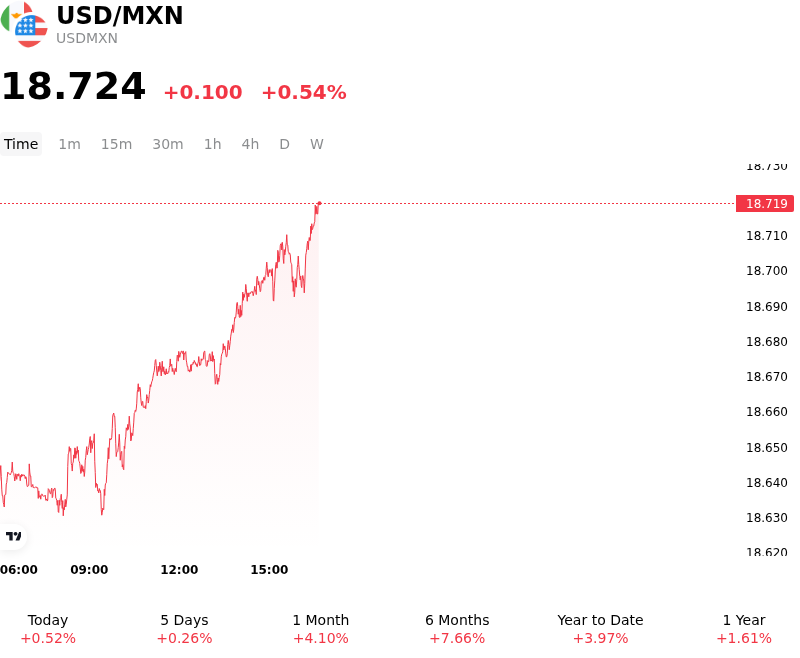
What is driving USD/MXN (USDMXN)’s stock price up today?
The upward movement in USDMXN is primarily driven by widening policy divergence between the Federal Reserve and Banco de México, which continues to erode the Mexican peso's yield advantage. While the Federal Reserve maintains a hawkish posture supported by resilient domestic economic conditions, Banxico has adopted an increasingly dovish stance. Mexican central bank officials have emphasized their willingness to proceed with monetary easing without mechanically mirroring Fed policy decisions. This disparity has led to a noticeable compression in the US-Mexico interest rate differential, weakening the carry-trade appeal that previously anchored capital flows into the peso. As institutional investors unwind peso long positions in response to shrinking carry buffers, capital reallocations toward dollar-denominated assets have gathered momentum.
Macroeconomic data releases have reinforced this divergence. Stronger-than-expected US economic indicators, including robust consumer confidence metrics and expanding durable goods orders, have bolstered US Treasury yields across the curve, reinforcing expectations that US interest rates will remain elevated. In contrast, Mexican inflation figures show a controlled price environment, granting Banxico additional monetary flexibility to lower borrowing costs without risking immediate inflationary spillovers. The resulting shift in rate expectations has prompted market participants to price in further narrowing of sovereign yield spreads, adding sustained upward pressure on the currency pair.
Broader market sentiment and structural policy risks have further weighed on the Mexican peso. Global risk aversion and elevated US yields have curtailed risk appetite for high-beta emerging market assets, steering flows into safe-haven liquidity in the US dollar. Additionally, persistent trade policy uncertainty surrounding upcoming USMCA renegotiations and domestic institutional shifts have introduced an added risk premium into Mexican securities. Unless Banxico delivers a hawkish monetary signal or US yields experience a sharp repricing lower, the macro trajectory favors continued support for USDMXN driven by compressed yield differentials and defensive portfolio flows.
Technical Analysis of USD/MXN (USDMXN)
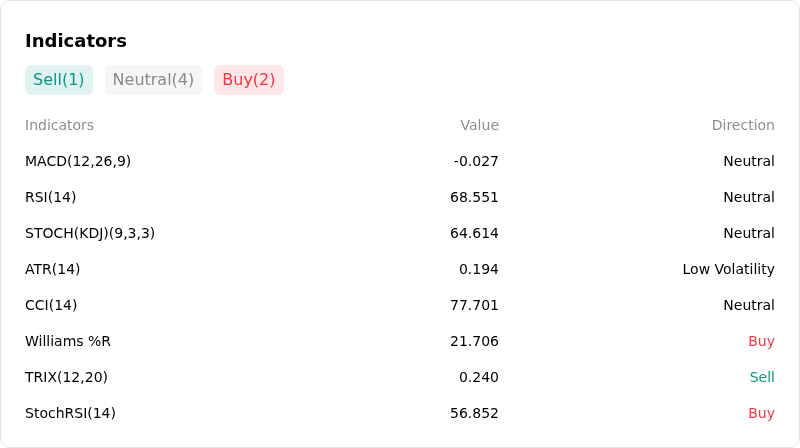
Technically, USD/MXN (USDMXN) shows a MACD (12,26,9) value of -0.027, indicating a neutral signal. The RSI at 68.551 suggests neutral condition and the Williams %R at 21.706 suggests buy condition. Please monitor closely.
More details about USD/MXN (USDMXN)
Recent Events and Risks:
- Banxico-Fed Policy Differential Compression: Dovish policy guidance from Banco de México (Banxico) combined with persistent Federal Reserve rate expectations has rapidly narrowed the U.S.-Mexico yield spread, eroding the peso's carry trade advantage and driving institutional unwinds.
- USMCA Negotiations and Trade Policy Uncertainty: Persistent ambiguity surrounding bilateral trade relations and stalled momentum on USMCA renewal discussions between the U.S. and Mexico are generating significant headline risk and downside pressure on Mexican peso sentiment.
- Domestic Political and Fiscal Friction: Emerging institutional uncertainty linked to leadership changes at Mexico's National Electoral Institute (INE) alongside a narrowing domestic trade surplus has amplified local risk premiums, leaving the peso vulnerable to capital outflows.
- Global Risk Aversion and Safe-Haven Dollar Demand: Elevated geopolitical tensions and firm U.S. Treasury yields are stoking broader risk-off market sentiment, driving asset reallocations out of high-beta emerging market currencies into greenback-denominated assets.
This article may include AI-generated content that is human-reviewed, which is for reference and general information purposes only and does not constitute investment advice.
Recommended Articles










Comments (0)
Click the $ button, enter the symbol, and select to link a stock, ETF, or other ticker.