


Parker-Hannifin Corp Stock (PH) Moved Down by 3.27% on Oct 20: What Signal Does It Send?



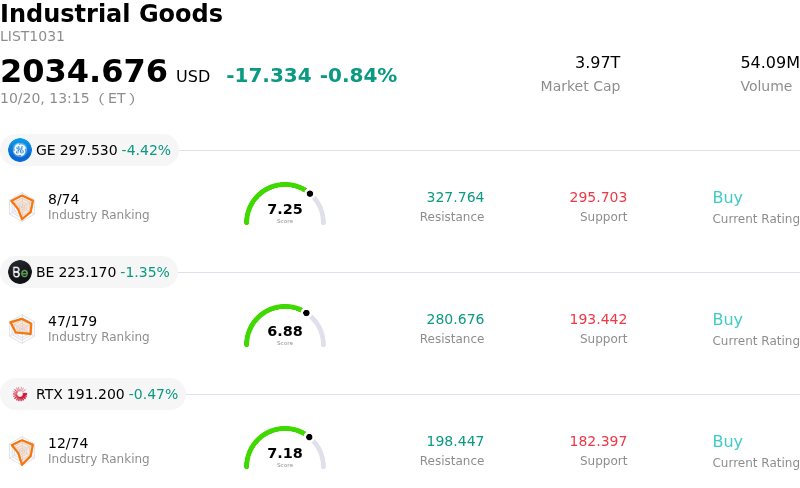
Parker-Hannifin Corp (PH) moved down by 3.27%. The Industrial Goods sector is down by 0.84%. The company underperformed the industry. Top 3 stocks by turnover in the sector: General Electric Co (GE) down 4.42%; Bloom Energy Corp (BE) down 1.32%; RTX Corp (RTX) down 0.47%.
What is driving Parker-Hannifin Corp (PH)’s stock price down today?
Parker-Hannifin experienced downward price movement and heightened intraday volatility as a cluster of recent Wall Street analyst price target trims and valuation downgrades weighed on market sentiment. Following an extended rally that drove shares near record highs, several prominent financial institutions recently lowered their target prices for the stock, citing stretched valuation metrics relative to projected earnings and free cash flows. With the stock trading at premium earnings multiples, market participants utilized the elevated valuation environment to lock in profits, triggering selling pressure across institutional and retail channels.
Beyond direct analyst recalibrations, broader industrial sector caution has introduced incremental friction. Channel checks and distributor sentiment surveys indicate growing wariness over macroeconomic factors, including persistent inflationary pressures, sustained higher interest rates, and volatile energy costs. These macro headwinds have raised questions about near-term industrial order momentum, causing investors to adopt a more conservative posture ahead of the company's upcoming quarterly earnings release. The combination of high investor expectations and macroeconomic uncertainty has made the equity particularly sensitive to negative revisions and sector-wide risk aversion.
Despite the temporary pullback, Parker-Hannifin's underlying operational fundamentals remain robust. Strong long-term demand in its core aerospace and defense operations, backed by substantial order backlogs and steady margin execution, continues to anchor the company's multi-year growth strategy. Consequently, the intraday price decline reflects a necessary valuation consolidation and sentiment reset following a prolonged surge, rather than a structural breakdown in the company's core business model.
Technical Analysis of Parker-Hannifin Corp (PH)
Technically, Parker-Hannifin Corp (PH) shows a MACD (12,26,9) value of -1.620, indicating a sell signal. The RSI at 39.645 suggests neutral condition and the Williams %R at 94.408 suggests oversold condition. Please monitor closely.
Fundamental Analysis of Parker-Hannifin Corp (PH)
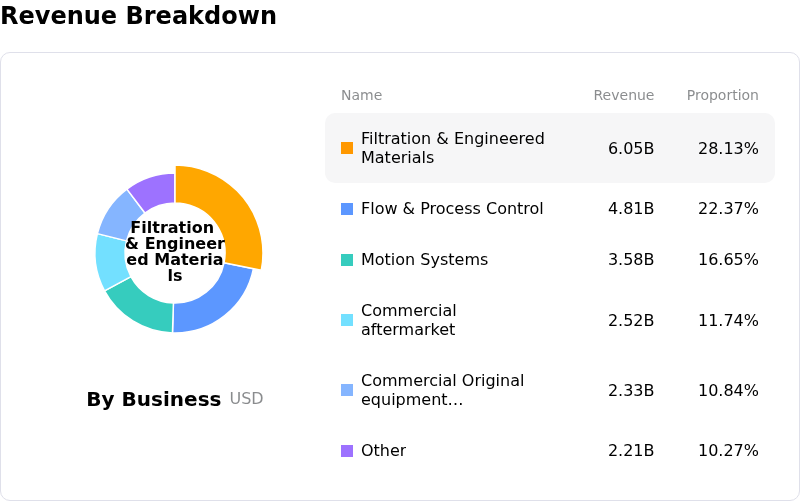
Parker-Hannifin Corp (PH) is in the Industrial Goods industry. Its latest annual revenue is $21.50B, ranking 8 in the industry. The net profit is $3.65B, ranking 4 in the industry. Company Profile
Over the past month, multiple analysts have rated the company as Buy, with an average price target of $1156.37, a high of $1358.00, and a low of $693.60.
More details about Parker-Hannifin Corp (PH)
Company Specific Risks:
- Wall Street Price Target Trims and Valuation Overhang: Major Wall Street brokerages, including Stifel lowering its target to $1,002 and Mizuho trimming to $1,200, have cited valuation risks as the stock trades at an elevated forward P/E multiple relative to fair value, leaving minimal margin for error heading into upcoming earnings.
- Distributor Caution and Macro Economic Pressures: Industry channel surveys reveal growing concern among distributors regarding high oil prices, persistent inflation, and elevated interest rates, which threaten short-cycle industrial order momentum and demand visibility.
- Free Cash Flow Compression and Integration Leverage: M&A activity and integration costs associated with recent acquisitions have increased leverage and debt-servicing demands, which are expected to temporarily weigh on free cash flow generation and limit near-term capital return flexibility.
- Cyclical Softness in Core Industrial Markets: Persistent weakness across broader North American and international manufacturing sub-segments creates volume headwinds, posing a risk that softness in short-cycle industrial end markets will dilute gains achieved in aerospace and data center exposures.
This article may include AI-generated content that is human-reviewed, which is for reference and general information purposes only and does not constitute investment advice.
Recommended Articles







Comments (0)
Click the $ button, enter the symbol, and select to link a stock, ETF, or other ticker.