


USD/MXN (USDMXN) Is up 0.50% on Sep 18: What Is Driving the Move?



USD/MXN (USDMXN) is up 0.50% at Sep 18 11:10(ET), now at $17.24997, with a 7-day up of 1.66%.
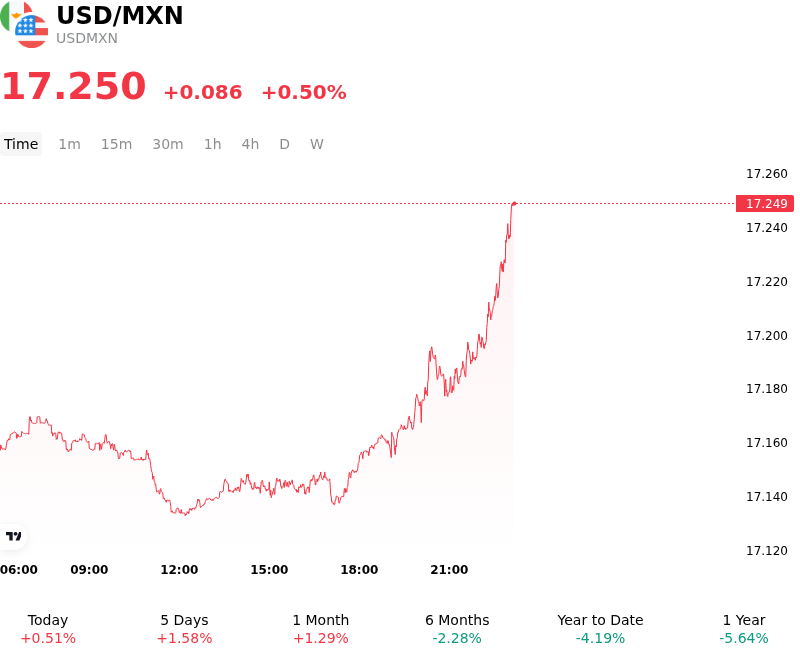
What is driving USD/MXN (USDMXN)’s stock price up today?
The advancement in USDMXN reflects a combination of renewed US dollar momentum driven by hawkish Federal Reserve expectations and the resulting compression of the US-Mexico interest rate differential. With the Fed signaling a firm monetary policy stance and maintaining policy expectations near the 4.00 percent level, US Treasury yields have remained well supported. Meanwhile, Banco de Mexico has kept its benchmark rate at 6.50 percent, maintaining a prolonged hold as domestic inflation continues to align near its target range. This central bank dynamic has compressed the policy rate spread between the two countries to roughly 250 basis points, reducing the relative yield premium that previously incentivized institutional carry trade flows into the peso.
Market expectations surrounding Banco de Mexico's upcoming monetary policy meeting have further limited upside for the Mexican currency. Investors anticipate that Mexican policymakers will maintain an extended pause rather than taking steps to re-widen the interest rate spread, reinforcing a neutral monetary outlook. At the same time, solid US economic indicators and ongoing trade policy uncertainties in North America have sustained demand for US dollar assets, encouraging systematic rebalancing out of emerging market exposure.
Technical dynamics and institutional order flow also accelerated the currency pair's upward momentum. As USDMXN cleared key technical resistance levels around the 17.10 to 17.15 region, stop-loss execution and short-covering by foreign exchange trading desks increased. The shift in market positioning was further amplified by momentum-based buying. Overall, the move in USDMXN is anchored in broader macro fundamentals and relative interest-rate repricing, suggesting that dollar strength remains backed by macro monetary drivers rather than temporary liquidity imbalances.
Technical Analysis of USD/MXN (USDMXN)
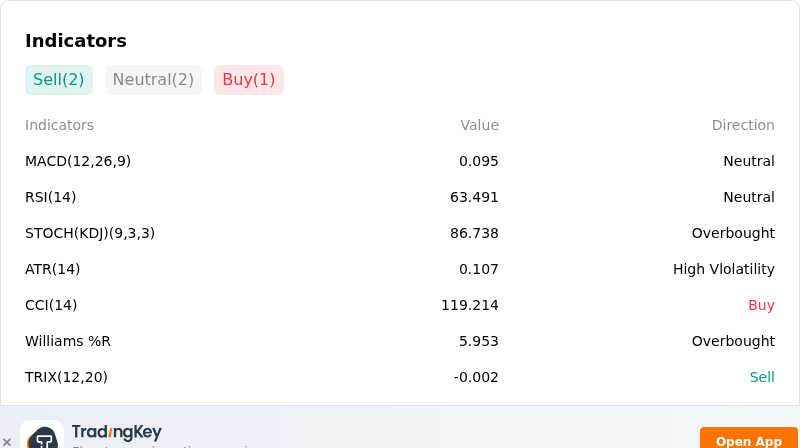
Technically, USD/MXN (USDMXN) shows a MACD (12,26,9) value of 0.095, indicating a neutral signal. The RSI at 63.491 suggests neutral condition and the Williams %R at 5.953 suggests overbought condition. Please monitor closely.
More details about USD/MXN (USDMXN)
Recent Events and Risks:
- Federal Reserve Tightening and Yield Spread Compression: The U.S. Federal Reserve's rate hike to a target range of 3.75% to 4.00% has compressed the U.S.-Mexico policy rate differential down to roughly 250 basis points. With Banco de México expected to hold its key rate at 6.50% at its upcoming meeting, this narrowing interest rate gap erodes the Mexican peso's carry trade advantage and fuels upward pressure on USD/MXN.
- Geopolitical Escalation and Energy Shock Risk: Heightened geopolitical conflict in the Middle East has pushed crude oil prices above $100 per barrel, reigniting global inflation fears and driving risk-off sentiment. The resulting flight-to-safety flows toward the U.S. Dollar generate acute downside liquidity stress for emerging market currencies like the peso.
- Domestic Judicial Reform and Policy Uncertainty: Persistent market anxiety over the implementation of Mexico's sweeping judicial and constitutional reforms continues to weigh on foreign investor confidence. Structural concerns regarding legal predictability and foreign direct investment inflows keep the peso vulnerable to sudden risk-off sell-offs.
- U.S. Inflation Persistence and Treasury Yield Pressures: Stronger-than-expected U.S. producer price inflation (PPI) and robust labor market indicators have reinforced market expectations of prolonged Fed monetary restriction. Rising U.S. Treasury yields and broad-based Greenback strength continue to exert upside pressure on USD/MXN spot prices.
This article may include AI-generated content that is human-reviewed, which is for reference and general information purposes only and does not constitute investment advice.
Recommended Articles







Comments (0)
Click the $ button, enter the symbol, and select to link a stock, ETF, or other ticker.