


NZD/USD (NZDUSD) Is up 0.50% on Sep 17: What Signals Does the Macro Data Send?



NZD/USD (NZDUSD) is up 0.50% at Sep 17 02:55(ET), now at $0.57402, with a 7-day down of 0.94%.
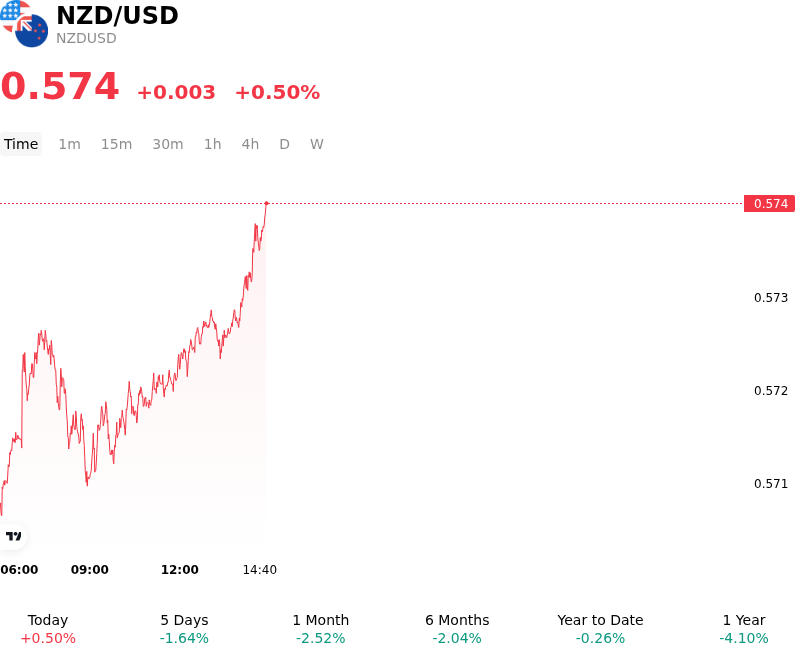
What is driving NZD/USD (NZDUSD)’s stock price up today?
The advance in NZDUSD was primarily driven by stronger-than-expected New Zealand second-quarter gross domestic product data, which shifted interest-rate expectations in favor of the kiwi dollar. Economic activity expanded by 0.2 percent quarter-on-quarter, topping consensus expectations for a 0.1 percent increase, while annual output accelerated to 2.6 percent. Upward revisions to prior-quarter growth further reinforced the narrative that domestic economic momentum remains solid despite elevated borrowing costs and global headwinds. The positive growth print prompted money markets to reprice monetary policy expectations for the Reserve Bank of New Zealand, increasing the probability of a tighter policy stance, which provided upward pressure on New Zealand sovereign bond yields and supported the base currency.
On the other side of the pair, the US dollar encountered resistance as market participants digested the Federal Open Market Committee policy announcement and recalibrated relative interest-rate differentials. While the Federal Reserve maintained a hawkish monetary policy stance and emphasized elevated inflation concerns, much of the policy outlook had already been priced into the greenback prior to the decision. Consequently, the relative rate differential between New Zealand and US short-term yields moved to favor the kiwi dollar, encouraging capital flows into the base currency after recent selling pressure had pushed the pair toward multi-month support levels.
Institutional positioning and technical factors further bolstered the pair during the trading session. NZDUSD attracted notable dip-buying interest near crucial technical support thresholds, triggering short-covering flows from institutional accounts that had recently built short exposures. Additionally, a modest stabilization in broader risk sentiment across global asset classes helped lift high-beta G10 currencies, offsetting persistent geopolitical friction. While the medium-term trajectory for NZDUSD remains sensitive to upcoming US labor market indicators and broader macroeconomic trends, the immediate combination of a domestic growth beat and technical rebalancing allowed the New Zealand dollar to firmly outperform the US dollar.
Technical Analysis of NZD/USD (NZDUSD)
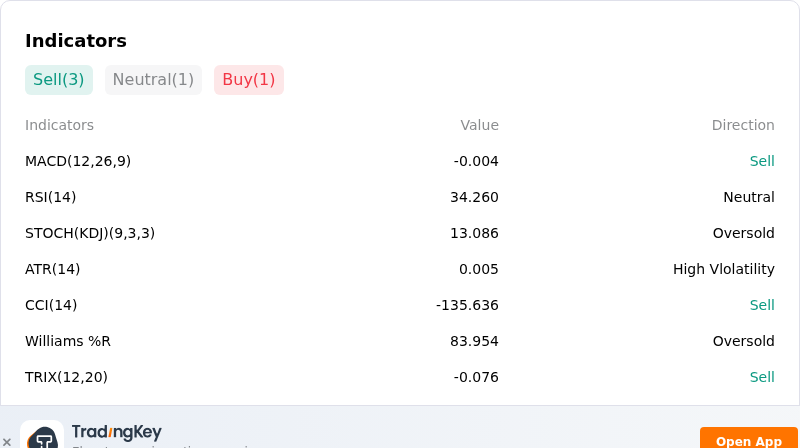
Technically, NZD/USD (NZDUSD) shows a MACD (12,26,9) value of -0.004, indicating a sell signal. The RSI at 34.260 suggests neutral condition and the Williams %R at 83.954 suggests oversold condition. Please monitor closely.
More details about NZD/USD (NZDUSD)
Recent Events and Risks:
- Hawkish Federal Reserve Signals and Resilient USD Yields: Lingering market repricing following the Federal Reserve's signal for additional policy tightening, combined with elevated US Treasury yields, continues to bolster the US Dollar. This maintains strong downside pressure on NZDUSD and dampens the potential for sustainable intraday rebounds above 0.5720.
- RBNZ Dovish Policy Guidance Disappointment: Although the Reserve Bank of New Zealand delivered a 25 basis point rate hike to 2.75%, central bank guidance emphasized a cautious, gradual trajectory capped near 3.00%. This dovish stance disappointed markets looking for aggressive tightening, compressing front-end yield differentials to the detriment of the Kiwi.
- Geopolitical Volatility and Risk-Averse Sentiment Flows: Heightened geopolitical tensions in the Middle East and elevated global energy costs have driven broad market risk aversion. This environment fuels liquid, safe-haven flows into the US Dollar while systematically penalizing growth-sensitive, high-beta commodity currencies such as the New Zealand Dollar.
- Internal Sector Contraction and Primary Trading Partner Fragility: Despite a modest 0.2% Q2 GDP print, domestic performance remains uneven, dragged down by contractions in retail, transport, and warehousing. Furthermore, persistent growth sluggishness in China—New Zealand's largest export destination—continues to suppress demand for agricultural commodities and weigh on currency sentiment.
This article may include AI-generated content that is human-reviewed, which is for reference and general information purposes only and does not constitute investment advice.
Recommended Articles











Comments (0)
Click the $ button, enter the symbol, and select to link a stock, ETF, or other ticker.