


UBS Group AG Stock (UBS) Moved Down by 3.45% on Sep 15: Key Drivers Unveiled



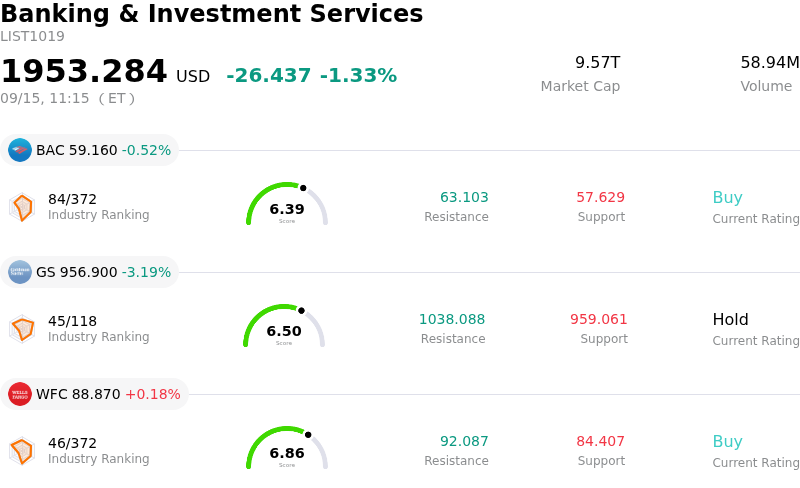
UBS Group AG (UBS) moved down by 3.45%. The Banking & Investment Services sector is down by 1.33%. The company underperformed the industry. Top 3 stocks by turnover in the sector: Bank of America Corp (BAC) down 0.52%; Goldman Sachs Group Inc (GS) down 3.19%; Wells Fargo & Co (WFC) up 0.10%.
What is driving UBS Group AG (UBS)’s stock price down today?
European financial sector weakness and broader equity market pullbacks weighed on shares of UBS Group AG. Global banking equities experienced selling pressure amid macroeconomic uncertainty and shifting interest rate expectations ahead of upcoming central bank policy meetings. The general risk-off sentiment across European financial institutions contributed to increased intraday trading volatility and downward pressure on the stock.
A key factor driving investor caution remains the ongoing regulatory and legislative debate in Switzerland regarding capital adequacy requirements following the Credit Suisse acquisition. Swiss lawmakers and parliamentary committees are actively debating proposed overhauls to banking laws, including requirements for foreign subsidiaries and the regulatory treatment of Additional Tier 1 debt relative to core equity capital. Although legislative compromises are under discussion to soften initial government capital demands, proposed regulatory conditions could impose automatic restrictions on share buybacks, dividend distributions, and bonus pools if target capital thresholds are breached. The persistent uncertainty surrounding final Swiss regulatory standards and potential capital distribution limits continues to weigh on investor sentiment.
From a corporate perspective, UBS continues to navigate its multi-year operational integration and restructuring strategy across global wealth management and investment banking divisions. However, institutional market participants remain focused on capital buffer compliance costs, execution risks, and potential drag on return metrics. The convergence of sector-wide pressure on European financials and heightened sensitivity to domestic regulatory policy developments primarily drove the stock lower on the session.
Technical Analysis of UBS Group AG (UBS)
Technically, UBS Group AG (UBS) shows a MACD (12,26,9) value of -0.793, indicating a neutral signal. The RSI at 35.396 suggests neutral condition and the Williams %R at 99.794 suggests oversold condition. Please monitor closely.
Fundamental Analysis of UBS Group AG (UBS)
UBS Group AG (UBS) is in the Banking & Investment Services industry. Its latest annual revenue is $75.76B, ranking 5 in the industry. The net profit is $7.77B, ranking 5 in the industry. Company Profile
Over the past month, multiple analysts have rated the company as Buy, with an average price target of $49.57, a high of $50.93, and a low of $48.20.
More details about UBS Group AG (UBS)
Company Specific Risks:
- Swiss Regulatory Capital Requirement Escalation: As the Swiss parliament debates post-Credit Suisse banking regulations during its autumn session, opposition from financial regulators to proposed debt-based concessions heightens the risk of full equity mandates, which could require up to $22 billion in additional CET1 capital, depressing return-on-equity expectations and limiting share buyback capacity.
- Legacy Debt Restructuring and Funding Costs: Ongoing balance sheet realignments, including expanded tender offers to redeem and replace billions in legacy Credit Suisse debt, introduce near-term funding cost pressure and execution complexity while optimizing regulatory loss-absorbing capacity.
- Credit Suisse Operational Integration and Legal Liabilities: The complex multi-year consolidation of legacy Credit Suisse IT systems, legal entities, and international accounts presents continuous execution risks, potential integration cost overruns, and lingering legal exposure from disputed Additional Tier 1 bond write-downs.
- Wealth Management Sensitivity to Macroeconomic Volatility: Shifting central bank rate trajectories and heightened yield volatility threaten to suppress net interest margins and client activity across global wealth management and investment banking divisions, dragging on fee income performance.
This article may include AI-generated content that is human-reviewed, which is for reference and general information purposes only and does not constitute investment advice.
Recommended Articles









Comments (0)
Click the $ button, enter the symbol, and select to link a stock, ETF, or other ticker.