


Brent (UKOIL) Is down 7.69% on Aug 3: What You Need to Watch



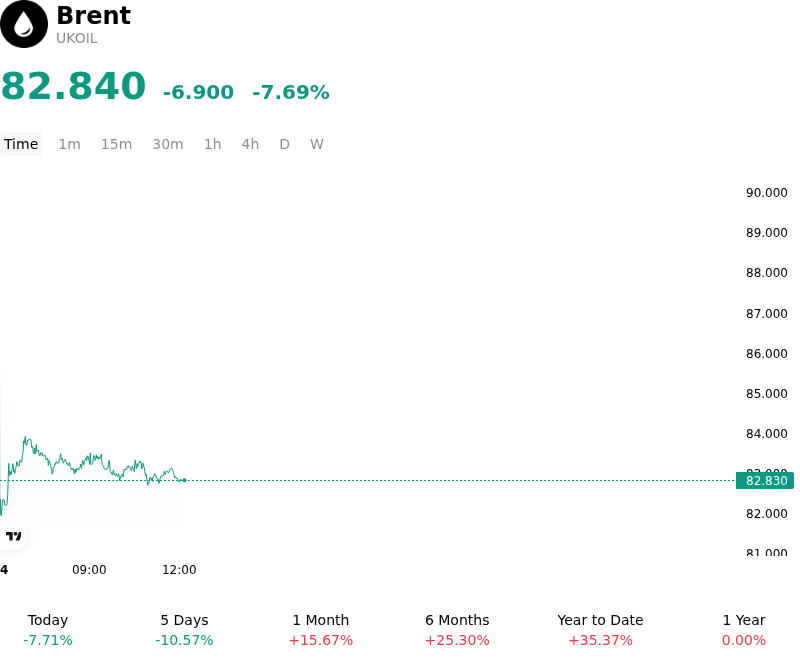
Brent (UKOIL) is down 7.69% at Aug 3 00:10(ET), now at $82.84, with a 7-day down of 2.66%.
What is driving Brent (UKOIL)’s stock price down today?
The sharp decline in Brent crude is primarily driven by a perceived shift in the OPEC+ production strategy, as market participants react to indications that the alliance may be pivoting away from strict price support in favor of defending market share. Reports suggesting an accelerated timeline for unwinding voluntary production cuts have fundamentally altered global supply expectations for the remainder of the year. This potential influx of additional barrels into a market already struggling with lackluster fundamentals has triggered a rapid liquidation of long positions and a significant adjustment in the forward curve.
Simultaneously, deteriorating demand signals from the world’s two largest oil consumers have exacerbated the downward pressure. Subdued manufacturing data and cooling industrial activity in China have heightened concerns regarding a structural slowdown in crude imports, which have historically been the primary engine of global demand growth. In the United States, recent macroeconomic indicators pointing toward a softening labor market and weaker-than-expected fuel consumption during the peak summer driving season have led institutional investors to revise their global demand forecasts downward, suggesting the market is entering a period of sustained surplus.
The magnitude of the intraday volatility was further amplified by technical factors and the unwinding of geopolitical risk premiums. As prices breached critical psychological and moving-average support levels, systematic trend-following strategies and commodity trading advisors accelerated their selling activity to manage downside risk. Additionally, the lack of immediate escalations in key transit corridors has allowed the market to strip away the "war premium" that had previously supported prices, leaving the commodity exposed to its underlying bearish supply-demand balance.
Institutional capital flows currently reflect a flight from energy assets as real yields and a strengthening US dollar increase the cost of holding dollar-denominated commodities. Investors are now closely monitoring official inventory reports and refinery utilization rates for signs of physical market tightening that could provide a floor for prices. However, without a clear signal from major producers regarding a commitment to further output restraint or a meaningful rebound in global manufacturing activity, the outlook for Brent remains skewed to the downside as the market recalibrates for an oversupplied environment.
Technical Analysis of Brent (UKOIL)
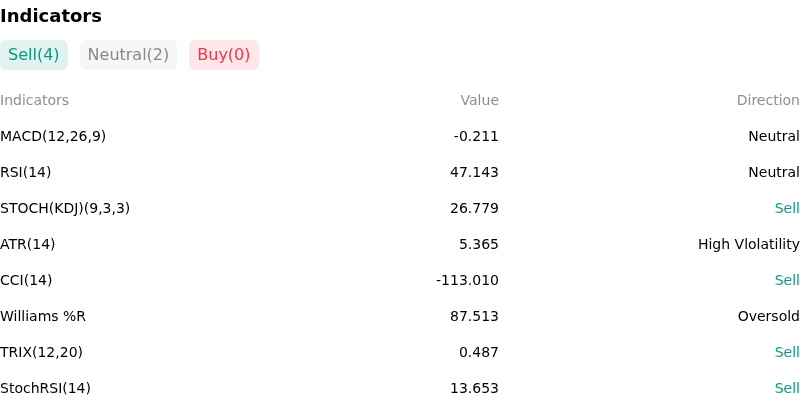
Technically, Brent (UKOIL) shows a MACD (12,26,9) value of -0.211, indicating a neutral signal. The RSI at 47.143 suggests neutral condition and the Williams %R at 87.513 suggests oversold condition. Please monitor closely.
More details about Brent (UKOIL)
Recent Events and Risks:
- China Industrial Demand Deterioration: Recent manufacturing PMI data showing a third consecutive month of contraction, paired with lower-than-expected refinery throughput rates, has intensified concerns that the world's largest importer is facing a structural slowdown in crude consumption.
- OPEC+ Production Policy Uncertainty: Market participants are expressing concern over the potential for an oversupplied market in Q4, as recent communications suggest OPEC+ may proceed with plans to gradually phase out 2.2 million bpd of voluntary production cuts despite Brent prices trading at the lower end of the year-to-date range.
- U.S. Economic Recession Fears: Disappointing employment and manufacturing data in the last 72 hours have triggered a broad macro risk-off sentiment, leading to significant long liquidation in oil futures as traders price in a reduction in global fuel demand due to a potential U.S. economic slowdown.
- Geopolitical Risk Premium Erosion: Increased diplomatic pressure and renewed ceasefire negotiations in the Middle East have led to a rapid unwinding of the geopolitical risk premium, as the immediate threat to physical supply flows from the Persian Gulf appears to have diminished in the near term.
This article may include AI-generated content that is human-reviewed, which is for reference and general information purposes only and does not constitute investment advice.
Recommended Articles









Comments (0)
Click the $ button, enter the symbol, and select to link a stock, ETF, or other ticker.