


USD/JPY (USDJPY) Is down 0.57% on Aug 2: What Signals Does the Macro Data Send?



USD/JPY (USDJPY) is down 0.57% at Aug 2 20:30(ET), now at $156.656, with a 7-day down of 4.32%.
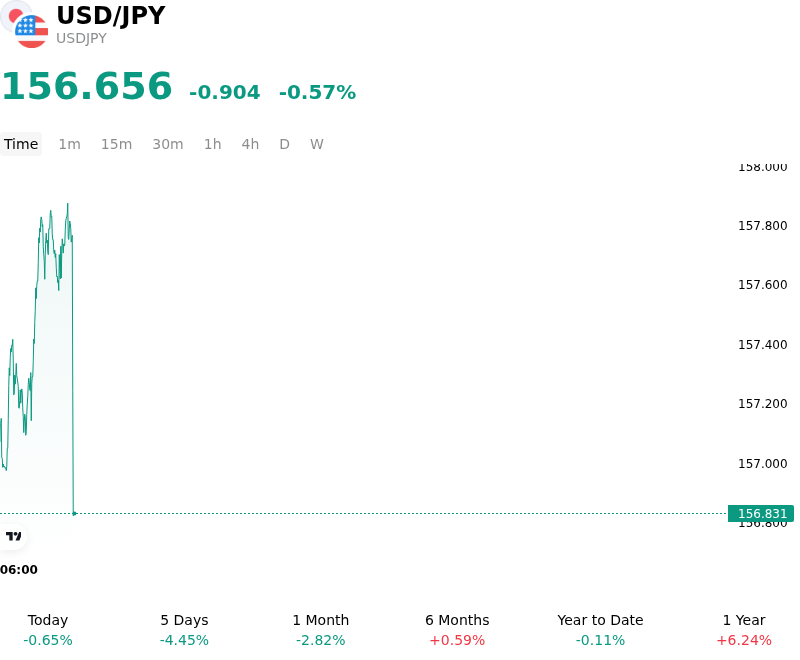
What is driving USD/JPY (USDJPY)’s stock price down today?
The downward pressure on USDJPY is primarily driven by a narrowing of the interest-rate differential between the Federal Reserve and the Bank of Japan, as market participants recalibrate their expectations for monetary policy convergence. Institutional investors are responding to a shift in the perceived path of the Bank of Japan, following weekend commentary that suggested Japanese policymakers are increasingly inclined to accelerate the normalization of interest rates. This hawkish lean has provided a significant tailwind for the Yen, which had previously been suppressed by the wide yield gap favoring the U.S. Dollar.
Simultaneously, the U.S. Dollar is experiencing broad-based weakness as recent macroeconomic data flows reinforce the narrative of a cooling labor market and moderating inflationary pressures in the United States. The decline in front-end U.S. Treasury yields reflects a growing consensus that the Federal Reserve has reached the end of its restrictive cycle and may soon pivot toward a more accommodative stance to support economic growth. As the yield advantage of the dollar diminishes, the incentive for carry-trade positions is reduced, prompting a liquidation of long-dollar exposures against the Yen.
Risk sentiment has also transitioned toward a more defensive posture, providing additional support to the Yen in its capacity as a traditional safe-haven asset. Heightened volatility in global equity markets and uncertainty regarding regional geopolitical developments have triggered a flight to quality. In this environment, Japanese institutional investors often repatriate capital, further intensifying the demand for the Yen relative to the Dollar. The breach of key technical support levels during early-week trading has likely accelerated these flows, as algorithmic models and trend-following strategies align with the shift in macro fundamentals.
Looking forward, the pair remains highly sensitive to the divergence in terminal rate expectations between the two central banks. While the Federal Reserve appears to be navigating a soft landing, any further evidence of U.S. economic deceleration will likely exert additional downward pressure on USDJPY. Conversely, the market remains attentive to the Bank of Japan’s communication regarding the timing of its next policy adjustment, as even marginal shifts in JGB yields can cause outsized movements in the currency pair due to the concentration of short-Yen positioning in the institutional space.
Technical Analysis of USD/JPY (USDJPY)
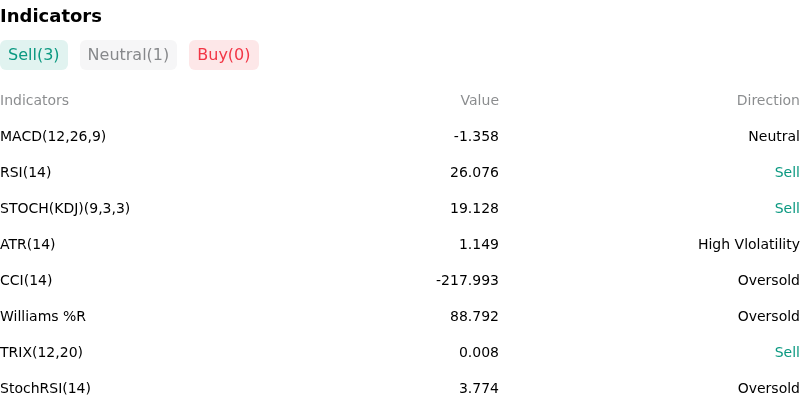
Technically, USD/JPY (USDJPY) shows a MACD (12,26,9) value of -1.358, indicating a neutral signal. The RSI at 26.076 suggests sell condition and the Williams %R at 88.792 suggests oversold condition. Please monitor closely.
More details about USD/JPY (USDJPY)
Recent Events and Risks:
- Hawkish FOMC Minutes and Policy Divergence: The release of the latest FOMC minutes revealed that several Federal Reserve officials are open to further interest rate hikes if inflation remains sticky. This hawkish surprise has maintained upward pressure on U.S. yields, but it significantly elevates the risk of a sharp USDJPY reversal should upcoming U.S. economic data show any signs of cooling, triggering a massive unwind of long-USD positions.
- JGB Yield Breakout and Quantitative Tightening Fears: The 10-year Japanese Government Bond (JGB) yield has recently hit a decade-high of 1.0%, fueled by market speculation that the Bank of Japan will announce a formal plan to reduce its monthly bond purchases. This shift toward quantitative tightening creates immediate volatility as traders reprice the narrowing yield spread between the U.S. and Japan, traditionally a major driver for the pair.
- Heightened Ministry of Finance Intervention Risk: With USDJPY trading near multi-decade highs, Japanese authorities have intensified their verbal warnings, indicating that they are monitoring currency moves with "a high sense of urgency." The risk of direct physical intervention by the Ministry of Finance remains extreme, particularly during thin liquidity windows, which could result in a sudden 200-400 pip decline to flush out carry trade speculators.
- Structural Trade Deficit Volatility: Recent Japanese trade data highlighted a persistent deficit exacerbated by high energy import costs and the weak yen. Institutional strategists are concerned that this structural vulnerability leaves the JPY exposed to any near-term spikes in global commodity prices, which would worsen Japan's terms of trade and potentially force the BoJ into an unplanned, hawkish policy adjustment to stabilize the currency.
This article may include AI-generated content that is human-reviewed, which is for reference and general information purposes only and does not constitute investment advice.
Recommended Articles









Comments (0)
Click the $ button, enter the symbol, and select to link a stock, ETF, or other ticker.