


AUD/USD (AUDUSD) Volatility Intensified on Jul 30: Factors to Watch



AUD/USD (AUDUSD) is up 0.73% at Jul 30 09:45(ET), now at $0.70043, with a 7-day up of 0.53%.
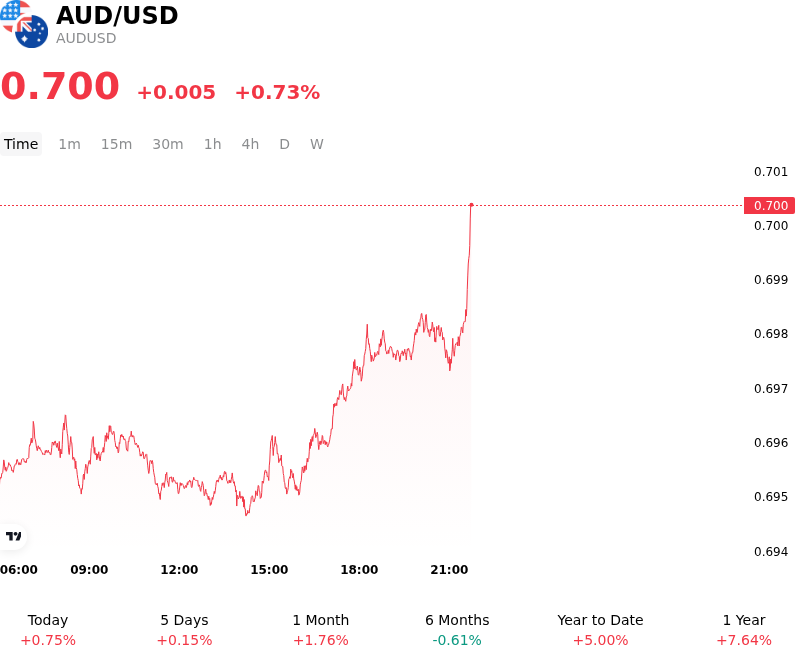
What is driving AUD/USD (AUDUSD)’s stock price up today?
The appreciation of the Australian dollar against the U.S. dollar is primarily driven by a widening interest-rate differential as market participants repriced the trajectory of the Reserve Bank of Australia (RBA) relative to the Federal Reserve. The primary catalyst for this move stems from the latest quarterly inflation data out of Australia, which revealed that underlying price pressures, particularly within the services sector, remain uncomfortably high. This sticky inflation print has effectively priced out near-term easing expectations for the RBA, with institutional investors now contemplating the necessity of a prolonged restrictive stance to anchor inflation expectations.
Conversely, the U.S. dollar has faced downward pressure following the conclusion of the latest Federal Open Market Committee meeting and recent cooling in domestic labor market indicators. The Fed’s shift toward a more balanced tone, acknowledging the steady progress toward their inflation target, has led to a compression in U.S. Treasury yields. As the spread between Australian Commonwealth Government Bonds and U.S. Treasuries narrows, capital flows have rotated into the Australian dollar, seeking to capture the yield advantage as the Fed nears a policy pivot while the RBA remains in a hawkish holding pattern.
Macroeconomic sentiment in the Asia-Pacific region has further supported the move. Improved industrial activity data and recent fiscal support measures from China have bolstered the outlook for Australia’s key commodity exports, notably iron ore and base metals. The resulting lift in the terms of trade provides fundamental support for the Australian dollar, acting as a tailwind alongside the hawkish domestic monetary policy outlook. This combination of commodity-driven support and a resilient domestic economy makes the Aussie a preferred vehicle for pro-cyclical exposure in the current environment.
From a technical and positioning standpoint, the move was exacerbated by the liquidation of short positions as the pair breached key psychological resistance levels. With the U.S. dollar broadly softer against G10 peers due to deteriorating interest-rate support, the Australian dollar has outperformed as a high-beta beneficiary of the shift in global risk sentiment. Investors are now focused on upcoming U.S. employment data and RBA policy communications to determine if this momentum signals a structural trend change or a tactical response to the recent divergence in central bank rhetoric.
Technical Analysis of AUD/USD (AUDUSD)
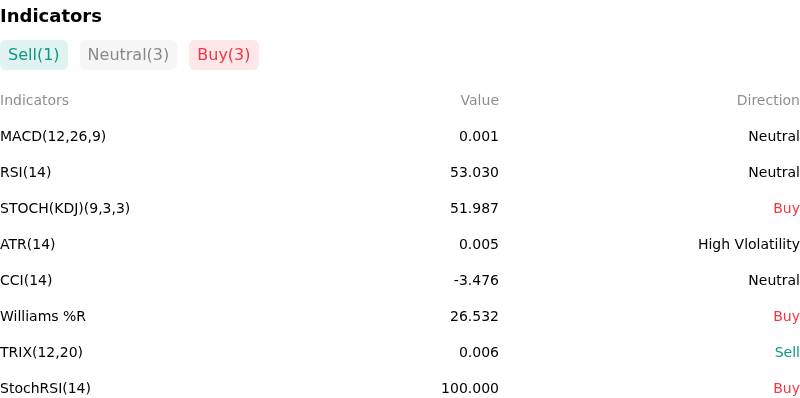
Technically, AUD/USD (AUDUSD) shows a MACD (12,26,9) value of 0.001, indicating a neutral signal. The RSI at 51.934 suggests neutral condition and the Williams %R at 32.312 suggests buy condition. Please monitor closely.
More details about AUD/USD (AUDUSD)
Recent Events and Risks:
- Chinese Economic Softness: Persistent weakness in Chinese manufacturing PMIs and ongoing deflationary pressures in the property sector continue to suppress demand for Australian iron ore and coal, directly undermining the AUD's status as a high-beta proxy for Chinese growth.
- Diverging Monetary Policy Expectations: Recent sticky U.S. inflation data and hawkish commentary from Federal Reserve officials have pushed back expectations for USD rate cuts, while signs of a cooling Australian labor market have led traders to price in a more dovish path for the Reserve Bank of Australia (RBA), narrowing the yield spread.
- Commodity Price Correction: A sharp intraday decline in global iron ore and base metal prices, driven by high port inventories and lackluster global industrial demand, has weakened Australia’s terms of trade and triggered technical sell-offs in the AUDUSD pair.
- Geopolitical Risk Aversion: Escalating tensions in the Middle East and uncertainty surrounding global trade tariffs have prompted a "risk-off" environment, leading institutional investors to exit pro-cyclical carry trades and seek liquidity in the safe-haven US Dollar.
This article may include AI-generated content that is human-reviewed, which is for reference and general information purposes only and does not constitute investment advice.
Recommended Articles







Comments (0)
Click the $ button, enter the symbol, and select to link a stock, ETF, or other ticker.