


Banco Santander SA Stock (SAN) Moved Down by 3.47% on Jul 29: Drivers Behind the Movement



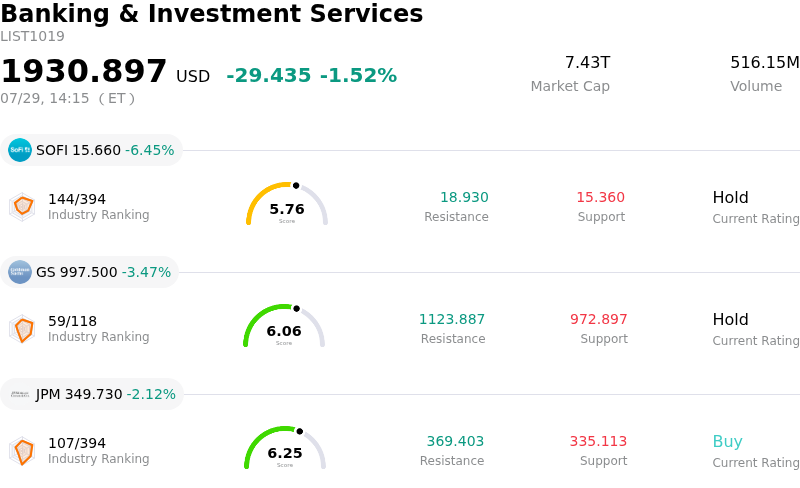
Banco Santander SA (SAN) moved down by 3.47%. The Banking & Investment Services sector is down by 1.52%. The company underperformed the industry. Top 3 stocks by turnover in the sector: SoFi Technologies Inc (SOFI) down 7.02%; Goldman Sachs Group Inc (GS) down 3.54%; JPMorgan Chase & Co (JPM) down 2.25%.
What is driving Banco Santander SA (SAN)’s stock price down today?
Banco Santander is experiencing downward pressure today, driven primarily by a combination of macroeconomic headwinds and sector-specific concerns regarding credit quality. The broader financial landscape is currently navigating a pivot in central bank policy, where the anticipation of sustained high interest rates is being replaced by fears of an economic slowdown. For a diversified global lender like Santander, this transition creates a challenging environment for net interest margin growth, especially as funding costs remain elevated while loan demand softens across key European markets.
The intraday volatility seen in the stock reflects investor anxiety over the bank's exposure to emerging markets, particularly in Latin America. Recent economic data from these regions suggest a cooling trend, which has heightened concerns about potential increases in loan loss provisions. Institutional investors appear to be de-risking their portfolios in response to these uncertainties, leading to a noticeable sell-off during the trading session. The market is sensitive to any indication that credit cycles are peaking, and Santander's significant footprint in developing economies makes it more susceptible to these shifts than its purely domestic peers.
Furthermore, the regulatory environment in the European Union continues to weigh on investor sentiment. Discussions surrounding stricter capital requirements and the potential for windfall taxes on banking profits in certain jurisdictions have created a cloud of uncertainty. While the bank has maintained a robust capital position, the prospect of tighter margins and limited room for aggressive share buybacks or dividend increases is discouraging bulls. The current price action suggests that market participants are repricing the stock to account for a more conservative earnings outlook in the coming quarters.
From a technical perspective, the breach of recent support levels has triggered automated selling programs, exacerbating the downward movement. The heightened volatility is also a byproduct of broader market sentiment, as recent inflation prints and employment data have led to a rotation out of value-oriented financial stocks into defensive sectors. Until there is more clarity on the trajectory of interest rates and the stability of the global credit environment, Santander is likely to remain under pressure as investors prioritize safety over the higher-beta exposure offered by international banking giants.
Technical Analysis of Banco Santander SA (SAN)
Technically, Banco Santander SA (SAN) shows a MACD (12,26,9) value of -0.053, indicating a neutral signal. The RSI at 57.720 suggests neutral condition and the Williams %R at 11.702 suggests overbought condition. Please monitor closely.
Fundamental Analysis of Banco Santander SA (SAN)
Banco Santander SA (SAN) is in the Banking & Investment Services industry. Its latest annual revenue is $65.95B, ranking 5 in the industry. The net profit is $15.90B, ranking 5 in the industry. Company Profile
Over the past month, multiple analysts have rated the company as Buy, with an average price target of $14.71, a high of $15.60, and a low of $13.82.
More details about Banco Santander SA (SAN)
Company Specific Risks:
- UK Motor Finance Regulatory Exposure: The ongoing Financial Conduct Authority (FCA) investigation into historical motor finance commission arrangements remains a primary downside driver, as analysts project significant industry-wide compensation payouts that could necessitate substantial new litigation provisions for the bank’s UK operations.
- Net Interest Margin (NIM) Compression: Following recent signals of a monetary policy pivot by the European Central Bank, institutional analysts have highlighted an immediate risk of narrowing net interest margins in the core Spanish market, as the benefit of higher interest rates on loan re-pricing begins to fade while deposit costs remain elevated.
- Credit Quality Weakness in US Auto Lending: Intraday volatility has been exacerbated by concerns over rising delinquency rates and higher-than-anticipated net charge-offs in the bank’s US consumer finance division, specifically targeting the subprime auto loan portfolio amidst a cooling labor market.
- Emerging Market FX and Macro Volatility: Significant exposure to the Brazilian and Mexican markets leaves the bank vulnerable to currency devaluation and political instability in Latin America, which threatens to erode consolidated earnings through unfavorable foreign exchange translation and increased cost of risk in these high-growth regions.
This article may include AI-generated content that is human-reviewed, which is for reference and general information purposes only and does not constitute investment advice.
Recommended Articles









Comments (0)
Click the $ button, enter the symbol, and select to link a stock, ETF, or other ticker.