


Ethereum (ETHUSD) Is down 1.34% on Jul 29: What Are the Risk Factors?



Ethereum (ETHUSD) is down 1.34% at Jul 29 00:00(ET), now at $1890.41, with a 7-day down of 1.76%.
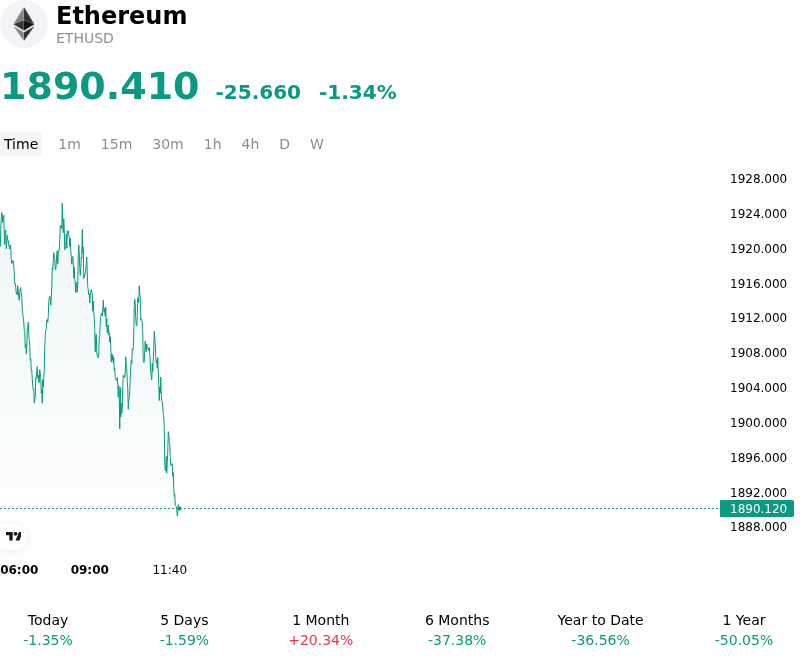
What is driving Ethereum (ETHUSD)’s stock price down today?
The downward pressure on Ethereum reflects a tightening of global liquidity and a recalibration of risk premiums within the digital asset space. A primary driver of this intraday weakness is the softening of net inflows into spot Ethereum ETFs, suggesting that institutional demand is currently sidelined as participants await clearer signals from the Federal Reserve regarding the terminal rate for the current cycle. This lack of aggressive dip-buying has allowed localized sell-side pressure to dictate price action, particularly as the US Dollar exhibits renewed strength against a basket of G10 currencies.
Rising Treasury yields have also contributed to the negative sentiment, as higher risk-free rates diminish the relative attractiveness of digital assets. For Ethereum specifically, the market is closely monitoring the interplay between staking yields and traditional fixed-income returns. As the spread narrows, institutional allocators may be rotating capital back into sovereign debt, leading to a reduction in spot exposure. This rotation is further compounded by a shift in on-chain fundamentals, where increased Layer-2 scaling efficiency has led to lower mainnet transaction fees, subsequently reducing the daily burn rate and easing the deflationary pressure on the ETH supply.
From a derivatives perspective, the intraday volatility was exacerbated by a modest flush-out of leveraged long positions. Market data indicates that open interest had become concentrated near recent resistance levels, and the failure to reclaim those highs triggered automated sell orders and liquidations. This technical weakness, combined with a period of stagnant stablecoin minting, points to a temporary exhaustion of buy-side liquidity. While the long-term narrative surrounding Ethereum’s role as a foundational settlement layer remains intact, current market conditions are defined by tactical de-risking and a preference for cash preservation.
Regulatory considerations continue to play a role in shaping investor appetite. Recent discourse surrounding the decentralized nature of Layer-2 sequencers and the potential for increased oversight of decentralized finance protocols has introduced a layer of uncertainty. Institutional investors are demonstrating increased sensitivity to these developments, often opting to reduce exposure ahead of potential regulatory milestones or macroeconomic data releases. Consequently, the current price action should be viewed as a reflection of cautious positioning within a macro environment characterized by persistent inflation concerns and a strengthening dollar.
Technical Analysis of Ethereum (ETHUSD)
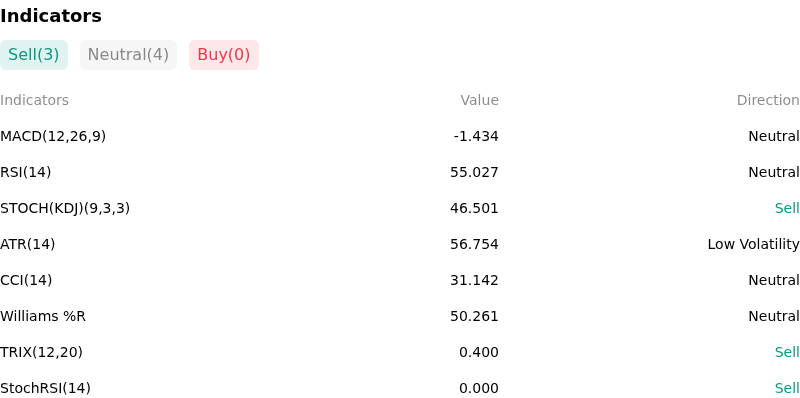
Technically, Ethereum (ETHUSD) shows a MACD (12,26,9) value of -1.217, indicating a neutral signal. The RSI at 55.241 suggests neutral condition and the Williams %R at 49.306 suggests neutral condition. Please monitor closely.
More details about Ethereum (ETHUSD)
Recent Events and Risks:
- Spot ETF Outflow Uncertainty: Market participants are increasingly concerned that the potential conversion of the Grayscale Ethereum Trust (ETHE) into a Spot ETF will trigger massive capital outflows similar to those experienced by the Bitcoin Trust, creating sustained selling pressure as long-term holders exit.
- Regulatory Staking Ambiguity: While preliminary ETF filings have been approved, the SEC has not clarified the legal status of Ethereum staking, leaving institutional "staking-as-a-service" providers under threat of enforcement actions and creating a legal cloud over Ethereum's yield-bearing characteristics.
- Whale Profit-Taking Activity: On-chain monitoring has detected significant transfers of ETH from large-scale "whale" wallets to centralized exchanges over the last 48 hours, signaling an increased appetite for profit-taking at current resistance levels and a potential exhaustion of local buy-side liquidity.
- Derivative Leverage and Liquidation Risks: Elevated funding rates across major derivatives exchanges suggest a highly leveraged market skewed toward long positions; any failure to maintain upward momentum risks a "long squeeze" and a rapid liquidation cascade, which could exacerbate intraday price volatility.
This article may include AI-generated content that is human-reviewed, which is for reference and general information purposes only and does not constitute investment advice.
Recommended Articles









Comments (0)
Click the $ button, enter the symbol, and select to link a stock, ETF, or other ticker.