


NZD/USD (NZDUSD) Is up 0.52% on Jul 21: What Signals Does the Macro Data Send?



NZD/USD (NZDUSD) is up 0.52% at Jul 21 01:10(ET), now at $0.58656, with a 7-day up of 0.95%.
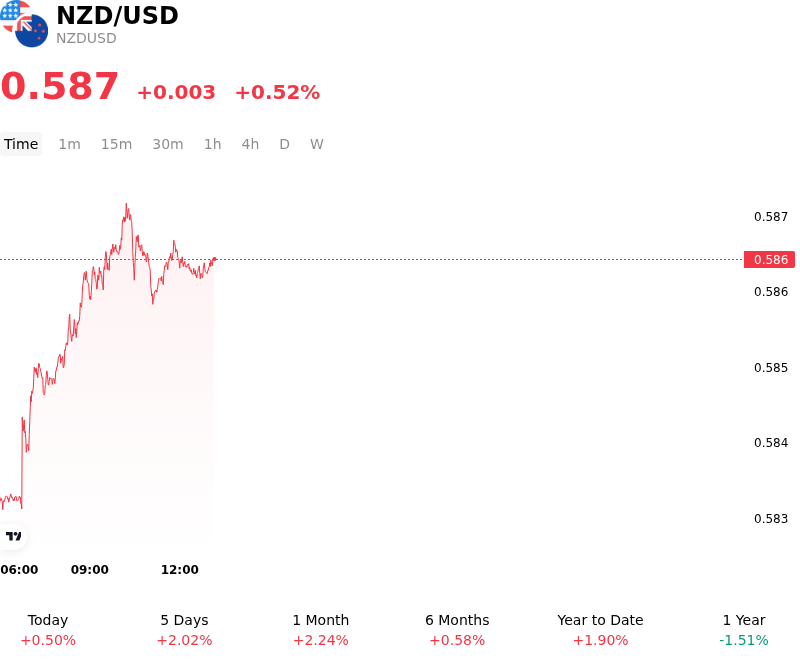
What is driving NZD/USD (NZDUSD)’s stock price up today?
The appreciation of the New Zealand dollar against the U.S. dollar is primarily driven by a repricing of the Reserve Bank of New Zealand's interest rate trajectory following an upside surprise in domestic underlying inflation. Market participants are increasingly betting that the RBNZ will maintain a restrictive policy stance for longer than previously anticipated, especially as non-tradable inflation components remain stubborn. This stands in contrast to the cooling labor market conditions observed in the United States, which have reinforced expectations that the Federal Reserve has concluded its tightening cycle and may soon pivot toward a more neutral policy setting to support growth.
Real interest rate differentials have shifted in favor of the Kiwi as New Zealand government bond yields outperformed their U.S. counterparts during the session. While U.S. Treasury yields faced downward pressure from underwhelming regional manufacturing data and a slight softening in consumer inflation expectations, New Zealand swap rates climbed as traders unwound bets on near-term rate cuts. This divergence in yield momentum has attracted carry-seeking capital into the NZD, particularly as the spread between the RBNZ’s official cash rate and the Fed’s target rate remains wide enough to favor the higher-yielding currency in a stabilizing volatility environment.
Global risk sentiment has also provided a significant tailwind for the pair. A recovery in regional equity markets and positive signals regarding industrial demand in East Asia have bolstered the outlook for New Zealand’s primary commodity exports. As a high-beta currency, the NZD often serves as a liquid proxy for global growth and trade activity. The stabilization in dairy auction prices and broader agricultural commodities has further supported New Zealand’s terms-of-trade, encouraging institutional investors to rotate out of the defensive U.S. dollar and into pro-cyclical assets.
While the current move is supported by fundamental data, the pair’s trajectory is also influenced by institutional positioning. The breach of key technical resistance levels has triggered a wave of short-covering from systematic trend-followers who had previously positioned for a more resilient U.S. dollar. For this upward momentum to evolve into a sustained trend, markets will require continued evidence that U.S. disinflation is accelerating alongside a hawkish commitment from RBNZ officials. Investors remain focused on upcoming global manufacturing surveys to gauge whether the relative economic outperformance of the Asia-Pacific region can be maintained.
Technical Analysis of NZD/USD (NZDUSD)
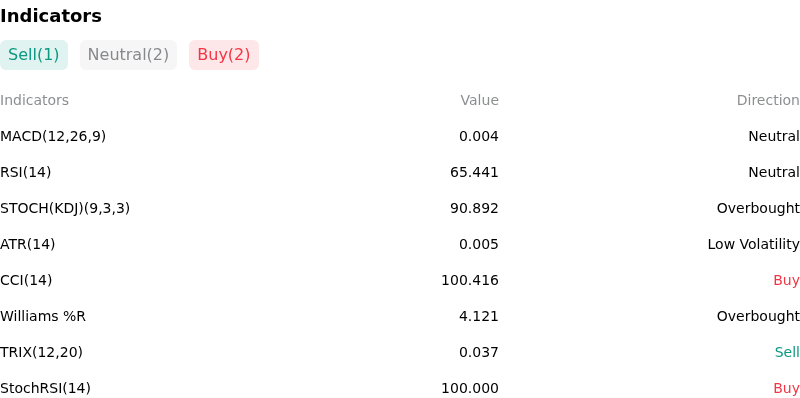
Technically, NZD/USD (NZDUSD) shows a MACD (12,26,9) value of 0.004, indicating a neutral signal. The RSI at 65.441 suggests neutral condition and the Williams %R at 4.121 suggests overbought condition. Please monitor closely.
More details about NZD/USD (NZDUSD)
Recent Events and Risks:
- Dovish RBNZ Policy Shift: Growing market consensus for an aggressive 50-basis point interest rate cut by the Reserve Bank of New Zealand in the final quarter of the year, driven by rapidly cooling domestic inflation and a stagnating labor market, continues to exert downward pressure on the kiwi dollar.
- China Economic Growth Concerns: Persistent weakness in Chinese retail sales and property sector data has dampened the outlook for New Zealand’s primary export destination, triggering proxy-selling of the NZD as investors hedge against a broader slowdown in the Asia-Pacific region.
- US Yield Resurgence: Robust US economic data, including resilient retail sales and sticky core inflation prints over the last 72 hours, has led to a hawkish repricing of Federal Reserve expectations, widening the yield spread in favor of the USD and accelerating capital outflows from high-beta currencies.
- Heightened Risk Aversion: Escalating geopolitical tensions in the Middle East and uncertainty surrounding global trade policy have fueled a flight-to-safety, disproportionately impacting the NZD/USD pair due to its high sensitivity to global equity sentiment and commodity price volatility.
This article may include AI-generated content that is human-reviewed, which is for reference and general information purposes only and does not constitute investment advice.
Recommended Articles









Comments (0)
Click the $ button, enter the symbol, and select to link a stock, ETF, or other ticker.